
Love Letters of a Violinist, and Other Poems
Eric Mackay
THE CLASSIC COLLECTION · 1822
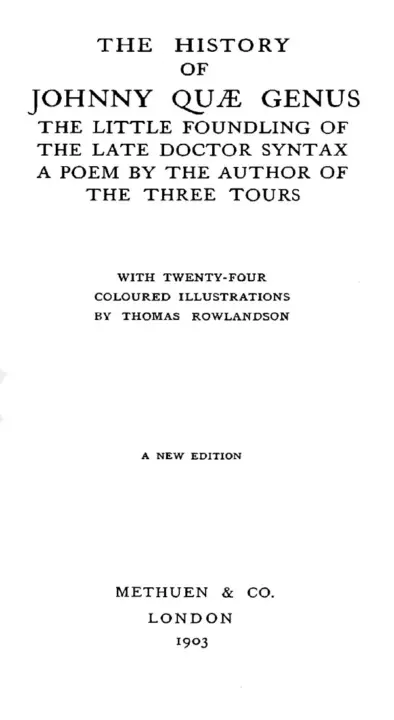
"The History of Johnny Quæ Genus, the Little Foundling of the Late Doctor Syntax" is a poem written in the early 19th century. It follows the titular character, Johnny Quæ Genus, a foundling with a unique name and a troubled past, navigating through a world filled with challenges and misfortunes following the death of his benefactor, Doctor Syntax. The book serves as a narrative that explores themes of identity, fate, and the struggles of life. The beginning of the poem introduces Johnny Quæ Genus, reflecting on the peculiar nature of his name, which was given to him by Doctor Syntax. It highlights his early life marked by the love and care of Mrs. Syntax, who raises him until her own demise. Following her death, Johnny finds himself lost in a harsh world where he faces deceit and hardship. He eventually decides to seek employment in London to uphold his newfound independence. The narrative sets the stage for his adventures and misadventures while establishing a whimsical yet poignant tone that intertwines humor with the trials of the protagonist.
Introduction adapted from the source catalogue; source summaries may be automatically generated.
Free to read · English · 55,270 words · No account needed
MAKE TIME FOR A GOOD BOOK
On by default. Untick to stop anonymous reading totals. Each page counts after 10 seconds in view. How this works.
Anonymous counting is on unless you have switched it off.
"My genteel folk I have declin'd,
At least, the sort which I could find;
And just as much dispos'd to sneeze
At all my Rural Deities:
But still I've got a heap of Cash,
And, while it lasts, will make a Dash!
But here one firm resolve I make,--
I never will my Elbow shake;
And if I take care not to play, }
I shall get something for my pay: }
It will not all be thrown away! }
Who knows what CUPID, too, may do?
For I may win if I should woo;
And e'en, in spite of this same Hump,
Fortune may turn me up a trump.
--My standard now shall be unfurl'd,
And I will rush into the world:
Nay, when I have the world enjoy'd,
With emptied purse and spirits cloy'd,
I then can trip it o'er the main:
VALCOUR will take me back again;
Once more his humble friend receive,
With all the welcome he can give:
We know not what from ill may screen us,
And I, once more, shall be QUÆ GENUS."
--He spoke, and seem'd to close his plan
Of keeping up the Gentleman.
The Sun had sunk beneath the west,
To go to bed and take his rest,
As Poets feign, in THETIS lap,
Where he ne'er fails to have a nap;
When, with his second bottle rallied,
Our Hero rose, and out he sallied
In search of any lively fun,
That he, perchance, might hit upon.
--As through a court he chanc'd to pass,
He saw a gay, well-figur'd lass,
Who, in her floating fripp'ry shone,
With all the trim of fashion on.
She had descended from a coach,
And did a certain door approach,
With tripping step and eager haste,
When soon th' illumin'd arch she pass'd:
And still he saw, in height of feather,
Small parties enter there together,
While jovial gentlemen appear'd,
Who, as they came, each other cheer'd.
--He asked, where these fine Ladies went?
The watchman said,--"For merriment;
And should a little dancing fit you,
A crown, your honour, will admit you."
--The 'Squire then rapp'd, the door was op'd,
He gave his coin, and in he popp'd:
The music sounded in the hall,
And smiling faces grac'd the ball,
Where, as he lov'd a merry trip
With some gay Miss he chose to skip,
But as they Waltz'd it round in pairs
A noise was heard upon the stairs,
And strait a magistrate appear'd
With solemn aspect; while, uprear'd,
Official staves in order stand,
To wait the laws' so rude command.
--Sad hurry and confusion wait
On this their unexpected state;
When there broke forth, as it might seem,
From snow-white throats, a fearful scream;
Nor, to add horror, was there wanting
Some strong appearances of fainting:
But Justice, with its iron brow
Unfeeling scowl'd on all the show.
In shriller tones the ladies cried,
In diff'rent key the beaux replied,
Though some consoling bev'rage quaff,
Give a smart twirl, nor fear to laugh:
While coarser voices,--"hold your tongue,
Pack up your alls and come along."
Then, of fair culprits full a score,
And of their dancing partners more,
Beneath stern power's relentless rod,
Were rang'd, and order'd off to QUOD.
They march'd away in long procession
To take the fruits of their transgression:--
Staffmen did at their head appear,
And watchmen lighted up the rear.
Our Hero felt the ridicule
Of having idly play'd the fool,
And, as he handed on his Belle,
He could not but compare the smell
That rotten root and trodden leaf
Do to th' offended senses give
Of those who, by the lamp's pale light,
Through Covent-Garden stroll at night,
With all the garlands which he weav'd
Ere Molly's letter was receiv'd:
And all the fragrance of the flowers
He thought to cull in Molly's bowers;
Nay, which, but the preceding morning,
His promis'd hopes had been adorning.
It was indeed a noisome change,
O it was strange, 'twas passing strange!
But still the watch-house made amends,
Such as they were, they gave him friends.
Which here, I'm not suppos'd to think
Were such as save from ruin's brink;
But lively sprites who have a taste
To hurry on the stream to waste.
Thus, when the welcome morn was come,
And Justice sent the party home;
He and two blades of certain feather
Propos'd to pass the day together:
The one, more grave, declar'd his breed,
Famous on t'other side the Tweed,
The other lively, brisk and airy,
Boasted his birth in Tipperary;
Though whether this were truly so,
'Tis from their words alone we know:
But they were easy, free and jolly,
Decided foes to melancholy,
And seem'd well-form'd to aid a day
In passing pleasantly away.
--But first the TRIO thought it best
To snatch some hours' refreshing rest,
When, as it was in Summer's pride, }
They pass'd their jovial hours beside }
The crystal Thames imperial tide; }
And as the river roll'd along,
Made the banks echo with their song.
--At length it was a rival jest
Who of the three could sing the best.
--The sturdy Scot the song began,
And thus th' harmonious contest ran.
Your reading position is saved on this browser. Take it to another device with a library code. Reading pages adapt to text, rather than matching a printed edition.
BEHIND THE BOOK
This eBook is for the use of anyone anywhere in the United States and most other parts of the world at no cost and with almost no restrictions whatsoever. You may copy it, give it away or re-use it under the terms of the Project Gutenberg License included with this eBook or online at www.gutenberg.org. If you are not located in the United States, you will have to check the laws of the country where you are located before using this eBook. Read the source licence.
The original source file, including credits and licence, is retained by this library. Request an original-format copy at no charge. Please include the book title and Project Gutenberg identifier #42299.
KEEP YOUR CURIOSITY GOING
Eric Mackay
Edmund Gosse
Sophia Margaretta Hensley
Gilbert Parker
George MacDonald

Elizabeth Bibesco