
Love Letters of a Violinist, and Other Poems
Eric Mackay
THE CLASSIC COLLECTION · 1822
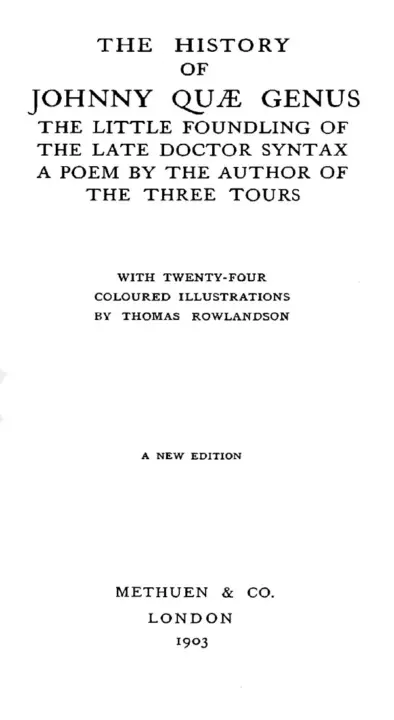
"The History of Johnny Quæ Genus, the Little Foundling of the Late Doctor Syntax" is a poem written in the early 19th century. It follows the titular character, Johnny Quæ Genus, a foundling with a unique name and a troubled past, navigating through a world filled with challenges and misfortunes following the death of his benefactor, Doctor Syntax. The book serves as a narrative that explores themes of identity, fate, and the struggles of life. The beginning of the poem introduces Johnny Quæ Genus, reflecting on the peculiar nature of his name, which was given to him by Doctor Syntax. It highlights his early life marked by the love and care of Mrs. Syntax, who raises him until her own demise. Following her death, Johnny finds himself lost in a harsh world where he faces deceit and hardship. He eventually decides to seek employment in London to uphold his newfound independence. The narrative sets the stage for his adventures and misadventures while establishing a whimsical yet poignant tone that intertwines humor with the trials of the protagonist.
Introduction adapted from the source catalogue; source summaries may be automatically generated.
Free to read · English · 55,270 words · No account needed
MAKE TIME FOR A GOOD BOOK
On by default. Untick to stop anonymous reading totals. Each page counts after 10 seconds in view. How this works.
Anonymous counting is on unless you have switched it off.
'Squire Free-born soon began to feel
A relaxation in his zeal
To push away that class among
Who did his evening parties throng,
From whom no fair return was made,
And mod'rate fashion was display'd.
Manners were ap'd, but in a way
That did vulgarity betray;
And the best show that he might see,
Was dash of awkward finery:--
Besides, a rude and rough event
Gave spirit to his discontent.
--He call'd, one day, where, on admission,
The parties were in sad condition;
It was a scene of mutual flame,
'Tween Start-up and his lovely dame.
He was a clerk on public duty,
And she a most conceited beauty:
When, as he enter'd, her sharp tongue
Began in tones both harsh and strong,--
"Pray, FREE-BORN, do you think it breeding,
That he should thus be always reading?
When he does from his office come
'Tis thus he sits hum-drum at home,
As if he thought so low my wit
I'm not for conversation fit;
Nor does he seem to rate me higher
Than to trace figures in the fire!"
--"Call you, hum-drum, that information
So suited to official station,"
He sternly said, "which now engages
Attention to these curious pages!"
--"My mind," she cried, "was in the dark
When I was married to a Clerk:--
O had I join'd a fool instead
Of one to office breeding bred!
He, who in honour should protect me,
You see, Sir, how he dares neglect me!"
--In terms polite to praise and blame,
Free-born now hop'd to quench the flame,
And therefore offer'd, nothing loth,
To give a little spice of both.
"Madam, by persons of discerning,
My friend is known for store of learning;
While you are bless'd with those rare charms,
A Prince might wish to fill his arms."
He gently smil'd and so did she,
At this same two-fold flattery,
Which, in a moment, seem'd to smother
The flames of anger 'gainst each other:
He therefore ventur'd to proceed,
But did not now so well succeed.
"You ask me to unfold my thought,
Which is with truth and friendship fraught.
We all well know, in life's great stake,
There's such a Rule as give and take;
A maxim, with your good in view,
I recommend to both of you.
On this, for peace, fix your reliance,
And learn to practise kind compliance.
If he is haughty, soothe his pride,
Nor with disdainful glances chide.
When you are angry, he must chase }
All frownings from that lovely face, }
With tender words and soft embrace. }
Both of you now are in the wrong,
He with his BOOK,--you with your TONGUE."
But, ere he could his speech conclude,
With scornful look and accents rude,
Again the furious Dame began:--
"What Impudence is in the Man!
Thus, 'gainst his betters, to let loose
His vulgar tongue in such abuse.
My husband to be thus belied,
Who is my love, my boast, my pride!"
When Start-up foam'd,--"You risk your life,
In treating thus my darling wife;
Who, I proclaim, as 'tis my duty,
Has charms superior to her beauty!"
Then each gave each a warm embrace,
And both star'd in poor Free-born's face,
The one as if he wish'd to beat him,
The other as if she could have eat him.
He then, as suiting her desire,
Threw the base volume in the fire,
When she----"Thus ends a petty fuss
Which may cross those who love like us;
Though I might wish it had not been
By such a saucy booby seen."
--Free-born, but not from sense of fear,
Now thought it best to disappear;
And as they rang the clam'rous bell,
He heard them both the servant tell--
"Discharg'd you shall be, if the door
Is open'd to that varlet more."
--Such vulgar threat the 'Squire amus'd,
For he no more would be refus'd
By those whose silly actions prove
That they could scold, and lie, and love:
But still he rather felt the wrongs
Which had proceeded from the tongues
Of those who had no fair pretence
At what he said to take offence:
A pretty way to make amends
For having treated them as friends;
In short, he thought it best to fly
His late acquir'd society:
Pert Lawyers and such busy men
As in some office wield the pen;
Who, when their daily labour's done,
Put their best coats and faces on;
Leave home, where tallow dimly lights 'em,
For wax, when some dull fool invites 'em,
The plenteous evening to prolong
In lively glee or tender song,
Or in some funny tale to shine,
And give a current to the wine.
There, too, their wives and sisters flow, }
Gay, scanty finery to show, }
In gawdy trim and furbelow; }
Who can, perhaps, the music play,
And scream the carol of the day;
Nay, work a waltz, while staring eyes
Proclaim their gentle ecstasies.
At length the shawls and wrappers come,
When in their hacks they trundle home.
--Though, after all, whate'er his aim,
Whate'er his fancy chose to claim,
'Twas not amiss;--this first degree
In what is call'd society,
Where step by step he must advance
To higher place in fashion's dance:
But with the folk, he 'gan to find,
Who din'd with him, he never din'd,
And got no more than casual tea
For what his guests thought luxury;
And, in a snug, familiar way,
For all they gave, they made him pay.
Besides, he sometimes felt offence,
At what he thought impertinence:
Such as they were, both great and small,
He cut acquaintance with them all.
His purse had thus indulg'd his whim,
But they ne'er heard again from him.
Your reading position is saved on this browser. Take it to another device with a library code. Reading pages adapt to text, rather than matching a printed edition.
BEHIND THE BOOK
This eBook is for the use of anyone anywhere in the United States and most other parts of the world at no cost and with almost no restrictions whatsoever. You may copy it, give it away or re-use it under the terms of the Project Gutenberg License included with this eBook or online at www.gutenberg.org. If you are not located in the United States, you will have to check the laws of the country where you are located before using this eBook. Read the source licence.
The original source file, including credits and licence, is retained by this library. Request an original-format copy at no charge. Please include the book title and Project Gutenberg identifier #42299.
KEEP YOUR CURIOSITY GOING
Eric Mackay
Edmund Gosse
Sophia Margaretta Hensley
Gilbert Parker
George MacDonald

Elizabeth Bibesco