
Love Letters of a Violinist, and Other Poems
Eric Mackay
THE CLASSIC COLLECTION · 1822
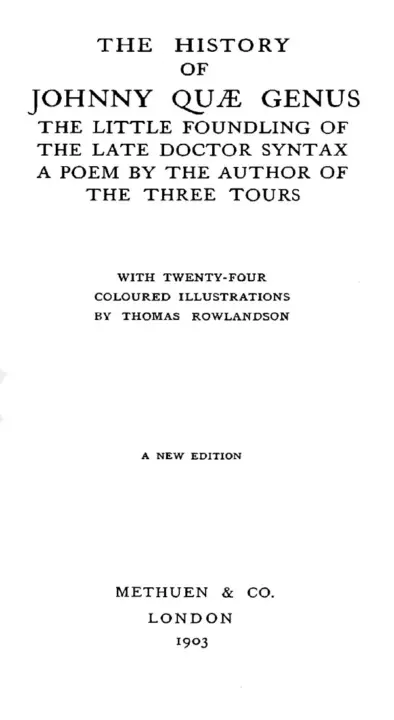
"The History of Johnny Quæ Genus, the Little Foundling of the Late Doctor Syntax" is a poem written in the early 19th century. It follows the titular character, Johnny Quæ Genus, a foundling with a unique name and a troubled past, navigating through a world filled with challenges and misfortunes following the death of his benefactor, Doctor Syntax. The book serves as a narrative that explores themes of identity, fate, and the struggles of life. The beginning of the poem introduces Johnny Quæ Genus, reflecting on the peculiar nature of his name, which was given to him by Doctor Syntax. It highlights his early life marked by the love and care of Mrs. Syntax, who raises him until her own demise. Following her death, Johnny finds himself lost in a harsh world where he faces deceit and hardship. He eventually decides to seek employment in London to uphold his newfound independence. The narrative sets the stage for his adventures and misadventures while establishing a whimsical yet poignant tone that intertwines humor with the trials of the protagonist.
Introduction adapted from the source catalogue; source summaries may be automatically generated.
Free to read · English · 55,270 words · No account needed
MAKE TIME FOR A GOOD BOOK
On by default. Untick to stop anonymous reading totals. Each page counts after 10 seconds in view. How this works.
Anonymous counting is on unless you have switched it off.
From all he did the Artist thought
He had a real treasure got;
Nor had QUÆ GENUS any cause
To grumble at domestic laws;
For all who serv'd them were content
With the well-rang'd establishment.
Above, was all that taste could show,
And ease and comfort reign'd below;
For CARMINE sought not cost to spare,
And splendid plenty revell'd there.
--O Discretion, what thy powers,
To watch o'er life's fantastic hours,
To check warm nature's glowing heat
When passions in the bosom beat,
And whim and fancy's busy train
Play their vagaries through the brain!
But that comptroller of the will,
That sober judge 'tween good and ill,
Or from his folly or his pride
QUÆ GENUS seem'd to throw aside.
This was the spot where he might stay, }
Where duty was improving play, }
Till hope should paint the wish'd-for way. }
But whimsies did his wits employ
The play-game of an idle boy,
For which if, at his earliest school,
Thus he had dared to play the fool,
He would have felt the smarting fate
That does on thoughtless culprit wait.
--The easy, morning duties done,
The after-day was all his own,
When, as it surely may be thought
He might have some improvement sought:
But no, his genius seem'd to chuse
His luckless leisure to amuse,
In changing, when brimfull of glee,
The system of the Gallery;
Would make the pictures change their places,
And with his chalk deform their faces,
(For, from a boy, whate'er he saw,
With a rude outline, he could draw,)
Turn down the portraits in their frames,
And look and laugh and call them names.
Though if no other harm were done,
Unknown he might have had his fun:
But hence the mischief did ensue,
The names he call'd were written too:
In short, he turn'd the painter's school
Completely into ridicule,
And, by a TITLE or a SCROLL,
He strove to stigmatize the whole.
--He would a Lawn-rob'd Prelate place
As if he ogled Cælia's face,
Exclaiming "There's no greater bliss,
No, not in Heaven, than Cælia's Kiss;"
While Cælia might be made to say
"Hands off, my pious Lord, I pray!
Remember what you ought to feel--
The good book says you must not steal;
And steal you will, if you receive it,
For hang me, FUSTY, if I give it."
--He then, perhaps, would run his rig,
With Cap and Bells on Judge's Wig;
When thus his fancy might indite,
And in a well turn'd label write,--
"Now should MY LORD be in a fury,
And shake that WIG, he'd fright the JURY."
--The portrait of an AGED DAME
Might have this added to her name,--
"Your Crutch-stick tells you scarce can walk,
But still you bore all ears with talk;
A most incorrigible Hag,
Who nothing but your TONGUE can wag."
--A MARRIED PAIR together plac'd,
And with their household emblems grac'd,
Though looking in each other's faces,
He would remove to sep'rate places,
And then contrive to make them say,
"How shall we, Sir, this act repay?
Our Home Cabals we now shall smother,
At this nice distance from each other;
Thus far removed we shall agree,--
'Tis just as we both wish to be."
--A LORD MAYOR's brow he would adorn
With honours of a double Horn;
Then from a long scroll make him cry,
"Make room for Cuckolds, here comes I."
--A LAWYER, clad in wig and band,
With briefs and papers in his hand,
QUÆ GENUS would contrive to trace
A JANUS with a Double Face,
And each face with a ready tongue
To plead the cause or right or wrong,
Exclaiming in both scrolls--"'Tis We,
And waiting for a Double Fee_."
Such was his wit, which sometimes told
Its thoughts in flashes far too bold:
Which the Muse knows would not be meet
For her Chaste Spirit to repeat.
--Thus when the Monkey's hand had done
With this display of idle fun,
And in his vacant hour of sense
Had triumph'd in Impertinence;
He would repair his saucy tricks,
The pictures in their places fix,
Wipe out the mischief of the chalk
And bid the portraits cease to talk;
Then with a military air,
Aloud command them--"AS YOU WERE."--
--Now it, at least, was once a week,
He did this gay amusement seek,
When CARMINE'S absence gave the power
Thus to pass off his leisure hour,
As different faces might present
Fresh subjects for his merriment.
But those foul imps who oft molest,
With awkward thoughts, the human breast,
(As the expression's not so civil,
We will not hint it is the devil,)
Will, as their trade is to deceive,
Fast in the lurch their vot'ries leave;
And soon QUÆ GENUS was betray'd
Into the trap his folly laid.
Your reading position is saved on this browser. Take it to another device with a library code. Reading pages adapt to text, rather than matching a printed edition.
BEHIND THE BOOK
This eBook is for the use of anyone anywhere in the United States and most other parts of the world at no cost and with almost no restrictions whatsoever. You may copy it, give it away or re-use it under the terms of the Project Gutenberg License included with this eBook or online at www.gutenberg.org. If you are not located in the United States, you will have to check the laws of the country where you are located before using this eBook. Read the source licence.
The original source file, including credits and licence, is retained by this library. Request an original-format copy at no charge. Please include the book title and Project Gutenberg identifier #42299.
KEEP YOUR CURIOSITY GOING
Eric Mackay
Edmund Gosse
Sophia Margaretta Hensley
Gilbert Parker
George MacDonald

Elizabeth Bibesco