
Love Letters of a Violinist, and Other Poems
Eric Mackay
THE CLASSIC COLLECTION · 1822
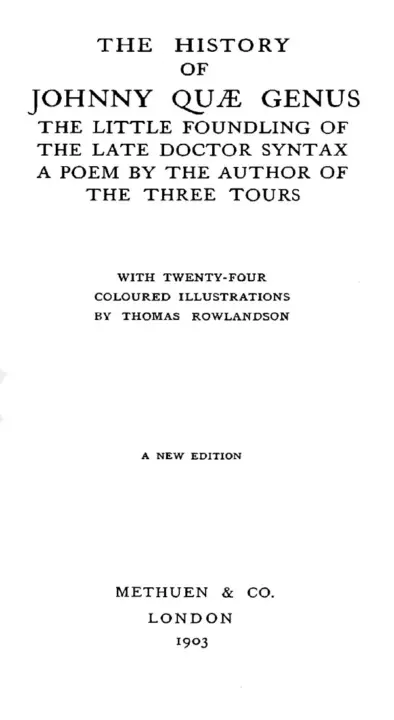
"The History of Johnny Quæ Genus, the Little Foundling of the Late Doctor Syntax" is a poem written in the early 19th century. It follows the titular character, Johnny Quæ Genus, a foundling with a unique name and a troubled past, navigating through a world filled with challenges and misfortunes following the death of his benefactor, Doctor Syntax. The book serves as a narrative that explores themes of identity, fate, and the struggles of life. The beginning of the poem introduces Johnny Quæ Genus, reflecting on the peculiar nature of his name, which was given to him by Doctor Syntax. It highlights his early life marked by the love and care of Mrs. Syntax, who raises him until her own demise. Following her death, Johnny finds himself lost in a harsh world where he faces deceit and hardship. He eventually decides to seek employment in London to uphold his newfound independence. The narrative sets the stage for his adventures and misadventures while establishing a whimsical yet poignant tone that intertwines humor with the trials of the protagonist.
Introduction adapted from the source catalogue; source summaries may be automatically generated.
Free to read · English · 55,270 words · No account needed
MAKE TIME FOR A GOOD BOOK
On by default. Untick to stop anonymous reading totals. Each page counts after 10 seconds in view. How this works.
Anonymous counting is on unless you have switched it off.
He woke in such an agitation
His night-cap stream'd with perspiration;
He started with a fearful stare,
Not knowing if to pray or swear.
He did from further sleep refrain
As he perhaps should dream again,
And Sommerden's departed Rector
Might read another curtain-lecture.
But when as through the shutter's crack
He saw the beams of Phoebus break,
Up he arose, the bell he rung,
And, "Breakfast," issued from his tongue:
The loud command was soon obey'd,
And morning meal in order laid.
On sofa stretch'd, he munch'd the toast,
And sipp'd the Bohea, doubly dos'd
With cordial drops, we won't say gin,
Which he pour'd plentifully in,
And did his trem'rous nerves redeem }
By power of the reviving stream, }
From the dire horrors of the dream. }
--His spirits thus with strength recruited,
He turn'd his mind to what was suited
To the condition chance had bound him,
And perils which might still surround him:
Of his late playmates what became
When power broke up the midnight game;
And if pursued by any danger,
To which as yet he was a stranger.
But soon he found, enquiry made,
The Bow-street spirits all were laid;
Nor was it to the party known,
By whom the mischief had been done.--
Thus, from all legal threat secure,
He felt determin'd to abjure
The course of life he had pursued,
Nor suffer knav'ry to delude
His conduct into any plan
That might disgrace a Gentleman;
The character which his fond thought
Had to a flatt'ring crisis brought,
When he might try, and not in vain,
The wish'd for honour to maintain.
Besides, in favour of his scheme,
He felt the warnings of the dream,
As he their meaning understood
Foreboded much of future good.
At length his boasting fancies tired
Of all to which his pride aspired;
And, having nothing else to do,
He sauntered forth to take a view
Of what a saunter might present
For serious thought or merriment;
When, as he careless stroll'd along,
Half-humming some new-fangled song,
He heard a voice that did proclaim
His own but too familiar name.
'Twas Mr. CARMINE, who was known
An artist of the first renown
For portraiture of living faces,
Whose pencil gave and heighten'd graces,
Who, 'mid the hurry of the street,
Did sauntering QUÆ GENUS greet:
When, having sought a place of quiet,
Free from the passing, bustling riot,
In civil tones the man of art
Began his Queries to impart.
"Your family, I hope, are well,
And will you Lady VALCOUR tell,
If it so please her you may come
And fetch her fine resemblance home:
Nay she may have forgot, I fear,
That the last sitting's in arrear:
Give but the hint as I demand
And you shall feel my grateful hand."
--QUÆ GENUS hasten'd to reply
With the gay VALCOURS' history,
And fear'd that, for a year or two,
The picture must in statu quo
Within his gallery remain,
At least, till they came home again.
"Well then," said CARMINE, "tell me friend,
What fortunes on your steps attend."
"Sir," he replied, "'tis Fortune's pleasure
I should enjoy a state of leisure.
Sir CHARLES, so generous and kind,
Wish'd not that I should stay behind,
Nay, would have paid me high to go,
As I've a paper that will shew:
But certain schemes play'd on my brain
Which fix'd my purpose to remain,
And yet, with all my honest care,
I have not brought one scheme to bear."
"My friend," the artist said, "if you
Have not a better scheme in view,
My place, unless I greatly err,
Would suit your turn and character
'Tis but to know and to make known
The beauties by my pencil shewn,
And lard, as you the occasion see,
With strokes of modest flattery.
Take care you manage well your tongue
To please the old as well as young,
And study the expressive grace
That's seen to beam on any face;
When, in fair words and cautious mood
You may mark the similitude
Between the charms that smiling live,
And such as art like mine can give.
Nor to the sex your hints confine,
The ermin'd sage and grave divine,
The chubby face of childhood too
Attention must be made to woo,
While I shall to your mind impart
The nomenclature of my art;--
And if, as I presume you will,
Display the show with ready skill,
From Misses, Beaux, Old Dames and Sages,
You'll gain, Good Fellow, three-fold wages.
--Now turn the offer in your mind,
And, if your prudence is inclin'd
To take it, you will let me know
To-morrow how your wishes flow."
Your reading position is saved on this browser. Take it to another device with a library code. Reading pages adapt to text, rather than matching a printed edition.
BEHIND THE BOOK
This eBook is for the use of anyone anywhere in the United States and most other parts of the world at no cost and with almost no restrictions whatsoever. You may copy it, give it away or re-use it under the terms of the Project Gutenberg License included with this eBook or online at www.gutenberg.org. If you are not located in the United States, you will have to check the laws of the country where you are located before using this eBook. Read the source licence.
The original source file, including credits and licence, is retained by this library. Request an original-format copy at no charge. Please include the book title and Project Gutenberg identifier #42299.
KEEP YOUR CURIOSITY GOING
Eric Mackay
Edmund Gosse
Sophia Margaretta Hensley
Gilbert Parker
George MacDonald

Elizabeth Bibesco