
Love Letters of a Violinist, and Other Poems
Eric Mackay
THE CLASSIC COLLECTION · 1822
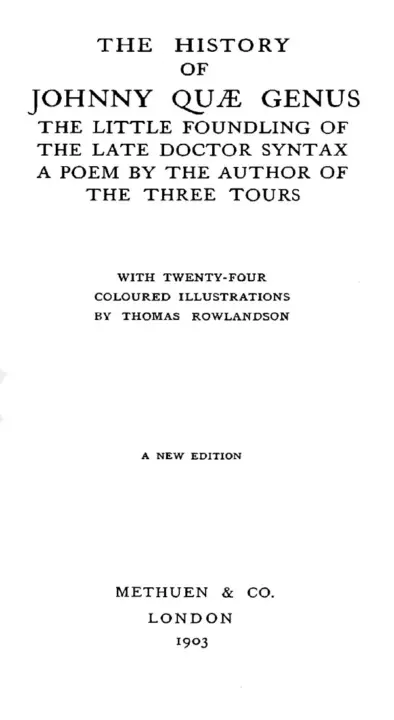
"The History of Johnny Quæ Genus, the Little Foundling of the Late Doctor Syntax" is a poem written in the early 19th century. It follows the titular character, Johnny Quæ Genus, a foundling with a unique name and a troubled past, navigating through a world filled with challenges and misfortunes following the death of his benefactor, Doctor Syntax. The book serves as a narrative that explores themes of identity, fate, and the struggles of life. The beginning of the poem introduces Johnny Quæ Genus, reflecting on the peculiar nature of his name, which was given to him by Doctor Syntax. It highlights his early life marked by the love and care of Mrs. Syntax, who raises him until her own demise. Following her death, Johnny finds himself lost in a harsh world where he faces deceit and hardship. He eventually decides to seek employment in London to uphold his newfound independence. The narrative sets the stage for his adventures and misadventures while establishing a whimsical yet poignant tone that intertwines humor with the trials of the protagonist.
Introduction adapted from the source catalogue; source summaries may be automatically generated.
Free to read · English · 55,270 words · No account needed
MAKE TIME FOR A GOOD BOOK
On by default. Untick to stop anonymous reading totals. Each page counts after 10 seconds in view. How this works.
Anonymous counting is on unless you have switched it off.
Thus when the pleasant song was heard,
HIBERNIA'S minstrel was preferr'd;
Nor from the voice or in the eye
Was there a hint of jealousy:
Nay, while they took their parting glass,
These sentiments were heard to pass.
"The Thistle, Shamrock and the Rose
May challenge all the world at blows:
English and Irish names are known,--
There's Marlborough and Wellington;
And O, what men of glorious name
Do Scotia's annals give to Fame!"
With friends like these the 'Squire began
His new career, and thus it ran,
With others whom he chanc'd to light on
In trips to Tunbridge or to Brighton,
SWELLS at most public places known
And as gay triflers 'bout the town;
Who might, perhaps, at times resort
To Billiard-rooms or Tennis-court,
Where lively grace, and easy skill
Might flatter Fortune to their will.
Freeborn these gay companions sought,
Who soon their brisk disciple taught
How to direct his lively course
By the snug compass in his purse;
In short, who tutor'd his quick sense }
In the gay world to make pretence }
By modest, well-dress'd impudence. }
--Ye Dandies, Bucks or by what name
Bond Street re-echoes with your fame;
Whether in Dennet, Gig or Tandem,
In five-cap'd coats you bang at random,
With such nice skill that you may break
Your own, or Dulcinea's neck:
Or, when lock'd arm in arm you meet,
From the plain causeway to the street,
Drive Ladies in their morning walk,
While you enjoy your lounging talk:
Then saunter off to pass your hours
In roving through those gaudy bowers
Where purchas'd pleasure seems design'd
To occupy the thoughtless mind:
And, having idled through the day, }
To quicken dull night's weary way, }
You seek the mask, the dance or play;-- }
With you our Hero did contrive
To keep himself and time alive;
But now and then too prone to trace
Those scrapes that border on disgrace,
And threat the unreflecting plan
Of the best would-be Gentleman!
From such as these he was not free, }
As we, I fear, shall shortly see, }
In this so busy history. }
--To him no social life was known,
His home, his friends were through the town
Who were seen wand'ring here and there,
Caring for no one, no one's care;
Prepared no pleasures to receive
But coin could buy or chance might give;
And would prove lively or were dull,
As the silk purse was drain'd or full.
For though deck'd out with all the art
That Fashion's journeymen impart,
They never pass'd the tonish wicket
Of High-life, but by purchas'd ticket
Obtain'd by the resistless bribe
To Traitors of the livried tribe,
Which, by some bold disguise to aid,
Might help them through a masquerade;
Or, with some sly, well-fram'd pretence
And varnish'd o'er with impudence,
A proud admittance might obtain
With chance to be turn'd out again:
Nor was the luckless Freeborn spar'd,
When he the saucy trial dar'd.
--One night, the hour we need not tell,
Into a trap the coxcomb fell.
As through the streets he rattled on
Lamps with inviting brilliance shone;
The music's sound, the portal's din
Told 'twas a joyous scene within:
The second bottle of the night,
Might have produced a double sight,
And two-fold courage to pursue
The splendid prospect in his view,
He, therefore bade the Hack approach,
And at the door present the coach;
Then made a push, got through the hall,
And quickly mingled with the ball.
--Whether his face was too well known
Among the dashers of the town,
Who do not an admittance gain
Among the more distinguish'd train,
Whose social habits will exclude
The mere street-trampling multitude,
Who, like the insects of a day,
Make a short buzz and pass away:
Or whether the intruding sinner
Eat as he seem'd to want a dinner;
Or if it did his fancy suit
To line his pocket with the fruit;
Or if he let some signal fly,
Not usual in such company,
Or if his spirits were so loud
As to alarm the polish'd crowd;
Whatever was the Spell that bound him,
Suspicion more than hover'd round him;
For, he replied with silent stare, }
As he was taken unaware, }
When he was ask'd how he came there. }
Nor did he show a visage bold
When, in a whisper, he was told,
But still with steady look express'd
By the stern Master of the feast,
If he wish'd not to play a farce
To make his pretty figure scarce.
--That such a part he might not play }
Which menac'd e'en the least delay, }
He thought it best to glide away; }
And, to avoid the threat'ning rout,
As he push'd in, he darted out.
Your reading position is saved on this browser. Take it to another device with a library code. Reading pages adapt to text, rather than matching a printed edition.
BEHIND THE BOOK
This eBook is for the use of anyone anywhere in the United States and most other parts of the world at no cost and with almost no restrictions whatsoever. You may copy it, give it away or re-use it under the terms of the Project Gutenberg License included with this eBook or online at www.gutenberg.org. If you are not located in the United States, you will have to check the laws of the country where you are located before using this eBook. Read the source licence.
The original source file, including credits and licence, is retained by this library. Request an original-format copy at no charge. Please include the book title and Project Gutenberg identifier #42299.
KEEP YOUR CURIOSITY GOING
Eric Mackay
Edmund Gosse
Sophia Margaretta Hensley
Gilbert Parker
George MacDonald

Elizabeth Bibesco