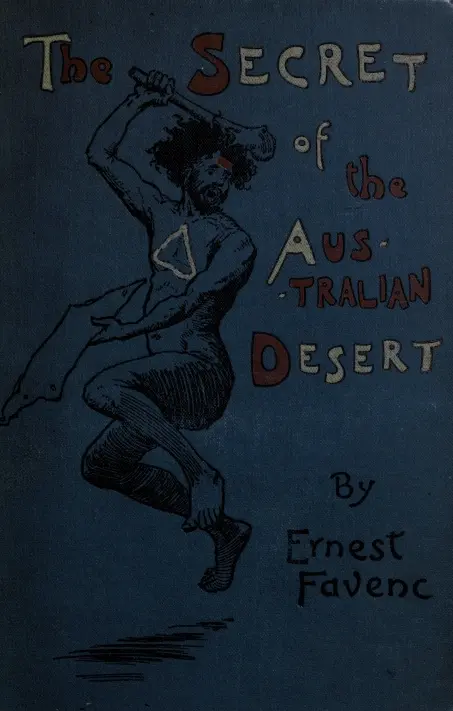
The secret of the Australian desert
Ernest Favenc
THE CLASSIC COLLECTION · 1888
"The History of Australian Exploration from 1788 to 1888" by Ernest Favenc is a historical account written in the late 19th century. The book meticulously chronicles the exploration of Australia over a century, detailing the numerous expeditions that led to the discovery and mapping of the continent. Favenc aims to weave together the tales of both public expeditions, which often received government support, and the lesser-known journeys of private individuals, showcasing their significant contributions to Australian history. At the start of this extensive work, Favenc dedicates the book to a prominent figure in Australian politics, Sir Henry Parkes, and provides a preface explaining the challenges historians face in compiling a complete history of Australian exploration. The opening portion discusses early navigators and explorers, tracing the myths and realities surrounding Australia's discovery, such as hopes for an inland sea and encounters with the indigenous population. It outlines the endeavors of key figures like Captain Phillip and Captain Tench, who initially explored the terrain around Sydney, focusing on the discovery of the Hawkesbury and Nepean Rivers and their attempts to penetrate the daunting Blue Mountains. The subsequent expeditions, marked by descriptions of the land’s physical characteristics and indigenous tribes, set the groundwork for understanding Australia's vast interior landscape.
Introduction adapted from the source catalogue; source summaries may be automatically generated.
Free to read · English · 185,806 words · No account needed
MAKE TIME FOR A GOOD BOOK
On by default. Untick to stop anonymous reading totals. Each page counts after 10 seconds in view. How this works.
Anonymous counting is on unless you have switched it off.
Winnecke and Barclay-- Two surveyors dispatched by the South Australian Government in 1878 to reach the Queensland border from the overland telegraph line, it being a matter of moment to settle the position of the border line between the two colonies. Another attempt in 1880 proved successful. 1878-80.
Witt, Willem de--
In the VIANEN, sighted the north-west coast and reported (see De Witt) it
"a foul and barren shore, green fields, and very wild, barbarous
inhabitants." 1628.
Zeachern, Captain--
In the MAURITIUS, claims to have discovered Arnheim's Land. 1618.
"Zeehaan" (The)--
Under command of Captain Gerrit Jansen, accompanied by Abel Janz Tasman
in the HEEMSKIRK. Discovered Van Dieman's Land, and took possession of
New Holland. 1642.
"Zeemeuw," "Limmen," and "De Brak"--
Under Abel Janz Tasman. 1644.
"Zeewyck" (The)--
Lost on Houtman's Abrolhos. In 1839 Captain Stokes found a gun and other
relics of this vessel on one of the islands. 1727.
Zouch, Lieutenant (N.S.W. Mounted Police)-- Sent in command of party to arrest the natives who murdered Richard Cunningham, the botanist to Sir Thomas Mitchell's expedition. 1835. [See Appendix.]
1503--De Gonneville visited the South Seas, and is claimed by the French to have touched on Australia.
1520--Magalhaens, the first circumnavigator, claims to have discovered
Australia. (Doubtful.)
1540--The Portuguese claims to early discovery of Australia are doubtful.
1542--Guillaume le Testu. Claims based on a map now in the Depôt de la Guerre, at Paris, indicating Australia.
1601--Manoel Godinho de Eredia, a Spaniard. (Claim doubtful.)
1606--The DUYFHEN entered the Gulf of Carpentaria as far as Cape
Keer-Weer (Turn Again).
1606--Luis Vaez de Torres, with Pedro Fernandez de Quiros, discovered
Torres Straits.
1616--Dirk Hartog, in the ENDRACHT, visited the west coast.
1618--Zeachern, in the MAURITIUS, discovered Arnheim's Land.
1619--John Van Edels on the west coast.
1622--The Landt van de Leeuwin, south-west cape of Australia, named after
the ship LEEUWIN.
1623--Jan Carstens, with the yachts PERA and ARNHEIM; on the south-west
coast.
1627--Pieter Nuyts, in the GULDE ZEEPARD; western and southern coasts.
1628--Willem de Witt, the VIANEN; north-west coast named after him.
1628--Pieter Carpenter discovered the Gulf of Carpentaria.
1629--Francis Pelsart, in the BATAVIA; lost on Houtman's Albrolhos.
1636--Gerrit Tomaz Pool, with the KLYN, AMSTERDAM, and WEZEL; coast of
Arnheim's Land.
1642--Abel Janz Tasman and Gerrit Jansen, with the HEEMSKIRK and ZEEHAAN; discovered Van Dieman's Land, and took possession of New Holland.
1644--Abel Janz Tasman, with the LIMMEN, ZEEMEUW, and DE BRAK west coasts
of Carpentaria.
1656--The VERGULDE DRAECK lost on Houtman's Albrohos.
1688--William Dampier, in the BACHELOR'S DELIGHT and CYGNET, with crews
of buccaneers.
1695--William de Vlaming, with the GEELVINK, NYPTANGH, and WEZELTJE,
named the Swan River.
1699--William Dampier, in the ROEBUCK; north-west coast of New Holland.
Your reading position is saved on this browser. Take it to another device with a library code. Reading pages adapt to text, rather than matching a printed edition.
BEHIND THE BOOK
This eBook is for the use of anyone anywhere in the United States and most other parts of the world at no cost and with almost no restrictions whatsoever. You may copy it, give it away or re-use it under the terms of the Project Gutenberg License included with this eBook or online at www.gutenberg.org. If you are not located in the United States, you will have to check the laws of the country where you are located before using this eBook. Read the source licence.
The original source file, including credits and licence, is retained by this library. Request an original-format copy at no charge. Please include the book title and Project Gutenberg identifier #7163.
KEEP YOUR CURIOSITY GOING
Wilfrid Scawen Blunt
Wilfrid Scawen Blunt

E. W. (Edgar Watson) Howe
Cécile Tormay

Moritz Busch
John L. Ransom