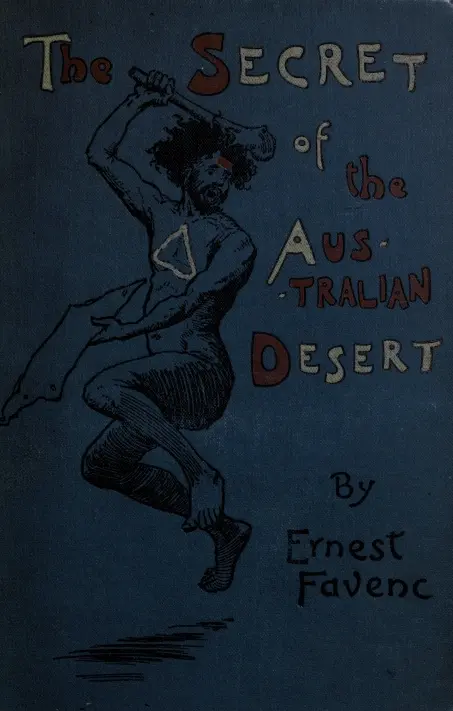
The secret of the Australian desert
Ernest Favenc
THE CLASSIC COLLECTION · 1888
"The History of Australian Exploration from 1788 to 1888" by Ernest Favenc is a historical account written in the late 19th century. The book meticulously chronicles the exploration of Australia over a century, detailing the numerous expeditions that led to the discovery and mapping of the continent. Favenc aims to weave together the tales of both public expeditions, which often received government support, and the lesser-known journeys of private individuals, showcasing their significant contributions to Australian history. At the start of this extensive work, Favenc dedicates the book to a prominent figure in Australian politics, Sir Henry Parkes, and provides a preface explaining the challenges historians face in compiling a complete history of Australian exploration. The opening portion discusses early navigators and explorers, tracing the myths and realities surrounding Australia's discovery, such as hopes for an inland sea and encounters with the indigenous population. It outlines the endeavors of key figures like Captain Phillip and Captain Tench, who initially explored the terrain around Sydney, focusing on the discovery of the Hawkesbury and Nepean Rivers and their attempts to penetrate the daunting Blue Mountains. The subsequent expeditions, marked by descriptions of the land’s physical characteristics and indigenous tribes, set the groundwork for understanding Australia's vast interior landscape.
Introduction adapted from the source catalogue; source summaries may be automatically generated.
Free to read · English · 185,806 words · No account needed
MAKE TIME FOR A GOOD BOOK
On by default. Untick to stop anonymous reading totals. Each page counts after 10 seconds in view. How this works.
Anonymous counting is on unless you have switched it off.
Russell, Stuart-- Journeyed from Moreton Bay to Wide Bay in a boat, and made an examination of some of the streams there emptying into the sea. During the same year Stuart Russell explored the country from Wide Bay to the Boyne (not Oxley's Boyne) and opened up much available pastoral country. 1842.
Saunders, Philip, and Adam, John-- Accompanied by a third man, successfully crossed from Roeburne, in Western Australia, to the overland telegraph line. 1876.
Scarr, Frank (Surveyor)-- Attempted to cross the line to the south of N. Buchanan's track, but was prevented by the waterless strip of country existing there. Finally made north, arriving at Tennant's Creek Station, and, owing to the dry season, did not extend his researches further. 1878.
Scott and Lieutenant Lawson--
Attempted to reach the Liverpool Plains. Discovered the Goulburn River.
1822.
Sergison, A. W., and Gilbert M'Minn--
Sent by the South Australian Government to ascertain the course of the
Katherine River. 1876.
Sergison, A. W., and R. Travers-- Explored the country about the Daly and Fitzmaurice Rivers. 1877.
Shortland, Lieutenant--
With three ships, from Sydney to England, passed through Bougainville's
Strait, north-west coast. 1788.
Discovered Hunter River. 1797.
Solander, Dr.--
Swedish botanist. Accompanied Captain Cook in the ENDEAVOUR. 1770.
Somerset-- Settlement at Cape York. Mr. Jardine, Police Magistrate at Rockhampton, took command, and a detachment of marines was stationed there. 1863.
Stewart, Captain--
Sent by Governor Macquarie to search for a passage supposed to exist
between Lake Bathurst and the sea. He lost his boat in Twofold Bay, and
on endeavouring to reach Sydney overland, was cut off by the natives.
1820.
Stirling, Captain--
Accompanied by Charles Frazer, in H.M.S. SUCCESS, surveyed coast from
King George's Sound to the Swan River. 1828.
Stock, Edwin (and party)--
West of Lake Eyre. 1857.
Stockdale, Harry-- Started on an expedition from Cambridge Gulf to explore the country in the neighbourhood with a view to settlement. Landed by steamer in Cambridge Gulf, and probably the first landing that had taken place since Captain Stokes. After a hard struggle, reached the telegraph line with one man; sending back relief to the others. 1884.
Stokes, Captain John Lort-- Took command of the BEAGLE on retirement of Captain T. C. Wickham, and continued the survey, which completed our geographical knowledge of the Australian coast. The survey continued from 1837 to 1845.
Strzelecki, Count-- Followed on M'Millan's tracks when he discovered Gipps Land, and has often been erroneously considered the discoverer. The object of this trip was to gather material for his now well-known book, "The Physical Description of New South Wales, Victoria, and Van Dieman's Land." He mounted the Alps, and named one of the highest peaks Kosciusko, from its fancied resemblance to the patriot's tomb at Cracow. 1840.
Your reading position is saved on this browser. Take it to another device with a library code. Reading pages adapt to text, rather than matching a printed edition.
BEHIND THE BOOK
This eBook is for the use of anyone anywhere in the United States and most other parts of the world at no cost and with almost no restrictions whatsoever. You may copy it, give it away or re-use it under the terms of the Project Gutenberg License included with this eBook or online at www.gutenberg.org. If you are not located in the United States, you will have to check the laws of the country where you are located before using this eBook. Read the source licence.
The original source file, including credits and licence, is retained by this library. Request an original-format copy at no charge. Please include the book title and Project Gutenberg identifier #7163.
KEEP YOUR CURIOSITY GOING
Wilfrid Scawen Blunt
Wilfrid Scawen Blunt

E. W. (Edgar Watson) Howe
Cécile Tormay

Moritz Busch
John L. Ransom