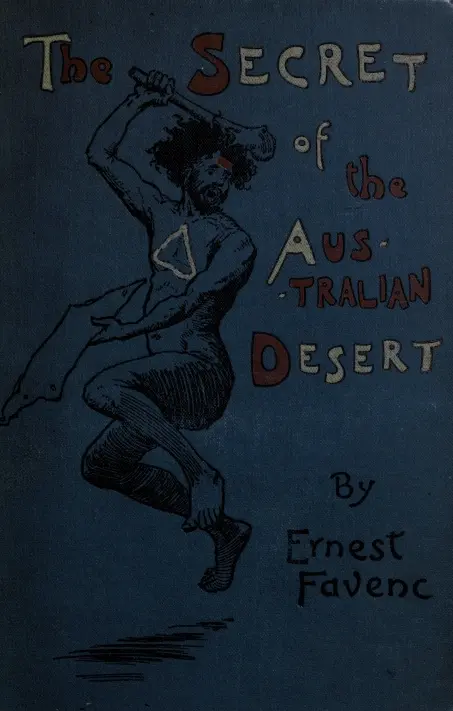
The secret of the Australian desert
Ernest Favenc
THE CLASSIC COLLECTION · 1888
"The History of Australian Exploration from 1788 to 1888" by Ernest Favenc is a historical account written in the late 19th century. The book meticulously chronicles the exploration of Australia over a century, detailing the numerous expeditions that led to the discovery and mapping of the continent. Favenc aims to weave together the tales of both public expeditions, which often received government support, and the lesser-known journeys of private individuals, showcasing their significant contributions to Australian history. At the start of this extensive work, Favenc dedicates the book to a prominent figure in Australian politics, Sir Henry Parkes, and provides a preface explaining the challenges historians face in compiling a complete history of Australian exploration. The opening portion discusses early navigators and explorers, tracing the myths and realities surrounding Australia's discovery, such as hopes for an inland sea and encounters with the indigenous population. It outlines the endeavors of key figures like Captain Phillip and Captain Tench, who initially explored the terrain around Sydney, focusing on the discovery of the Hawkesbury and Nepean Rivers and their attempts to penetrate the daunting Blue Mountains. The subsequent expeditions, marked by descriptions of the land’s physical characteristics and indigenous tribes, set the groundwork for understanding Australia's vast interior landscape.
Introduction adapted from the source catalogue; source summaries may be automatically generated.
Free to read · English · 185,806 words · No account needed
MAKE TIME FOR A GOOD BOOK
On by default. Untick to stop anonymous reading totals. Each page counts after 10 seconds in view. How this works.
Anonymous counting is on unless you have switched it off.
"14th September. Proceeded slowly westward, along the north bank of the creek, carefully searching for tracks. . . . Country opening out and improving in character. Magnificent reaches of water in the creek; some of the water quite salt, other holes containing water of a milky tint, sweet and pleasant to the taste, while in others again, it was brackish, and the edges were lined with petrified boughs, leaves, and some few fish. . . . Several times during the day we noticed blacks stealthily watching our movements from a distance, and travelling through the long grass in the direction we ourselves were going. . . . In the afternoon, Howitt, who had been riding well out from the creek, returned with the news that he had struck fresh camel tracks trending northwards, apparently those of a lost camel. . . . Another comfortable camp on the creek, with plenty of feed.
"15th September (Sunday). Left camp at 8 a.m. Howitt, with one of the black boys, started to run the camel track seen yesterday. I gave Sampson (the leading man of the file) a compass bearing to follow, with instructions to keep as closely to it as the windings of the creek would permit, and rode on ahead, actuated by curiosity as to the movements of our black friends of yesterday. After travelling about three miles, my attention was attracted by a number of niggers on the opposite bank of the creek, who shouted loudly as soon as they saw me, and vigorously waved and pointed down the creek. A feeling of something about to happen excited me somewhat, but I little expected what the sequel was to be. Moving cautiously on through the undergrowth which covered the banks of the creek, the blacks kept pace with me on the opposite side, their cries increasing in volume and intensity; when suddenly rounding a bend, I was startled at seeing a large body of them gathered on a sandy neck in the bed of the creek, between two large waterholes. Immediately they saw me, they too commenced to howl, throw their arms about, and wave their weapons in the air. I at once pulled up, and considered the propriety of waiting the arrival of the party, for I felt far from satisfied with regard to their intentions. But here, for the first time, my favourite horse--a black cob, known in the camp as 'Piggy,' a Murray Downs bred stock horse, of good local repute, both for foot and temper--appeared to think that his work was cut out for him, and the time arrived in which to do it. Pawing and snorting at the noise, he suddenly slewed round, and headed down the steep bank, through the undergrowth, straight for the crowd, as he had been wont to do after many a mob of weaners on his native plains. The blacks drew hurriedly back to the top of the opposite bank, shouting and gesticulating violently, and leaving one solitary figure, apparently covered with some scarecrow rags, and part of a hat, prominently alone in the sand. Before I could pull up, I had passed it, and as I passed it tottered, threw up its hands in the attitude of prayer, and fell on the ground. The heavy sand helped me to conquer Piggy on the level, and when I turned back, the figure had partially risen. Hastily dismounting, I was soon beside it, excitedly asking, 'Who, in the name of wonder, are you?' He answered, 'I am King, sir.' For a moment I did not grasp the thought that the object of our search was attained, for King being only one of the undistinguished members of the party, his name was unfamiliar to me. 'King?' I repeated. 'Yes,' he said; 'the last man of the exploring expedition.' 'What, Burke's?' 'Yes.' 'Where is he--and Wills?' 'Dead--both dead, long ago;' and again he fell to the ground. Then I knew who stood before me. Jumping into the saddle, I rode up the bank, fired two or three revolver shots to attract the attention of the party, and, on their coming up, sent the other black boy to cut Howitt's track and bring him back to camp. We then put up a tent to shelter the rescued man, and by degrees, as he recovered from the excitement of the meeting, we got from him the, sad story of the fate of his leader. We got it at intervals only, between the long rests which his exhausted condition compelled him to take, and the main facts are, as summarised, given below:--
Your reading position is saved on this browser. Take it to another device with a library code. Reading pages adapt to text, rather than matching a printed edition.
BEHIND THE BOOK
This eBook is for the use of anyone anywhere in the United States and most other parts of the world at no cost and with almost no restrictions whatsoever. You may copy it, give it away or re-use it under the terms of the Project Gutenberg License included with this eBook or online at www.gutenberg.org. If you are not located in the United States, you will have to check the laws of the country where you are located before using this eBook. Read the source licence.
The original source file, including credits and licence, is retained by this library. Request an original-format copy at no charge. Please include the book title and Project Gutenberg identifier #7163.
KEEP YOUR CURIOSITY GOING
Wilfrid Scawen Blunt
Wilfrid Scawen Blunt

E. W. (Edgar Watson) Howe
Cécile Tormay

Moritz Busch
John L. Ransom