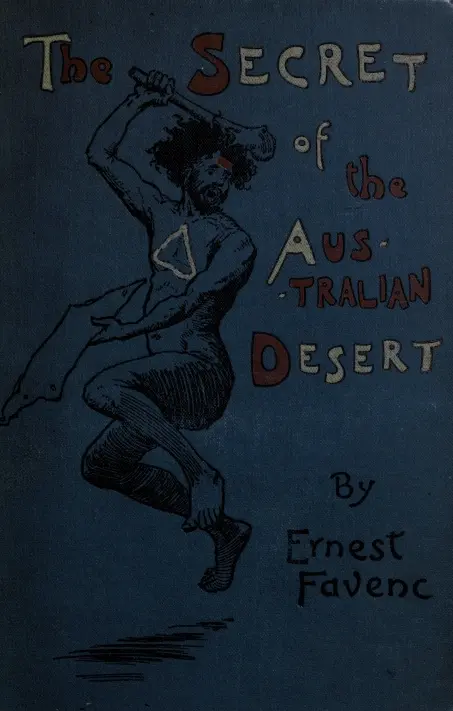
The secret of the Australian desert
Ernest Favenc
THE CLASSIC COLLECTION · 1888
"The History of Australian Exploration from 1788 to 1888" by Ernest Favenc is a historical account written in the late 19th century. The book meticulously chronicles the exploration of Australia over a century, detailing the numerous expeditions that led to the discovery and mapping of the continent. Favenc aims to weave together the tales of both public expeditions, which often received government support, and the lesser-known journeys of private individuals, showcasing their significant contributions to Australian history. At the start of this extensive work, Favenc dedicates the book to a prominent figure in Australian politics, Sir Henry Parkes, and provides a preface explaining the challenges historians face in compiling a complete history of Australian exploration. The opening portion discusses early navigators and explorers, tracing the myths and realities surrounding Australia's discovery, such as hopes for an inland sea and encounters with the indigenous population. It outlines the endeavors of key figures like Captain Phillip and Captain Tench, who initially explored the terrain around Sydney, focusing on the discovery of the Hawkesbury and Nepean Rivers and their attempts to penetrate the daunting Blue Mountains. The subsequent expeditions, marked by descriptions of the land’s physical characteristics and indigenous tribes, set the groundwork for understanding Australia's vast interior landscape.
Introduction adapted from the source catalogue; source summaries may be automatically generated.
Free to read · English · 185,806 words · No account needed
MAKE TIME FOR A GOOD BOOK
On by default. Untick to stop anonymous reading totals. Each page counts after 10 seconds in view. How this works.
Anonymous counting is on unless you have switched it off.
"ITEM. They say that, having refitted their ship in the best way they could, they prepared to return to France, and being willing, after the manner of those who discover strange lands, to carry some of the natives with them, they persuaded the king, Arosca, to let them have one of his sons, promising to the father that they would bring him back in twenty moons at farthest, with others who should teach them the use of firearms, and how to make mirrors, axes, knives, and whatever else they admired among the Christians. These promises determined Arosca to let his son, called Essomeric, go along with them, to whom he gave for a companion an Indian of thirty-five years of age, called Namoa. He and his people convoyed them to the ship, giving them provisions, besides many beautiful feathers and other rarities, in order to present to the King of France. At parting, Arosca obliged them to swear that they would return in twenty moons, and when the ship got under way the whole people gave a great cry, and, forming the sign of the Cross with their fingers, gave them to understand that they would carefully preserve the one set up among them.
"ITEM. They say that they left this southern country July 3rd, 1504, and saw no land until the day after the Feast of St. Denis, during which time they were much distressed by a malignant fever, of which their surgeon and three more died, among whom was the Indian, Namoa. The young son of Arosca also falling sick, they baptised him by the name of Binot, after their captain, who stood godfather to him. This was done September 14th, after which the young Indian grew better and arrived in France."
Callender further remarks:--
"Thus far the judicial declaration emitted by De Gonneville before the Admiralty. The rest of the author's memoir is filled with exhortations to the French to profit by this lucky discovery, and send the writer back to the country of his ancestors; but this appears never to have been done. The author seems to have begun this extract from De Gonneville's declaration in that place where he talks of the manners of the inhabitants, omitting what went before, though it is highly probable that the navigator must have said something of the voyage outwards and the portion of the country where he landed, which would have been of great importance for us to know at this day. The French writer from whom we have translated the above account informs us that the Count de Maurepas caused search lately through all the records of the Admiralty in Normandy, in order to find the original of this declaration, but an interval of two centuries and a half, and the confusions occasioned by the civil wars, had dispersed all the old papers, and all the information that M. de Maurepas could obtain was that a tradition still subsisted there that such a piece was once among the records, but they could give no account of what was become of it. Thus the full account of an attempt which Magellan some years after finished with success is entirely lost, except the very lame extract we have been able to lay before the reader. Our French author tells us he has seen another copy of this memorial at the end of the dedication to Pope Alexander VII. The author signs his name thus, at full length, 'Paulmier, Prêtre Indien Chanoine de l'Eglise Cathédrale de Lizieux.' The proprietor of this copy has added a note, testifying that this copy was given him by the author himself in 1664. He commends him as a person of universal knowledge, and one who had travelled all over Europe. He had made the history of navigation his principal study, and was perfectly acquainted with it. In another note we are told that Essomeric, the son of Arosca, lived to the year 1583, and left posterity under the name of Binot. One of his grand-children, J. B. Binot, was President of the Treasury of Provence, and left an only daughter, who was m married to the Marquis de la Barbent, May 4th, 1725. Our readers will not be surprised that we have entered into a detail of facts in order to elucidate and confirm the truth of this first discovery of the Terra Australis, especially as this account was never seen in our language till now, and is therefore little known even to those who are otherwise well acquainted with voyages made to this part of the world."
Your reading position is saved on this browser. Take it to another device with a library code. Reading pages adapt to text, rather than matching a printed edition.
BEHIND THE BOOK
This eBook is for the use of anyone anywhere in the United States and most other parts of the world at no cost and with almost no restrictions whatsoever. You may copy it, give it away or re-use it under the terms of the Project Gutenberg License included with this eBook or online at www.gutenberg.org. If you are not located in the United States, you will have to check the laws of the country where you are located before using this eBook. Read the source licence.
The original source file, including credits and licence, is retained by this library. Request an original-format copy at no charge. Please include the book title and Project Gutenberg identifier #7163.
KEEP YOUR CURIOSITY GOING
Wilfrid Scawen Blunt
Wilfrid Scawen Blunt

E. W. (Edgar Watson) Howe
Cécile Tormay

Moritz Busch
John L. Ransom