THE CLASSIC COLLECTION✦An outlaw’s diary: the CommuneCLASSIC FREE BOOKS
An outlaw’s diary: the Commune
Cécile Tormay
THE CLASSIC COLLECTION · 1912
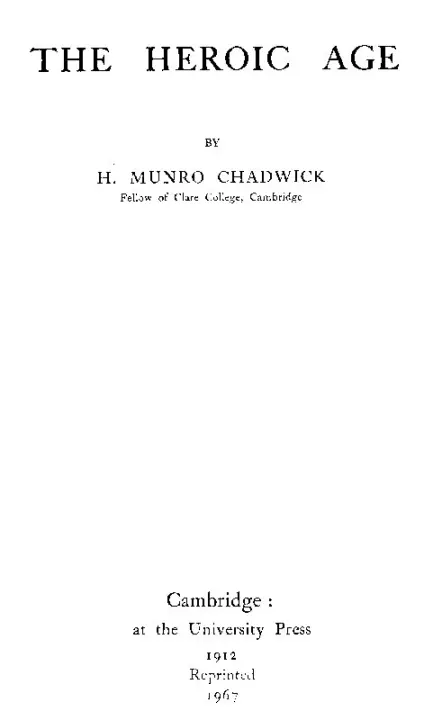
"The Heroic Age" by H. Munro Chadwick is a historical account written in the early 20th century. The work explores the characteristics and themes of heroic poetry across various cultures, particularly focusing on the Teutonic and Greek traditions. It investigates the oral narratives surrounding notable figures and events within these ancient literary forms, seeking to identify their origins and interconnections. The beginning of the book sets the stage for a comparative study of heroic poetry, emphasizing the recurrent themes and narrative structures found in the epics of different cultures. Specifically, Chadwick introduces the early narrative poetry of the Teutonic peoples, referencing significant works such as "Beowulf," and discusses their thematic concerns and historical context. He emphasizes the importance of understanding these stories within the framework of their own time, hinting at the anthropological implications of their content. This methodological approach offers a foundational basis for further exploration of the influence these heroic tales have had across generations and their significance in the development of cultural identity.
Introduction adapted from the source catalogue; source summaries may be automatically generated.
Free to read · English · 190,164 words · No account needed
MAKE TIME FOR A GOOD BOOK
On by default. Untick to stop anonymous reading totals. Each page counts after 10 seconds in view. How this works.
Anonymous counting is on unless you have switched it off.
Both these cases then appear to show a number of the features which characterise the Teutonic and Greek Heroic Ages, though scarcely to the same degree as is the case with the civilisation of the ancient Gauls. Analogies may also be found in the French and Russian Heroic Ages; but I am not aware that either of these presents any remarkable characteristics which do not occur in one or other of those with which we have dealt. On the other hand I have no doubt that many interesting features are to be found in the Irish Heroic Age (or rather perhaps Heroic Ages[636]). This subject however is beset with such extreme difficulties of every kind that I dare not touch it.
[629] Cf. Ammianus Marcellinus, XV 9. 8 (probably from Timagenes): et Bardi quidem fortia uirorum illustrium facta heroicis composita uersibus cum dulcibus lyrae modulis cantitarunt. Cf. also Diodoros, V 31; Strabo, IV 4. 4; Lucan, Phars. I 447 ff.
[630] Cf. Athenaios, VI 49 (quoting Poseidonios): Κελτοὶ περιάγονται μεθ' αὑτῶν καὶ πολεμοῦντες συμβιωτὰς οὓς καλοῦσι παρασίτους. οὗτοι δὲ ἐγκώμια αὐτῶν καὶ πρὸς ἀθρόους λέγουσιν ἀνθρώπους συνεστῶτας καὶ πρὸς ἕκαστον τῶν κατὰ μέρος ἐκείνων ἀκροωμένων. τὰ δὲ ἀκούσματα αὐτῶν εἰσιν οἱ καλούμενοι Βάρδοι· ποιηταὶ δὲ οὗτοι τυγχάνουσι μετ' ᾠδῆς ἐπαίνους λέγοντες. Reference may also be made to the story of Luernios, king of the Allobroges, and the minstrel who arrived too late (ib., IV 37). Cf. also Appian, Celtice, § 12 (describing the arrival of an envoy sent by Bitoitos, the father of Luernios): μουσικός τε ἀνὴρ εἵπετο, βαρβάρῳ μουσικῇ τὸν βασιλέα Βιτοῖτον, εἶτ' Ἀλλόβριγας, εἶτα τὸν πρεσβευτὴν αὐτὸν ἔς τε γένος καὶ ἀνδρείαν καὶ περιουσίαν ὑμνῶν· οὗ δὴ καὶ μάλιστα ἕνεκα αὐτοὺς οἱ τῶν πρεσβευτῶν ἐπιφανεῖς ἐπάγονται.
[631] κατὰ δὲ τὰς παρατάξεις εἰώθασι προάγειν τῆς παρατάξεως καὶ προκαλεῖσθαι τῶν ἀντιτεταγμένων τοὺς ἀρίστους εἰς μονομαχίαν, προανασείοντες τὰ ὅπλα καὶ καταπληττόμενοι τοὺς ἐναντίους. ὅταν δέ τις ὑπακούσῃ πρὸς τὴν μάχην τάς τε τῶν προγόνων ἀνδραγαθίας ἐξυμνοῦσι καὶ τὰς ἑαυτῶν ἀρετὰς προφέρονται καὶ τὸν ἀντιταττόμενον ἐξονειδίζουσι καὶ ταπεινοῦσι καὶ τὸ σύνολον τὸ θάρσος τῆς ψυχῆς τοῖς λόγοις προαφαιροῦνται (V 29).
[632] πλησίον δ' αὐτῶν ἐσχάραι κεῖνται γέμουσαι πυρὸς καὶ λέβητας ἔχουσαι καὶ ὀβελοὺς πλήρεις κρεῶν ὁλομερῶν. τοὺς δ' ἀγαθοὺς ἄνδρας ταῖς καλλίσταις τῶν κρεῶν μοίραις γεραίρουσι.... καλοῦσι δὲ καὶ τοὺς ξένους ἐπὶ τὰς εὐωχίας καὶ μετὰ τὸ δεῖπνον ἐπερωτῶσι τίνες εἰσὶ καὶ τίνων χρείαν ἔχουσιν (ib. 28).
[633] We may compare also what is said (ib. I 20) of the relations of Diuiciacus and Dumnorix. The latter had a large comitatus of his own: magnum numerum equitatus suo sumptu semper alere et circum se habere (I 18).
[634] Cf. Livy, V 34.
[635] The rise of the Cumbrian kingdoms presents a difficulty which historians do not seem to me to have sufficiently realised. During the fourth and fifth centuries the northern parts of the province were repeatedly menaced and ravaged by Pictish invaders. Yet after the fifth century we hear practically nothing more of Picts in the south of Scotland (except in Galloway). On the other hand it was in this region that the Britons offered the most determined resistance to the English. In the latter part of the sixth century Urien is said (Hist. Br., § 63) to have besieged them on one occasion in Lindisfarne (Metcaud); and in Strathclyde the Britons maintained their independence, except for one or two brief intervals, until long after the disappearance of the Northumbrian kingdom. It is often assumed, though on somewhat slender grounds, that the Britons held only the south-west of Scotland and that the south-east (Lothian, etc.) was Pictish before the English conquest. But this hypothesis does not get rid of the difficulties; for it is from Manau Guotodin, a district always regarded as Pictish, that Cunedda is said to have come (ib., § 62). I suspect that the distinction between Picts and Britons was not so rigid as is commonly supposed. Unfortunately Celtic scholars have not yet been able to come to any agreement as to the character of the Pictish language. Some hold that it was British (Brythonic), others Gaelic (Goidelic), others again non-Celtic. Possibly all these views may contain a certain amount of truth. At all events it seems to me quite incredible that Gaelic was not introduced into Scotland before the sixth century. All indications appear to me to favour the view that this language belonged to a wave of Celtic invasion earlier than the British. Yet I see no objection to supposing that in pre-Roman times the true (Gaelic) Picts--who probably included a non-Celtic substratum--may have been overlaid in part by a British element. If so, it is far from improbable that the south of Scotland in its turn received a 'Pictish' element, when that district was abandoned by the Romans. A mixed population of this kind would readily enough coalesce with the native (British) inhabitants.
Your reading position is saved on this browser. Take it to another device with a library code. Reading pages adapt to text, rather than matching a printed edition.
BEHIND THE BOOK
This eBook is for the use of anyone anywhere in the United States and most other parts of the world at no cost and with almost no restrictions whatsoever. You may copy it, give it away or re-use it under the terms of the Project Gutenberg License included with this eBook or online at www.gutenberg.org. If you are not located in the United States, you will have to check the laws of the country where you are located before using this eBook. Read the source licence.
The original source file, including credits and licence, is retained by this library. Request an original-format copy at no charge. Please include the book title and Project Gutenberg identifier #48426.
KEEP YOUR CURIOSITY GOING
Cécile Tormay

Moritz Busch
John L. Ransom

Maurice Baring
Frances Wright
Cécile Tormay