THE CLASSIC COLLECTION✦An outlaw’s diary: the CommuneCLASSIC FREE BOOKS
An outlaw’s diary: the Commune
Cécile Tormay
THE CLASSIC COLLECTION · 1912
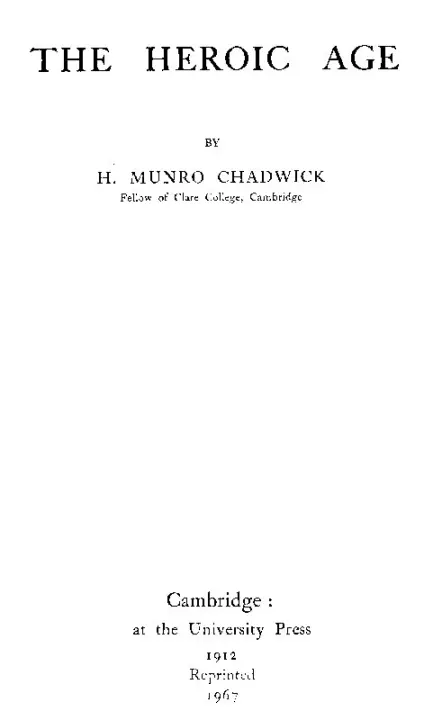
"The Heroic Age" by H. Munro Chadwick is a historical account written in the early 20th century. The work explores the characteristics and themes of heroic poetry across various cultures, particularly focusing on the Teutonic and Greek traditions. It investigates the oral narratives surrounding notable figures and events within these ancient literary forms, seeking to identify their origins and interconnections. The beginning of the book sets the stage for a comparative study of heroic poetry, emphasizing the recurrent themes and narrative structures found in the epics of different cultures. Specifically, Chadwick introduces the early narrative poetry of the Teutonic peoples, referencing significant works such as "Beowulf," and discusses their thematic concerns and historical context. He emphasizes the importance of understanding these stories within the framework of their own time, hinting at the anthropological implications of their content. This methodological approach offers a foundational basis for further exploration of the influence these heroic tales have had across generations and their significance in the development of cultural identity.
Introduction adapted from the source catalogue; source summaries may be automatically generated.
Free to read · English · 190,164 words · No account needed
MAKE TIME FOR A GOOD BOOK
On by default. Untick to stop anonymous reading totals. Each page counts after 10 seconds in view. How this works.
Anonymous counting is on unless you have switched it off.
[517] It may be observed that in Beow. 452 ff. the hero requests the Danish king to send his mail-coat to Hygelac, if he should be killed by Grendel. This mail-coat (described as Weland's handiwork) is said to have belonged formerly to Hrethel, Hygelac's father (Beowulf's grandfather).
[518] In the seventh century it appears to have been customary to make these grants when the recipient was about twenty-four or twenty-five years old; cf. Bede, Hist. Abb., §§ 1, 8; Ep. ad Ecgb., § 11.
[519] We may compare the use of the word sluga in Servian heroic poetry (cf. p. 316); its ordinary meaning is 'servant.'
[520] The same word is used in a similar sense in the Langobardic laws; gasindus (or gasindius), 'Gefolgsmann,' and so also gasindium, 'Gefolgschaft'; cf. Brückner, Quellen und Forschungen, LXXV p. 205.
[521] Quoted from the translation by Lang, Leaf and Myers.
[522] The interpretation of Hesiod, W. and D. 38 f., need not be
discussed here.
[523] The other types (e.g. Πηλείων, Τελαμώνιος) are less frequent.
[524] Καδμεῖοι, Καδμείωνες are at best very dubious examples, for Cadmos is probably to be regarded as an eponymous national hero, like Dardanos.
κρῖν' ἄνδρας κατὰ φῦλα, κατὰ φρήτρας, Ἀγάμεμνον, ὡς φρήτρη φρήτρηφιν ἀρήγῃ, φῦλα δὲ φύλοις.
Cf. Tacitus, Germ. 7: quodque praecipuum fortitudinis incitamentum est, non casus nec fortuita conglobatio turmam aut cuneum facit sed familiae et propinquitates. But the context shows that the conditions here are of a totally different character from those in the Iliad.
[526] But cf. Il. IX 63, where the word ἀφρήτωρ occurs, apparently with reference to the same institution.
[527] The meaning of the word ἔμφυλον in Od. XV 273 seems to be quite
ambiguous.
[528] Cf. Frazer, Lectures on the Early History of the Kingship, p. 238 ff. The story of Peleus and Eurytion bears rather a close resemblance to that of Bellerophon.
[529] It is to be borne in mind that the Epizephyrian Locrians were one of the first, if not the very first, of all Greek communities to obtain a codification of their laws--probably indeed within half a century of the establishment of the colony. This fact may perhaps account for the survival of primitive institutions among them.
[530] Except perhaps in Cos; but the evidence here is ambiguous.
[531] Cf. Ridgeway, The Origin of Tragedy, p. 190 ff.
[532] The nature of Agamemnon's proposal to Achilles in Il. IX 144 ff. (286 ff.) is not quite clear. Achilles is to choose one of Agamemnon's daughters and take her to Peleus' home. But with her Agamemnon is to give seven cities, situated apparently in Messenia, which in future are to be subject to Achilles. Possibly v. 149 is to be understood as introducing a new (alternative) proposal.
[533] Cf. Cauer, Grundfragen d. Homerkritik², p. 292 ff.
Your reading position is saved on this browser. Take it to another device with a library code. Reading pages adapt to text, rather than matching a printed edition.
BEHIND THE BOOK
This eBook is for the use of anyone anywhere in the United States and most other parts of the world at no cost and with almost no restrictions whatsoever. You may copy it, give it away or re-use it under the terms of the Project Gutenberg License included with this eBook or online at www.gutenberg.org. If you are not located in the United States, you will have to check the laws of the country where you are located before using this eBook. Read the source licence.
The original source file, including credits and licence, is retained by this library. Request an original-format copy at no charge. Please include the book title and Project Gutenberg identifier #48426.
KEEP YOUR CURIOSITY GOING
Cécile Tormay

Moritz Busch
John L. Ransom

Maurice Baring
Frances Wright
Cécile Tormay