THE CLASSIC COLLECTION✦An outlaw’s diary: the CommuneCLASSIC FREE BOOKS
An outlaw’s diary: the Commune
Cécile Tormay
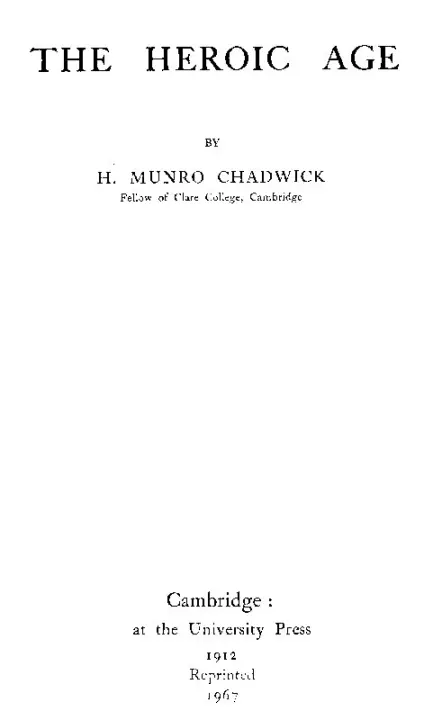
THE CLASSIC COLLECTION · 1912
"The Heroic Age" by H. Munro Chadwick is a historical account written in the early 20th century. The work explores the characteristics and themes of heroic poetry across various cultures, particularly focusing on the Teutonic and Greek traditions. It investigates the oral narratives surrounding notable figures and events within these ancient literary forms, seeking to identify their origins and interconnections. The beginning of the book sets the stage for a comparative study of heroic poetry, emphasizing the recurrent themes and narrative structures found in the epics of different cultures. Specifically, Chadwick introduces the early narrative poetry of the Teutonic peoples, referencing significant works such as "Beowulf," and discusses their thematic concerns and historical context. He emphasizes the importance of understanding these stories within the framework of their own time, hinting at the anthropological implications of their content. This methodological approach offers a foundational basis for further exploration of the influence these heroic tales have had across generations and their significance in the development of cultural identity.
Introduction adapted from the source catalogue; source summaries may be automatically generated.
Free to read · English · 190,164 words · No account needed
MAKE TIME FOR A GOOD BOOK
On by default. Untick to stop anonymous reading totals. Each page counts after 10 seconds in view. How this works.
Anonymous counting is on unless you have switched it off.
It is a great assumption that every local record relating to the heroes of the Trojan War owes its origin, directly or indirectly, to the influence of Homeric poetry; and yet that is what is involved by the hypothesis under discussion. There is no doubt that heroic poetry can influence local tradition in an age given to antiquarian speculation; but where shall we find any parallel for such a result as this? Pausanias (II 16. 5) states that the tombs of Agamemnon and his household were to be seen at Mycenae. It is likely enough that in this case the local belief was derived ultimately from the poems, although it seems to have contained some unorthodox features. But in Pindar, Aeschylus and other early poets we find forms of the story which differ much more widely from the Homeric account. These authorities also give us a good deal of information regarding other members of the family, Pelops, Atreus and Orestes--persons who seem not to have figured prominently in any Homeric poems that we know of. Particularly we should notice that according to Pausanias (III 19. 5) the Spartans also possessed a tomb of Agamemnon (at Amyclai), and that in early times they appear to have claimed him as one of their own kings. To this we have already referred (p. 240). The problem as a whole is surely one which requires considerably more investigation than it has yet received. But I should be much surprised if such investigations, carried out in an impartial spirit, did not bring to light many traces of stories relating to the Heroic Age, which were independent of anything that we may fairly call 'Homeric' poetry.
Perhaps it may be said that we can safely claim a fictitious origin for some of the leading characters without committing ourselves to the view that all of them were sprung from this source. The case of Agamemnon, which we have mentioned above, is scarcely one of the most promising. We will now take what is generally regarded as the most certain case, namely that of Aias[459]. There are two heroes of this name, of whom one is a Locrian, while the other belongs to Salamis. The theory now most usually held is that one of the two--preferably the latter--is a fictitious character, derived from the other. This theory rests on the following arguments: (i) that the two heroes are often found together, (ii) that Salamis is only mentioned in two passages, (iii) that, apart from his brother Teucros, the connections of Aias of Salamis are themselves obviously fictitious. The distinctive characteristic of this Aias is his enormous shield; and this gave birth both to the name of his father Τελαμών ('Strap'), and to that of his son, Εὐρυσάκης ('Broad-shield'). The appropriateness of the latter name is evident enough; but it does not occur in the Homeric poems. The evidence seems to indicate that this person is a genealogical creation of much later times--possibly due to the misunderstanding of an epithet. On the other hand the force of the name Τελαμών does not strike me as particularly obvious. Aias' distinguishing characteristic was not his shield-strap, but the shield itself. Several heroes, Agamemnon, Diomedes and others, are said to have shield-straps; indeed from Il. II 388 f. we may infer that they were commonly, if not generally, used. Moreover the word τελαμών does not necessarily mean 'shield-strap'; we find it used also, in several passages, for 'sword-strap.' Its original meaning appears to have been 'supporter'; and we have no reason for supposing that such a word was inadmissible as a proper name[460]. Again, the argument that Salamis is only mentioned twice loses its force when the general usage of the Iliad is taken into account. Except in three cases--due largely to certain stereotyped formulae--it is not customary to refer to the home or nationality of the Achaean leaders[461]. Even if the genuineness of Il. VII 199 be doubted, there can scarcely be any question that Aias was localised at Salamis by the time when the Homeric poems first obtained general currency in Greece; for the post-Homeric (or non-Homeric) genealogy of the Aiacidai and their connection with Aegina go back probably beyond the seventh century. There remains then only the fact that two friends and colleagues have the same name. That is doubtless a curious coincidence; but not more curious than many such cases which occur in real life. On the whole I cannot help thinking that the readiness with which this theory has been received is due to the prevalent enthusiasm for such hypotheses. When soberly considered the evidence in its favour is of the slightest.
Your reading position is saved on this browser. Take it to another device with a library code. Reading pages adapt to text, rather than matching a printed edition.
BEHIND THE BOOK
This eBook is for the use of anyone anywhere in the United States and most other parts of the world at no cost and with almost no restrictions whatsoever. You may copy it, give it away or re-use it under the terms of the Project Gutenberg License included with this eBook or online at www.gutenberg.org. If you are not located in the United States, you will have to check the laws of the country where you are located before using this eBook. Read the source licence.
The original source file, including credits and licence, is retained by this library. Request an original-format copy at no charge. Please include the book title and Project Gutenberg identifier #48426.
KEEP YOUR CURIOSITY GOING
Cécile Tormay

Moritz Busch
John L. Ransom

Maurice Baring
Frances Wright
Cécile Tormay