THE CLASSIC COLLECTION✦An outlaw’s diary: the CommuneCLASSIC FREE BOOKS
An outlaw’s diary: the Commune
Cécile Tormay
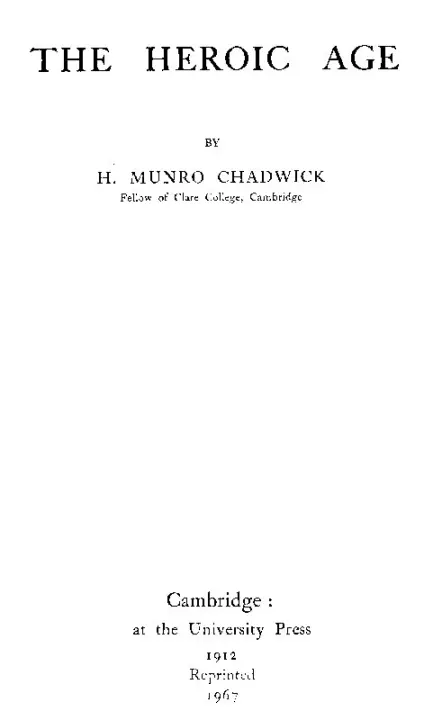
THE CLASSIC COLLECTION · 1912
"The Heroic Age" by H. Munro Chadwick is a historical account written in the early 20th century. The work explores the characteristics and themes of heroic poetry across various cultures, particularly focusing on the Teutonic and Greek traditions. It investigates the oral narratives surrounding notable figures and events within these ancient literary forms, seeking to identify their origins and interconnections. The beginning of the book sets the stage for a comparative study of heroic poetry, emphasizing the recurrent themes and narrative structures found in the epics of different cultures. Specifically, Chadwick introduces the early narrative poetry of the Teutonic peoples, referencing significant works such as "Beowulf," and discusses their thematic concerns and historical context. He emphasizes the importance of understanding these stories within the framework of their own time, hinting at the anthropological implications of their content. This methodological approach offers a foundational basis for further exploration of the influence these heroic tales have had across generations and their significance in the development of cultural identity.
Introduction adapted from the source catalogue; source summaries may be automatically generated.
Free to read · English · 190,164 words · No account needed
MAKE TIME FOR A GOOD BOOK
On by default. Untick to stop anonymous reading totals. Each page counts after 10 seconds in view. How this works.
Anonymous counting is on unless you have switched it off.
[338] Cf. Wilamowitz-Möllendorff, op. cit. p. 75 and (for a criticism) Cauer, Grundfragen², p. 181 ff.
[339] The Shield of Heracles contains a number of clearly Aeolic forms (ἄμμες, ὔμμι, etc.).
[340] Cf. Fick, Die homerische Odyssee (1883), and Die homerische Ilias (1886), where the poems are reconstructed in their original Aeolic form.
[341] E.g. the two texts of Riddle XXXVI (both printed in Sweet's Oldest English Texts, p. 150 f.) and the texts of Caedmon's Hymn from the Moore MS. of Bede's Eccles. History (ib. p. 149) and the Anglo-Saxon version (IV 24). Reference may also be made to the Dream of the Cross and the extracts given in the inscription on the Ruthwell Cross. A portion of the Old Saxon Genesis is printed, together with the Anglo-Saxon version, in Cook and Tinker's Translations from Old English Poetry, p. 184 f.
πέμπε δέ μιν Λυκίηνδε πόρεν δ' ὅ γε σήματα λυγρὰ, γράψας ἐν πίνακι πτυκτῷ θυμοφθόρα πολλὰ, δεῖξαι δ' ἠνώγειν ᾧ πενθερῷ ὄφρ' ἀπόλοιτο.
[343] The analysis of the Odyssey given by Prof. v. Wilamowitz-Möllendorff admittedly postulates a written text (Hom. Untersuch. p. 293). But I cannot assent to the proposition that the Catalogue of Ships in itself must come from a written source. This list scarcely differs in principle from the catalogues of Widsith.
[344] Further indirect evidence, of native origin, is supplied by the word facenstafas (O. Norse feiknstafir) in v. 1018, if the original meaning of this compound was 'harmful runes' (used magically). Cf. also vv. 317, 382, 458, 1753.
[345] It may be added that we really know nothing of the Ionic of Hesiod's time. It is quite uncertain how far it had already developed those characteristics which we find in our texts.
[346] The few exceptional forms such as (τ') οὖλον (Od. XVII 343) may be due to fairly late scribes familiar with (eastern) Ionic texts.
[347] We may note also the absence of the literary Ionic forms κότε,
κῶς, etc.
[348] It is true that we do not know exactly when h- was lost. But before that change took place Η cannot have been used for ē; consequently a wholesale μεταγραμματισμός would be involved (doubtless also affecting the representation of ō), just as in the case of Athens.
[349] Cf. Hoffmann, Griech. Dial. III, p. 549 f.; Fick, Neue
Jahrbücher, I 504 ff.
[350] Cauer, Delectus Inscr. Graec. 83, 84, 91. We may compare also such epic expressions as ευρυχορο, γαιας απο πατριδος, πολυμελο, κλεϝος απθιτον (ib. 54, 83, 445, 202), and, more particularly, an inscription on a bronze discus from Cephallenia (cf. Cook, Class. Review, XIII 77 f.):
Εχσοιδα μ ανεθεκε Διϝος ϙοροιν μεγαλοιο χαλκεον hοι νικασε Κεφαλανας μεγαθυμος
(cf. Hom. Hymn. XXXIII 9; Il. II 631).
Your reading position is saved on this browser. Take it to another device with a library code. Reading pages adapt to text, rather than matching a printed edition.
BEHIND THE BOOK
This eBook is for the use of anyone anywhere in the United States and most other parts of the world at no cost and with almost no restrictions whatsoever. You may copy it, give it away or re-use it under the terms of the Project Gutenberg License included with this eBook or online at www.gutenberg.org. If you are not located in the United States, you will have to check the laws of the country where you are located before using this eBook. Read the source licence.
The original source file, including credits and licence, is retained by this library. Request an original-format copy at no charge. Please include the book title and Project Gutenberg identifier #48426.
KEEP YOUR CURIOSITY GOING
Cécile Tormay

Moritz Busch
John L. Ransom

Maurice Baring
Frances Wright
Cécile Tormay