THE CLASSIC COLLECTION✦An outlaw’s diary: the CommuneCLASSIC FREE BOOKS
An outlaw’s diary: the Commune
Cécile Tormay
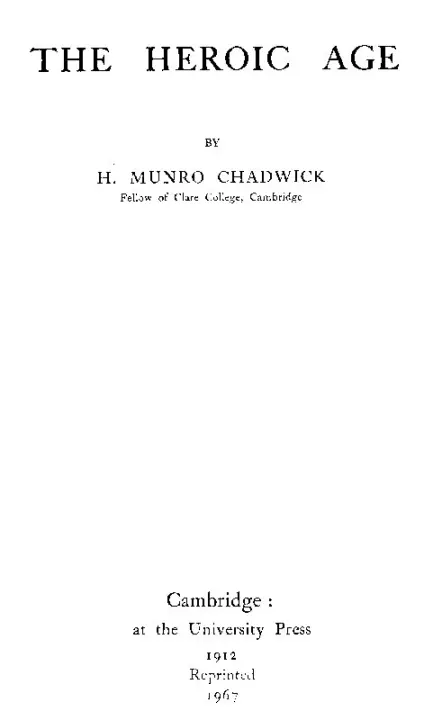
THE CLASSIC COLLECTION · 1912
"The Heroic Age" by H. Munro Chadwick is a historical account written in the early 20th century. The work explores the characteristics and themes of heroic poetry across various cultures, particularly focusing on the Teutonic and Greek traditions. It investigates the oral narratives surrounding notable figures and events within these ancient literary forms, seeking to identify their origins and interconnections. The beginning of the book sets the stage for a comparative study of heroic poetry, emphasizing the recurrent themes and narrative structures found in the epics of different cultures. Specifically, Chadwick introduces the early narrative poetry of the Teutonic peoples, referencing significant works such as "Beowulf," and discusses their thematic concerns and historical context. He emphasizes the importance of understanding these stories within the framework of their own time, hinting at the anthropological implications of their content. This methodological approach offers a foundational basis for further exploration of the influence these heroic tales have had across generations and their significance in the development of cultural identity.
Introduction adapted from the source catalogue; source summaries may be automatically generated.
Free to read · English · 190,164 words · No account needed
MAKE TIME FOR A GOOD BOOK
On by default. Untick to stop anonymous reading totals. Each page counts after 10 seconds in view. How this works.
Anonymous counting is on unless you have switched it off.
[306] Mr Lang (Homer and his Age, p. 265 ff.) has called attention to the fact that in v. 261 ff. Odysseus is represented as wearing a cap of a type which appears to have been in use during the Mycenean age. If it could be shown that the article in question was peculiar to that period, the lateness of the book would certainly be open to serious question.
[307] Bronze is mentioned 279 times in the Iliad and 80 times in the Odyssey. In a large proportion of these cases the reference is to weapons. Cf. Helbig, Das homerische Epos, p. 329 ff.
[308] Iron is mentioned altogether 48 times. In nine cases it is spoken of merely as a substance--a possession or article of trade. To these we may add fifteen more in which the word is used metaphorically as a standard of hardness, etc., and one (Od. IX 393) which refers to the testing of iron in water. Iron tools or implements are mentioned thirteen times, apart from the two references to knives given above. We hear also of iron chains (Od. I 204), the iron axle-tree of a (divine) chariot-wheel (Il. V 723), and the iron door of Tartarus (ib. VIII 15); cf. Cauer, Grundfragen der Homerkritik², p. 281 ff.
[309] Cf. Macalister, Palestine Expl. Fund, Quart. Rep., 1903, p. 199; Lang, Class. Rev. XXII, p. 47.
[310] Cf. Dörpfeld, Troja und Ilion, p. 368.
[311] αὐτὸς γὰρ ἐφέλκεται ἄνδρα σίδηρος. Cf. Burrows, The Discoveries in Crete, p. 214 ff.
[312] Cf. Ridgeway, The Early Age of Greece, p. 294 f. Prof. Ridgeway allows the occasional use of bronze swords, e.g. in the case of Euryalos the Phaeacian (Od. VIII 403-6). But the swords of Paris, Patroclos, Achilles and Odysseus (Il. III 334 f., XVI 135 f., XIX 372 f., Od. X 261 f.) are described in very similar terms (ξίφος ἀργυρόηλον χάλκεον). Further, the tendency of bronze swords to snap off short at the hilt is well illustrated by the case of Lycon in Il. XVI 338 f.
[313] Cf. Lang, Homer and his Age, p. 192 f.
[314] Cf. Reichel, Über homerische Waffen (Abh. d. arch.-epigr. Seminares d. Univ. Wien, Heft XI), p. 79 ff.
[315] Cf. p. 191 and Evans, Journal of the Anthropological Institute,
XXX 213 f.
[316] Cf. Ridgeway, op. cit. pp. 324 f., 475.
[317] This strap seems to have been used for carrying even comparatively small shields down to a much later period. It is not found apparently in the representations of the Shardina, though they have an arm-strap as well as a handle.
[318] The Shardina on the temple of Medinet Habu and the warriors represented on the Stele hold their spears poised in their right hands, precisely at the same angle. But it is not quite clear to me whether a cast or thrust is intended.
[319] φέρων σάκος ἠΰτε πύργον (Il. XII 219, etc.). There is a reference no doubt to the hero's great stature.
Your reading position is saved on this browser. Take it to another device with a library code. Reading pages adapt to text, rather than matching a printed edition.
BEHIND THE BOOK
This eBook is for the use of anyone anywhere in the United States and most other parts of the world at no cost and with almost no restrictions whatsoever. You may copy it, give it away or re-use it under the terms of the Project Gutenberg License included with this eBook or online at www.gutenberg.org. If you are not located in the United States, you will have to check the laws of the country where you are located before using this eBook. Read the source licence.
The original source file, including credits and licence, is retained by this library. Request an original-format copy at no charge. Please include the book title and Project Gutenberg identifier #48426.
KEEP YOUR CURIOSITY GOING
Cécile Tormay

Moritz Busch
John L. Ransom

Maurice Baring
Frances Wright
Cécile Tormay