THE CLASSIC COLLECTION✦The wolves and the lambCLASSIC FREE BOOKS
The wolves and the lamb
J. S. (Joseph Smith) Fletcher
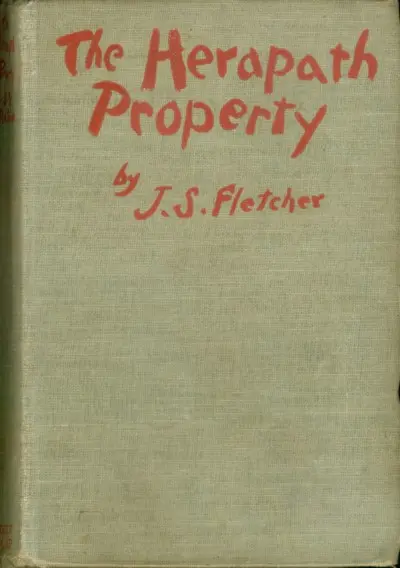
THE CLASSIC COLLECTION · 1921
"The Herapath Property" by J. S. Fletcher is a mystery novel likely written in the early 20th century. The story revolves around Jacob Herapath, a wealthy and particular Member of Parliament who has mysteriously disappeared, which sparks a police investigation filled with intrigue and suspicion. The main characters include Selwood, Herapath's secretary, Peggie Wynne, his devoted niece, and Mr. Tertius, a close associate who seems to hold secrets about Herapath's life and death. The opening of the novel establishes a tense mystery as Selwood is abruptly called to Herapath’s home early in the morning to learn of his employer's unexpected absence. The narrative unfolds through his interactions with the household staff, leading to the discovery that Herapath was last seen returning home after a night at the House of Commons, yet he is unaccounted for, and his room shows suspicious signs. As suspense builds, Selwood discovers that Herapath has indeed been found dead, raising questions of suicide or murder. The juxtaposition of his movements creates a compelling enigma, setting the stage for an investigation into the circumstances surrounding Herapath's untimely death.
Introduction adapted from the source catalogue; source summaries may be automatically generated.
Free to read · English · 73,820 words · No account needed
MAKE TIME FOR A GOOD BOOK
On by default. Untick to stop anonymous reading totals. Each page counts after 10 seconds in view. How this works.
Anonymous counting is on unless you have switched it off.
"Just so. Now these offices are quite apart and distinct from the rest of the building--mark that, inspector! There's no way out of them into the building, nor any way out of the building into them. In fact, the only entrance into these offices is by the front door. Isn't that so, Hancock?"
"That's quite so, sir--only that one door."
"No area entrance or side-door?"
"None, sir--nothing but that."
"And the only tenants in here--these offices--at night are you and your
wife, Hancock?"
"That's all, sir."
"Now, where are your rooms?"
"We've two rooms in the basement, sir--living-room and kitchen--and two rooms on the top floor--a bedroom and a bathroom."
"On the top-floor. How many floors are there?"
"Well, sir, there's the basement--then there's this--then there's two floors that's used by the clerks--then there's ours."
"That's to say there are two floors between your bedroom and this ground
floor?"
"Yes, sir--two."
"Very well. Now, about last night. What time did you and your wife go to
bed?"
"Eleven o'clock, sir--half an hour later than usual."
"You'd previously looked round, I suppose?"
"Been all round, sir--I always look into every room in the place last thing at night--thoroughly."
"Are you and your wife sound sleepers?"
"Yes, sir--both of us. Good sleepers."
"You heard no sound after you got to bed?"
"Nothing, sir--neither of us."
"No recollection of hearing a revolver shot?--not even as if it were a
long way off?"
"No, sir--we never heard anything--nothing unusual, at any rate."
"You heard no sound of doors opening or being shut, nor of any
conveyance coming to the door?"
"No, sir, nothing at all."
"Well, one or two more questions, Hancock. You didn't go into the room after first catching sight of the body? Just so--but you'd notice things, even in a hurried glance. Did you notice any sign of a struggle--overturned chair or anything?"
"No, sir. I did notice that Mr. Herapath's elbow chair, that he always sat in at his desk, was pushed back a bit, and was a bit on one side as it were. That was all."
"And the light--the electric light? Was that on?"
"No, sir."
"Then all you can tell us comes to this--that you never heard anything, and had no notion of what was happening, or had happened, until you came down in the morning?"
"Just so, sir. If I'd known what was going on, or had gone on, I should
have been down at once."
Barthorpe nodded and turned to the coachman.
"Now, Mountain," he said. "We want to hear your story. Be careful about your facts--what you can tell us is probably of the utmost importance."
Your reading position is saved on this browser. Take it to another device with a library code. Reading pages adapt to text, rather than matching a printed edition.
J. S. (Joseph Smith) Fletcher
J. S. (Joseph Smith) Fletcher
J. S. (Joseph Smith) Fletcher
J. S. (Joseph Smith) Fletcher
BEHIND THE BOOK
This eBook is for the use of anyone anywhere in the United States and most other parts of the world at no cost and with almost no restrictions whatsoever. You may copy it, give it away or re-use it under the terms of the Project Gutenberg License included with this eBook or online at www.gutenberg.org. If you are not located in the United States, you will have to check the laws of the country where you are located before using this eBook. Read the source licence.
The original source file, including credits and licence, is retained by this library. Request an original-format copy at no charge. Please include the book title and Project Gutenberg identifier #25388.
KEEP YOUR CURIOSITY GOING
Coulson Kernahan

Maurice Baring
Frances Wright
Cécile Tormay

Frederic Jesup Stimson

W. H. P. (William Henry Pope) Jarvis