THE CLASSIC COLLECTION✦The wolves and the lambCLASSIC FREE BOOKS
The wolves and the lamb
J. S. (Joseph Smith) Fletcher
THE CLASSIC COLLECTION · 1921
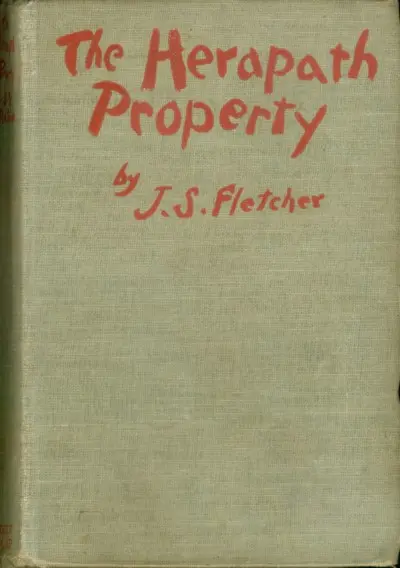
"The Herapath Property" by J. S. Fletcher is a mystery novel likely written in the early 20th century. The story revolves around Jacob Herapath, a wealthy and particular Member of Parliament who has mysteriously disappeared, which sparks a police investigation filled with intrigue and suspicion. The main characters include Selwood, Herapath's secretary, Peggie Wynne, his devoted niece, and Mr. Tertius, a close associate who seems to hold secrets about Herapath's life and death. The opening of the novel establishes a tense mystery as Selwood is abruptly called to Herapath’s home early in the morning to learn of his employer's unexpected absence. The narrative unfolds through his interactions with the household staff, leading to the discovery that Herapath was last seen returning home after a night at the House of Commons, yet he is unaccounted for, and his room shows suspicious signs. As suspense builds, Selwood discovers that Herapath has indeed been found dead, raising questions of suicide or murder. The juxtaposition of his movements creates a compelling enigma, setting the stage for an investigation into the circumstances surrounding Herapath's untimely death.
Introduction adapted from the source catalogue; source summaries may be automatically generated.
Free to read · English · 73,820 words · No account needed
MAKE TIME FOR A GOOD BOOK
On by default. Untick to stop anonymous reading totals. Each page counts after 10 seconds in view. How this works.
Anonymous counting is on unless you have switched it off.
"Because Jacob Herapath, the drawer, was dead before it was presented," replied the manager. "But of course we didn't know that. The cheque, you see, was drawn on November 12th, and it was presented here as soon as ever the doors were opened next morning and before any of us knew of what had happened during the night, and it was accordingly honoured in the usual way."
"The payee, of course, was known?" observed Mr. Halfpenny.
"No, he was not known, but he endorsed the cheque with name and address, and there can be no reason whatever to doubt that it had come to him in the ordinary way of business," replied the manager. "Quite a usual transaction, but, as I say, noteworthy, because, as you know, a cheque is no good after its drawer's demise."
Professor Cox-Raythwaite, who appeared to have fallen into a brown study for a moment, suddenly looked up.
"Now I wonder if we might be permitted to see that cheque--as a curiosity?" he said. "Can we be favoured so far?"
"Oh, certainly, certainly," answered Mr. Playbourne. "No trouble. I'll--ah, here's your information about the other cheque--the self cheque for five thousand."
He took a slip of paper from the clerk who just then entered, and read
it aloud.
"Here you are," he said. "'Mr. Herapath cashed cheque for L5,000 himself, at three o'clock; the money in fifty notes of L100 each, numbered as follows'--you can take this slip, if you like," he continued, handing the paper to Professor Cox-Raythwaite, as the obviously most interested man of his party. "There are the numbers of the notes. Of course, I can't see how all this throws any light on the mystery of Herapath's murder, but perhaps you can. Sellers," he continued, turning to the clerk, and beckoning him to look at the pass-book, "find me the cheque referred to there, and bring it here."
The clerk returned in a few minutes with the cheque, which Mr. Playbourne at once exhibited to his visitors.
"There you are, gentlemen," he said. "Quite a curiosity!--certainly the last cheque ever drawn by our poor friend. There, you see, is his well-known signature with his secret little mark which you wouldn't detect--secret between him and us, eh!--big, bold handwriting, wasn't it? Sad to think that that was--very likely--the last time he used a pen!"
Professor Cox-Raythwaite in his turn handled the cheque. Its face gave him small concern; what he was most interested in was the endorsement on the back. Without saying anything to his companions, he memorized that endorsement, and he was still murmuring it to himself when, a few minutes later, he walked out of the bank.
Your reading position is saved on this browser. Take it to another device with a library code. Reading pages adapt to text, rather than matching a printed edition.
J. S. (Joseph Smith) Fletcher
J. S. (Joseph Smith) Fletcher
J. S. (Joseph Smith) Fletcher
J. S. (Joseph Smith) Fletcher
BEHIND THE BOOK
This eBook is for the use of anyone anywhere in the United States and most other parts of the world at no cost and with almost no restrictions whatsoever. You may copy it, give it away or re-use it under the terms of the Project Gutenberg License included with this eBook or online at www.gutenberg.org. If you are not located in the United States, you will have to check the laws of the country where you are located before using this eBook. Read the source licence.
The original source file, including credits and licence, is retained by this library. Request an original-format copy at no charge. Please include the book title and Project Gutenberg identifier #25388.
KEEP YOUR CURIOSITY GOING
Coulson Kernahan

Maurice Baring
Frances Wright
Cécile Tormay

Frederic Jesup Stimson

W. H. P. (William Henry Pope) Jarvis