
Last letters from the living dead man
David Patterson (Spirit) Hatch
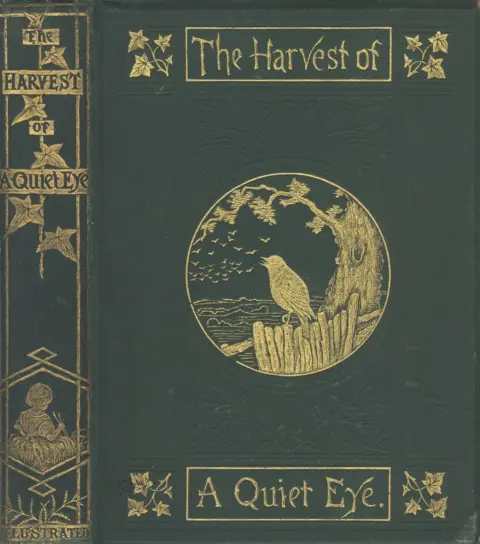
THE CLASSIC COLLECTION · 1867
"The Harvest of a Quiet Eye: Leisure Thoughts for Busy Lives" by John Richard Vernon is a reflective collection of essays written in the late 19th century. This work comprises contemplative meditations aimed at providing spiritual encouragement and moral insights amidst the chaos of daily life. Vernon's writings offer readers a gentle reminder of the beauty in ordinary experiences and the importance of introspection and quietude. The opening of the book serves as a heartfelt preface, where the author expresses his gratitude for the opportunity to share his reflections, which were originally published in periodicals. He muses on the transition from the Old Year to the New, engaging with themes of nostalgia, regret, and anticipation. The narrative tends to evoke a sense of melancholy and joy intertwined, as he cherishes the memories of the past while embracing the promise of a new beginning. The author invites readers to reflect on their spiritual journey, emphasizing the importance of quiet moments in one's life, as he sets the tone for a volume that seeks to comfort and inspire amidst the busyness of the modern world.
Introduction adapted from the source catalogue; source summaries may be automatically generated.
Free to read · English · 64,584 words · No account needed
MAKE TIME FOR A GOOD BOOK
On by default. Untick to stop anonymous reading totals. Each page counts after 10 seconds in view. How this works.
Anonymous counting is on unless you have switched it off.
Well, let me, I say, sit me down on this garden seat, under these “bare ruined choirs,” and hail the one little chorister, whose quiet, modest song ever seems to me to compensate for the absence of all the rest. The dewdrops twinkle about me in the drenched grass, groups of brown toadstools cluster here and there, and wax-white fungi straggle away in a broken line; there is a scarlet gleam of hips in the rose-bushes under the shrubbery, and of mountain-ash higher above them. It is Winter, but nature has not forgotten to stick some sprays of Christmas about her bare pillars, and to twist them in devices about her arches, that run up around me into this groined roof above.
The first thing that we all should muse about, under the bare boughs, would be, I suppose, the leaves that once clad them. Ay, even if, under the full shading foliage, we never thought to give them an upward glance of gratitude, love, and admiration. But they are gone, and what was taken as a matter of course is valued, now that it is missed. There is repining as to the desolation of Winter, and this from those who did not consciously enjoy the Summer.
I cannot reproach myself on this score. I have loved and learnt by heart every shape and development, from the first vivid light of green to the sombre sameness of hue, and then the rich variety that dispersed this;--all this growth, and attainment, and decay have I heedfully and affectionately noted, during the space which separated last year’s bare boughs from these.
“A million emeralds break from the ruby-budded lime.”
Yes, I saw that,--and I watched the juicy foliage deepen, and the thin maize-coloured strips of flower chequer the darkening full mass, and change the picture into
“The lime, a summer home of murmurous wings.”
Then those curved chesnut boughs near the grass--I detected the first fresh crumpled gleam, bursting from the brown sticky buds, until all over the tree, as in an illumination,
“The budding twigs spread out their fan
To catch the breezy air.”
And so I watched them into milky spires, and swarthy green globes, that grew brown, and fell, and burst threefold, lying among the heaped leaves, such a picture, with the white lining and bright nut!
The beech, changing from soft silky fledging of its boughs into hardier green foliage, and afterwards becoming a very mint, each branch
“All overlaid with patines of bright gold”;
and so subsiding into a sparer dress of sienna brown.
“The pillared dusk of sounding sycamores.”
The brave oaks, soon passing out of their Chaucerian attire,
Your reading position is saved on this browser. Take it to another device with a library code. Reading pages adapt to text, rather than matching a printed edition.
BEHIND THE BOOK
This eBook is for the use of anyone anywhere in the United States and most other parts of the world at no cost and with almost no restrictions whatsoever. You may copy it, give it away or re-use it under the terms of the Project Gutenberg License included with this eBook or online at www.gutenberg.org. If you are not located in the United States, you will have to check the laws of the country where you are located before using this eBook. Read the source licence.
The original source file, including credits and licence, is retained by this library. Request an original-format copy at no charge. Please include the book title and Project Gutenberg identifier #54261.
KEEP YOUR CURIOSITY GOING
David Patterson (Spirit) Hatch

David Patterson (Spirit) Hatch

David Patterson (Spirit) Hatch

Ralph Waldo Emerson

Maurice Baring

Oscar Wilde & James McNeill Whistler