THE CLASSIC COLLECTION✦His Second WifeCLASSIC FREE BOOKS
His Second Wife
Ernest Poole
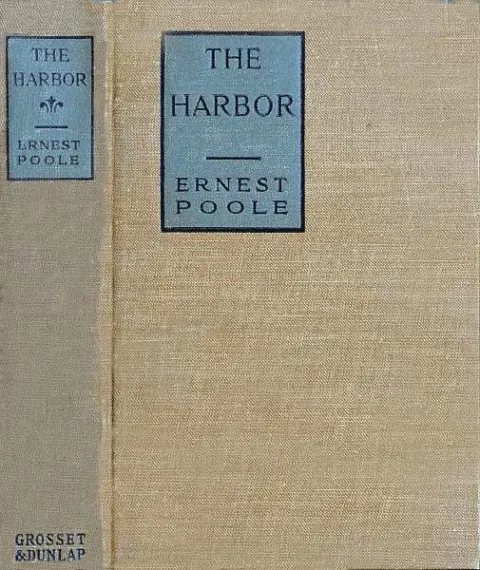
THE CLASSIC COLLECTION · 1915
"The Harbor" by Ernest Poole is a novel written in the early 20th century. The story revolves around a young boy's tumultuous relationship with the harbor of Brooklyn, embodying his innocent perception of adventure and danger, as well as his struggles with a dispassionate father and a devoted mother. Through the eyes of the protagonist, who reflects on his childhood experiences and dreams of exploration, the narrative delves into themes of innocence, adventure, and the dichotomy between safety and the allure of the unknown. At the start of "The Harbor," we are introduced to a seven-year-old boy who grapples with feelings of discomfort and alienation while sitting in church, waiting through a sermon by Henry Ward Beecher. As he reflects on his life, he recalls the strange and foreboding harbor visible from his home — a world filled with mysteries that spark both fear and fascination. The boy's emotions are intertwined with his family dynamics; he feels a lack of connection with his stern father, yet takes comfort in the nurturing presence of his mother. His thoughts wander to rebellious ideals, culminating in a resolve to escape his home and explore the harbor, setting the stage for his journey from childhood innocence to a deeper engagement with the world around him.
Introduction adapted from the source catalogue; source summaries may be automatically generated.
Free to read · English · 123,089 words · No account needed
MAKE TIME FOR A GOOD BOOK
On by default. Untick to stop anonymous reading totals. Each page counts after 10 seconds in view. How this works.
Anonymous counting is on unless you have switched it off.
"I'll see it," he said.
"The working people in full control. No restraints whatever from above."
"There won't be anyone left above. No more gods," he answered.
"Not even one?"
"Is there one?" he asked.
"You're an atheist, aren't you," I said.
"Yes, when I happen to think of it."
"And Sue would likely be the same."
"Isn't she now?" he inquired. I dropped the point and hurried on.
"How about Sue's friends, Joe? In a life like that--always in strikes--she'd have to give them up, wouldn't she?"
"Probably. Some of 'em think they're radicals, but I doubt if they'd come far out of the parlor."
"So her new friends would be either strikers or the people who lead in strikes. Her life would be practically sunk in the mass."
"I hope so."
"You may be in jail at times."
"Quite probably."
"Sue too?"
"Possibly."
I caught the look in my father's face and knew that I had but a few
moments more.
"Do you want to marry her, Joe?" I asked.
"Yes, I'll go down to City Hall--if a large fat Tammany alderman can
make our love any cleaner."
"You mean you don't believe in marriage."
"Not especially," he said.
"And so if either gets sick of the other he just leaves without any
fuss."
"Naturally."
There was a pause. And then Joe spoke again.
"You're a better interviewer than I thought you were," he said. "You've made the picture quite complete--as far as you can see it. Of course you've left all the real stuff out----"
"What is the real stuff, as you call it, young man?" My father's voice had a deadly ring. Joe turned and looked at him as before.
"You couldn't understand," he said.
"I think I understand enough." Dad rose abruptly and turned to Sue. "Sue," he said. "Shall I ask your anarchist friend to go?"
I could feel Sue gather herself. She was white.
"I'll have to go with him," she managed to say. A slight spasm shot over our father's face. For a moment there was silence.
"You've heard all he said of this life of his?"
"Yes."
"And what he wants and expects you to do?"
"I heard it."
"And just how he wants you to live--with nothing you've been used to--nothing? No money but what a few drunken stokers throw your way, no decent ideals, no religion, no home?"
Again a pause.
"I want to go with him," she brought out at last.
Dad turned sharply and left the room.
I heard a deep breath behind me. It came from Joe Kramer, whose face was
set in a frown of pain.
Your reading position is saved on this browser. Take it to another device with a library code. Reading pages adapt to text, rather than matching a printed edition.
BEHIND THE BOOK
This eBook is for the use of anyone anywhere in the United States and most other parts of the world at no cost and with almost no restrictions whatsoever. You may copy it, give it away or re-use it under the terms of the Project Gutenberg License included with this eBook or online at www.gutenberg.org. If you are not located in the United States, you will have to check the laws of the country where you are located before using this eBook. Read the source licence.
The original source file, including credits and licence, is retained by this library. Request an original-format copy at no charge. Please include the book title and Project Gutenberg identifier #29932.
KEEP YOUR CURIOSITY GOING
Coulson Kernahan

Maurice Baring
Frances Wright
Cécile Tormay

Frederic Jesup Stimson

W. H. P. (William Henry Pope) Jarvis