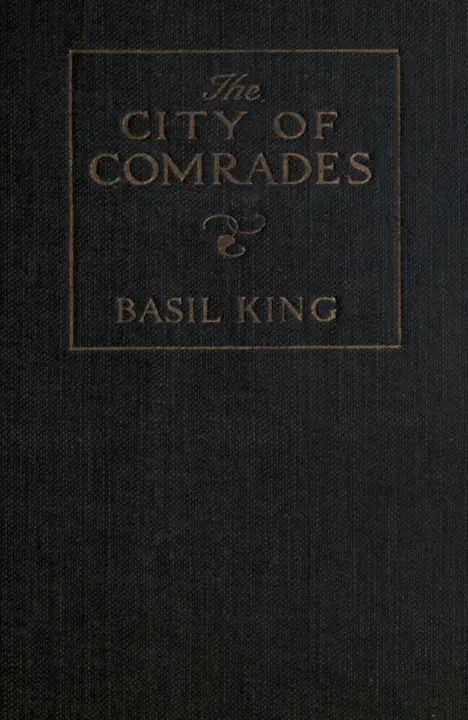
The City of Comrades
Basil King
THE CLASSIC COLLECTION · 1923
"The Happy Isles" by Basil King is a novel written in the early 20th century. The story begins with a focus on a young boy who, at just eight months old, has experienced a life filled with comfort, joy, and love from his caregivers. As the narrative unfolds, it explores the complexities of childhood and the stark contrast between joy and suffering as the boy becomes embroiled in a harrowing life filled with care and neglect. At the start of the novel, the reader is introduced to a vibrant nursery world through the eyes of an eight-month-old baby, who perceives his surroundings with wonder and curiosity, fully unaware of the challenges that life will soon bring. Shifting perspective, the narrative also delves into the lives of his caregivers, including Miss Nash, a devoted nursemaid who struggles with her emotions and duties. Soon, the idyllic life of the boy is abruptly changed by a series of incidents that lead to profound transformations in his life. The opening establishes a strong emotional foundation that hints at the trials and tribulations that will shape the boy’s journey, making it a compelling start for readers interested in stories about resilience and the complexities of human relationships.
Introduction adapted from the source catalogue; source summaries may be automatically generated.
Free to read · English · 126,001 words · No account needed
MAKE TIME FOR A GOOD BOOK
On by default. Untick to stop anonymous reading totals. Each page counts after 10 seconds in view. How this works.
Anonymous counting is on unless you have switched it off.
To Guy the situation was as droll as it was to his two friends. An old fellow trapped in his own shop! He was a Dago, Spit thought, which made the situation funnier. They laughed till, wearied with laughter, they threw themselves into armchairs, and lit their cigarettes.
Tom, who had laughed a little not at their joke but at them, felt obliged, in his own phrase, to butt in. He waited till a few puffs of tobacco had soothed them.
"Say, boys, don't you think the fun's gone far enough?"
The two guests turned and stared as if he had been a talking piece of furniture. Tad took his cigarette from his lips.
"What the hell business is it of yours?"
Tom kept his seat on the arm of the chair, speaking peaceably. "I suppose it isn't my business--except for the old man."
"What have you got to do with him? Is he your father?"
"He's probably somebody's father, and somebody's husband. You can't
leave him there all night."
Spit challenged this. "Why can't we?"
"Because you can't. Fellows like you don't do that sort of thing."
It looked as if Tad Whitelaw had some special animosity against him, when he sprang from his chair to say insolently, "And fellows like you don't hang round where they're not wanted."
"Oh, Tom didn't mean anything--" Guy began to interpose.
"Then let him keep his mouth shut, or--" he nodded toward the door--"or
get out."
Tom kept his temper, waiting till Tad dropped back into his chair again. "You see, it's this way. The old chap has a home, and if he doesn't come back to it in the course of, let us say, half an hour his family'll get scared. If they hunt him up at the shop, and find he's been locked in, they'll make a row at the police station just across the street. If the police get in on the business they're sure to find out who did it."
"Well, it won't be you, will it?" Tad sneered again.
"No, it won't be me, but even you don't want to be...."
Tad turned languidly to Guy. "Say, Guy! Awful pity isn't it about little Jennie Halligan! Cutest little dancer in the show, and she's fallen and broken her leg."
Tom got up, walked quietly to the table, picked up the key, and at the same even pace was making for the door, when Tad sprang in front of him.
"Damn you! Where do you think you're going?"
"I'm going to let the old fellow out."
"Drop that key."
"Get out of my way."
"Like hell I'll get out of your way."
Your reading position is saved on this browser. Take it to another device with a library code. Reading pages adapt to text, rather than matching a printed edition.
BEHIND THE BOOK
This eBook is for the use of anyone anywhere in the United States and most other parts of the world at no cost and with almost no restrictions whatsoever. You may copy it, give it away or re-use it under the terms of the Project Gutenberg License included with this eBook or online at www.gutenberg.org. If you are not located in the United States, you will have to check the laws of the country where you are located before using this eBook. Read the source licence.
The original source file, including credits and licence, is retained by this library. Request an original-format copy at no charge. Please include the book title and Project Gutenberg identifier #61344.
KEEP YOUR CURIOSITY GOING
Coulson Kernahan

Maurice Baring
Frances Wright
Cécile Tormay

Frederic Jesup Stimson

W. H. P. (William Henry Pope) Jarvis