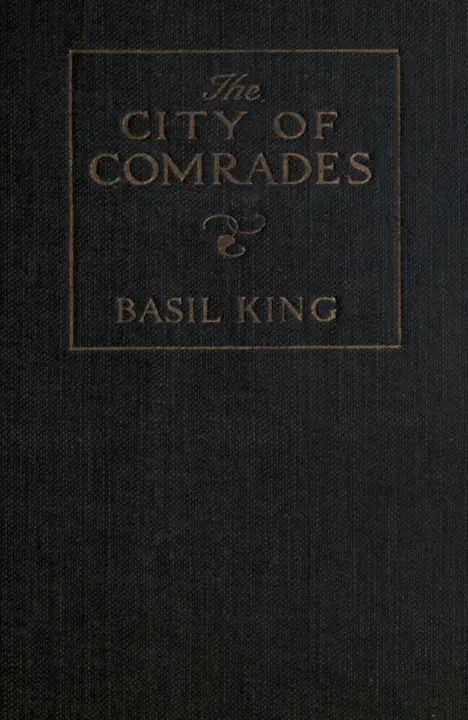
The City of Comrades
Basil King
THE CLASSIC COLLECTION · 1923
"The Happy Isles" by Basil King is a novel written in the early 20th century. The story begins with a focus on a young boy who, at just eight months old, has experienced a life filled with comfort, joy, and love from his caregivers. As the narrative unfolds, it explores the complexities of childhood and the stark contrast between joy and suffering as the boy becomes embroiled in a harrowing life filled with care and neglect. At the start of the novel, the reader is introduced to a vibrant nursery world through the eyes of an eight-month-old baby, who perceives his surroundings with wonder and curiosity, fully unaware of the challenges that life will soon bring. Shifting perspective, the narrative also delves into the lives of his caregivers, including Miss Nash, a devoted nursemaid who struggles with her emotions and duties. Soon, the idyllic life of the boy is abruptly changed by a series of incidents that lead to profound transformations in his life. The opening establishes a strong emotional foundation that hints at the trials and tribulations that will shape the boy’s journey, making it a compelling start for readers interested in stories about resilience and the complexities of human relationships.
Introduction adapted from the source catalogue; source summaries may be automatically generated.
Free to read · English · 126,001 words · No account needed
MAKE TIME FOR A GOOD BOOK
On by default. Untick to stop anonymous reading totals. Each page counts after 10 seconds in view. How this works.
Anonymous counting is on unless you have switched it off.
"Rotten luck!" the fat boy complained. "Got to trail a tutor along too, so that I shan't fall down on the Harvard exam when it comes. Wish I was you."
"If you were Mr. Whitelaw, Guy," his sister reminded him, "you'd find something else to worry you. We all have our troubles, haven't we, Mr. Whitelaw?"
"She's got nothing to worry her," the brother protested. "If she was me, with mother scared all the time that I'll be too hot or too cold or too tired or too hungry, or that some damn thing or other'll make me sick...."
"All the same," Tom broke in, "it's something to have a mother to make
a fuss."
The girl looked sympathetic. "You haven't, have you?"
"Oh, I get along."
"Guy says you live with a guardian."
"You may call him a guardian if you like, but the word is too big. You only have a guardian when you've something to guard, and I haven't anything."
"Yes, but how did you ever ...?"
Once more Tom said to himself, "It's the way she looks at you." He knew what she was trying to ask him, and in order to be open and aboveboard, he gave her the few main facts of his life. He did it briefly, hurriedly, throwing emphasis only on the point that, to keep him from becoming a State ward the second time, his stevedore friend had brought him to Boston and sent him to school.
"He must be an awfully good man!"
He was going to tell her that he was when the brother gave the talk
another twist.
"What are you going to do in your holidays?"
"Work, if I can find a job."
"What kind of job?"
He explained that for the last two summers he had worked round the Quincy and Faneuil Hall markets, but that he had outgrown them. A two-fisted, he-man's job was what he would look for now, and had no doubt that he would get it.
"After you've left Harvard what are you going to be?"
"Banking's what I'd like best, but most likely I'll have to make it barbering. What are you going to be yourself?"
"Oh, I've got to be a corporation lawyer. My luck! Just because dad'll have the business to take me into."
"But what would you like better?"
The piggy face broke into one of its captivating grins. "Hanged if I know, unless it'd be an orphan and an only child."
The meeting was important because of what it led to. A few days later Tom heard the wheezy girlish voice calling behind him in the street: "Tom! Tom!"
Your reading position is saved on this browser. Take it to another device with a library code. Reading pages adapt to text, rather than matching a printed edition.
BEHIND THE BOOK
This eBook is for the use of anyone anywhere in the United States and most other parts of the world at no cost and with almost no restrictions whatsoever. You may copy it, give it away or re-use it under the terms of the Project Gutenberg License included with this eBook or online at www.gutenberg.org. If you are not located in the United States, you will have to check the laws of the country where you are located before using this eBook. Read the source licence.
The original source file, including credits and licence, is retained by this library. Request an original-format copy at no charge. Please include the book title and Project Gutenberg identifier #61344.
KEEP YOUR CURIOSITY GOING
Coulson Kernahan

Maurice Baring
Frances Wright
Cécile Tormay

Frederic Jesup Stimson

W. H. P. (William Henry Pope) Jarvis