
East of the sun and west of the moon
Theodore Roosevelt & Kermit Roosevelt
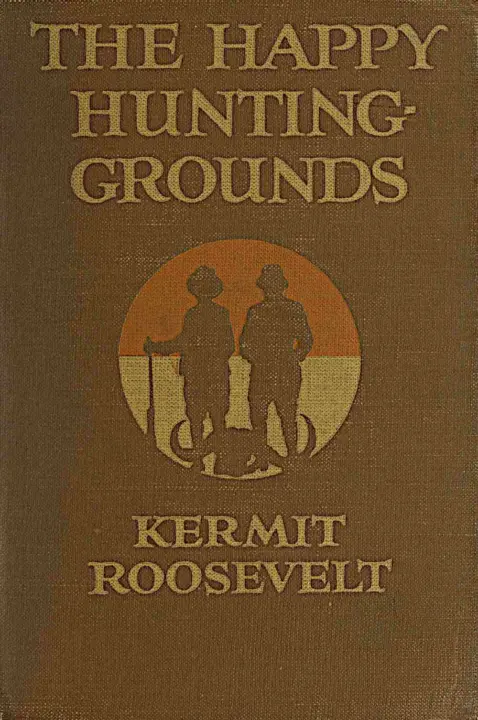
THE CLASSIC COLLECTION · 1912
"The Happy Hunting-Grounds" by Kermit Roosevelt is a collection of hunting autobiographies written in the early 20th century. The author shares his exceptional experiences of hunting expeditions, reflecting on both the adventures and challenges he faced in the wild. The narrative features various hunts across diverse locations such as Africa and the American deserts, portraying not only the thrill of the hunt but also insights into nature and personal reflections. The opening of the book sets the stage by discussing the impact of wilderness life on individuals, highlighting the changes in character that emerge when faced with discomfort and survival challenges. Roosevelt introduces his father as a passionate huntsman, recalling formative camping experiences that instilled in him a deep love for outdoor adventures. The chapter also emphasizes lessons learned about sharing and camaraderie among hunting companions, laying a foundation for the rich tales of expeditions that follow. Through engaging anecdotes, readers are invited into a world where the bond between man and nature is vividly explored.
Introduction adapted from the source catalogue; source summaries may be automatically generated.
Free to read · English · 36,032 words · No account needed
MAKE TIME FOR A GOOD BOOK
On by default. Untick to stop anonymous reading totals. Each page counts after 10 seconds in view. How this works.
Anonymous counting is on unless you have switched it off.
You will oblige me by complying with my request for contradiction. I assure you that I know nothing of the work or works in question--and have the honour to be (as the correspondents to magazines say) “your constant reader” and very
obedt
humble Servt,
BYRON.
To the editor of Galignani’s Messenger. Etc., etc., etc. Venice,
April 27, 1819.
Curiously enough, the book itself had been published by Galignani in 1828. The cost of our total purchases, a goodly heap, amounted to but five dollars.
The balance in quantity if not in quality in old books is held in Buenos Ayres by three brothers named Palumbo--Italians. The eldest is a surly old man who must be treated with severity from the very beginning. How he manages to support himself we do not know, for whenever we were in his store we were sure to hear him assail some customer most abusively. In a small subsidiary store of his, among a heap of old pamphlets, we came upon the original folios of Humboldt’s account of the fauna and flora of South America. Upon asking the price, the man said thirty-five apiece--we thought he meant pesos, and our surprise was genuine when we found he meant centavos--about fifteen cents. From him we got the first edition of Kendall’s Santa Fé Expedition. One of his brothers was very pleasant and probably, in consequence, the most prosperous of the three. The third was reputed crazy, and certainly acted so, but after an initial encounter we became friends and got on famously. All three had a very fair idea of the value of Argentine books, but knew little or nothing about English.
Another dealer who has probably a better stock than any of the Palumbos is a man named Real y Taylor. His grandmother was English, and his father spent his life dealing in books. At his death the store was closed and the son started speculating in land with the money his father had left him. Prices soared and he bought, but when the crash came he was caught with many others. Bethinking himself of his father’s books, he took them out of storage and opened a small booth. The stock was large and a good part of it has not yet been unpacked. Taylor has only a superficial knowledge of what he deals in. He shears folios, strips off original boards and old leathers to bind in new pasteboard, and raises the price five or ten dollars after the process. In this he is no different from the rest, for after a fairly comprehensive experience in Buenos Ayres we may give it as our opinion that there is not a single dealer who knows the “rules” as they are observed by scores of dealers in America and England. Taylor had only one idea, and that was that if any one were interested in a book, that book must be of great value; he would name a ridiculous price, and it was a question of weeks and months before he would reduce it to anything within the bounds of reason. We never really got very much from him, the best things being several old French books of early voyages to South America and a first edition of Anson’s Voyage Around the World. Just before we left he decided to auction off his stock, putting up five hundred lots a month. The first auction lasted three nights. The catalogue was amusing, giving a description of each book in bombastic fashion--all were “unique in interest,” and about every third was the “only copy extant outside the museums.” He had put base prices on most, and for the rest had arranged with cappers. The attendance was very small and nearly everything was bid in. It was curious to see how to the last he held that any book that any one was interested in must be of unusual worth. There was put up a French translation of Azara’s Quadrupeds of Paraguay. The introduction was by Cuvier, but it was not of great interest to us, for a friend had given us the valuable original Spanish edition. Taylor had asked fifteen dollars, which we had regarded as out of the question; he then took off the original binding, cut and colored the pages, and rebound it, asking twenty dollars. At the auction we thought we would get it, if it went for very little; but when we bid, Taylor got up and told the auctioneer to say that as it was a work of unique value he had put as base price fifteen dollars each for the two volumes. The auction was a failure, and as it had been widely and expensively advertised, the loss must have been considerable.
Your reading position is saved on this browser. Take it to another device with a library code. Reading pages adapt to text, rather than matching a printed edition.
Theodore Roosevelt & Kermit Roosevelt
BEHIND THE BOOK
This eBook is for the use of anyone anywhere in the United States and most other parts of the world at no cost and with almost no restrictions whatsoever. You may copy it, give it away or re-use it under the terms of the Project Gutenberg License included with this eBook or online at www.gutenberg.org. If you are not located in the United States, you will have to check the laws of the country where you are located before using this eBook. Read the source licence.
The original source file, including credits and licence, is retained by this library. Request an original-format copy at no charge. Please include the book title and Project Gutenberg identifier #64079.
KEEP YOUR CURIOSITY GOING

Fanny Van de Grift Stevenson

Isabel Anderson
Charles King
Henry Vizetelly
Randall Parrish
James De Mille