THE CLASSIC COLLECTION✦The strange transfiguration of Hannah StubbsCLASSIC FREE BOOKS
The strange transfiguration of Hannah Stubbs
Florence Marryat
THE CLASSIC COLLECTION · 1894
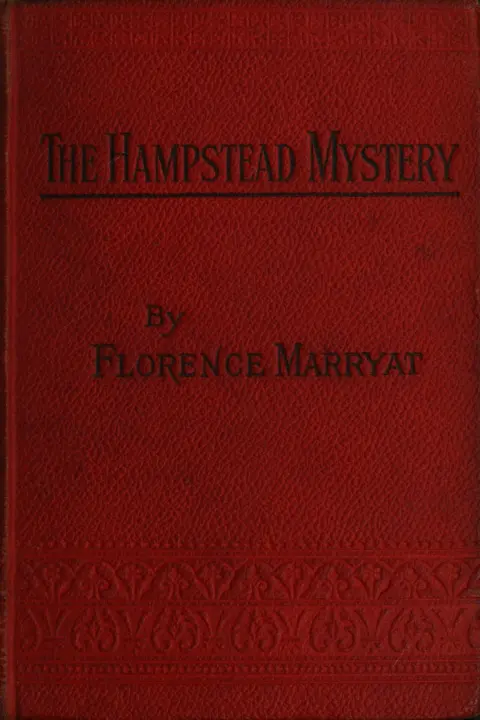
"The Hampstead Mystery" by Florence Marryat is a novel written in the late 19th century. The story centers around Hannah Hindes as she navigates the tumultuous changes in her husband Henry's behavior, shaped by a tragic incident and his growing dependence on morphia. With themes of family, mental health, and the intricacies of marital duty, the narrative explores both the personal struggles of the characters and the societal expectations of the time." "The opening of the novel introduces us to Hannah Hindes, who is grappling with her husband Henry's deteriorating mental state, exacerbated by his increasing use of morphia for his neuralgia. Captain Arthur Hindes, Henry's brother, expresses concern over his sibling's health, hinting at the underlying issues at play. As they converse, it's revealed that Henry's behavior has changed dramatically since the tragic death of a family friend, leading to a growing tension within his family, particularly as Hannah tries to manage his irritability and protect their children's wellbeing. The opening establishes a poignant scenario, as Hannah's fear for her husband's wellbeing collides with the harsh reality of his condition and their family’s disarray."
Introduction adapted from the source catalogue; source summaries may be automatically generated.
Free to read · English · 44,676 words · No account needed
MAKE TIME FOR A GOOD BOOK
On by default. Untick to stop anonymous reading totals. Each page counts after 10 seconds in view. How this works.
Anonymous counting is on unless you have switched it off.
As she spoke, and lifted the child in her arms, a shadow darkened the threshold of the open door, and, glancing up, she encountered the eyes of Frederick Walcheren fixed upon her. Rhoda rose in the utmost confusion. She did not know what to say to him. She was as timid of being caught with the child in her arms as if Frederick had never heard of its existence. The first words she stammered were,--
‘You! Oh, why have you come down here?’
‘Expressly to see you, Rhoda,’ he replied, ‘seeing that I know no one else in Luton. And so this is the little chap, is it? He is a sturdy fellow. And his eyes and hair are very dark, Rhoda.’
‘Yes,’ she answered in a low voice.
She could not understand why, under their present circumstances, Frederick should care to allude to the likeness between her child and himself. It jarred upon her. She put the baby down on the ground and began plaiting the straw again.
‘Mayn’t I come in? Are you not going to ask me to sit down? I am rather tired,’ said Frederick Walcheren, ‘and I have a good many things to talk to you about.’
‘Oh! yes, forgive me,’ she replied, as she rose and set a chair for her visitor at the opposite side of the little room.
‘Are you very much surprised to see me here, Rhoda?’ he commenced.
‘Yes! very! It is so unexpected. I don’t know what mother will say,’ replied the girl, in an uncertain tone.
‘I hope I may be able to relieve her mind. But you haven’t looked at
me, Rhoda.’
She raised her eyes then, and gave a little exclamation of surprise.
‘Oh! what is changed in you? What have you done to yourself? You look
so different!’
‘Cannot you see? I am in plain clothes.’
She recognised the alteration then. He wore a rough suit of grey tweed, such as gentlemen sport in the country, with a coloured tie, and a round hat.
‘You have discarded your cassock! What does this mean? Have you--can you really have left the Church?’
‘I have indeed, Rhoda! Whatever my friends or enemies may think of my determination, I have resolved to follow the dictates of my own conscience, and be accountable to no one for my actions except God.’
The soft rose colour mounted to the girl’s cheeks with pleasure.
‘I am so glad,’ she whispered.
‘So you ought to be, for it is all your doing. Ever since I saw you last, I have been unable to get those words out of my ears:
Your reading position is saved on this browser. Take it to another device with a library code. Reading pages adapt to text, rather than matching a printed edition.
Florence Marryat
Florence Marryat
Florence Marryat
Florence Marryat
BEHIND THE BOOK
This eBook is for the use of anyone anywhere in the United States and most other parts of the world at no cost and with almost no restrictions whatsoever. You may copy it, give it away or re-use it under the terms of the Project Gutenberg License included with this eBook or online at www.gutenberg.org. If you are not located in the United States, you will have to check the laws of the country where you are located before using this eBook. Read the source licence.
The original source file, including credits and licence, is retained by this library. Request an original-format copy at no charge. Please include the book title and Project Gutenberg identifier #71035.
KEEP YOUR CURIOSITY GOING
Coulson Kernahan

Maurice Baring
Frances Wright
Cécile Tormay

Frederic Jesup Stimson

W. H. P. (William Henry Pope) Jarvis