THE CLASSIC COLLECTION✦The strange transfiguration of Hannah StubbsCLASSIC FREE BOOKS
The strange transfiguration of Hannah Stubbs
Florence Marryat
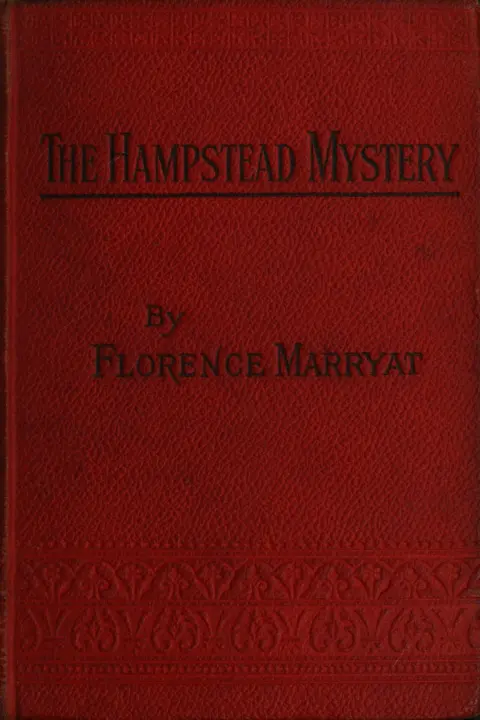
THE CLASSIC COLLECTION · 1894
"The Hampstead Mystery" by Florence Marryat is a novel written in the late 19th century. The book delves into the complex relationships and societal expectations surrounding Jenny Crampton, a spirited and beautiful young woman, as her father, Mr. Crampton, vehemently opposes her budding romance with Frederick Walcheren, a man of disreputable habits and Catholic faith. The narrative explores themes of love, parental control, and individual desire set against the backdrop of a rigid social structure. At the start of the novel, we are introduced to Mr. Crampton's authoritarian stance regarding his daughter Jenny's interactions with Mr. Walcheren. A heated discussion ensues between Mr. Crampton and his family regarding Jenny's alleged romantic interest in Walcheren. Despite her father's strict prohibitions, Jenny's affection for Walcheren remains steadfast, leading her to contemplate elopement. As tensions rise, the dynamics between love and duty become palpable, foreshadowing the conflicts that will challenge the characters throughout the unfolding drama.
Introduction adapted from the source catalogue; source summaries may be automatically generated.
Free to read · English · 40,331 words · No account needed
MAKE TIME FOR A GOOD BOOK
On by default. Untick to stop anonymous reading totals. Each page counts after 10 seconds in view. How this works.
Anonymous counting is on unless you have switched it off.
‘You are not here to tell us when the tide runs out, but to say how you discovered the body of the deceased Jane Emily Walcheren,’ said the coroner, consulting his papers.
‘Yes, yer worship. Well! as I and my mate here was a-haulin’ up the boats, I says to him, I says, “Bob,” I says, “what be that ’ere bundle of white,” I says, “under the cliff?” “Blowed if I know,” he says, “it looks like a sheet as has blowed over in drying,” he says.’
‘You are not here to tell the jury what your mate thought the body looked like. You are to tell us how you found it.’
‘Yes, sir. Well, sir, we thought it was a sheet, you see, but when we went to pick it up, we see it was a young woman. So we lifted her atween us and carries her to this ’ere ’ouse, and then my mate he fetches Dr M‘Coll. And that’s all, sir!’
‘Very good! Now, tell us, please, when you found the body was there no
one about?’
‘Not a soul as we see, my lord--I mean, yer worship--the beach was
empty from hend to hend.’
‘And the cliffs?’
‘Didn’t see a soul on the cliffs neither, yer worship.’
‘You met no one on your way here? You are sure!’
‘Quite sure, your honour! ’Twould be all over the town if we had!’
‘Very well! You can sit down. Call Dr M‘Coll!’
The doctor, having been sworn, deposed that he had been called to the ‘Bottle and Spurs’ at about six o’clock on Saturday night, to see the deceased. She was then quite dead--had been dead for two or three hours. There was a large bruise on the temple caused by her striking against the rocks in her fall. That was of itself sufficient to have caused death, but the spine was broken and the neck. The body was also much bruised. There was no question but that the deceased had met her death by falling over the cliffs.
‘Now, Dr M‘Coll, I should like to put a few questions to you, if you please,’ said Mr Procter, looking his very sharpest. ‘Is it your opinion that the deceased must inevitably have fallen over the cliffs of her own accord? Might she not have been blown over, or pushed over, or thrown herself over by design?’
‘Certainly she might! It is impossible to say how she came to fall over, but she did fall over--that is beyond a question.’
‘Ah!’ said the coroner, with self-satisfaction, as if he had discovered a very knotty point. ‘Then you consider death was due--’
Your reading position is saved on this browser. Take it to another device with a library code. Reading pages adapt to text, rather than matching a printed edition.
Florence Marryat
Florence Marryat
Florence Marryat
Florence Marryat
BEHIND THE BOOK
This eBook is for the use of anyone anywhere in the United States and most other parts of the world at no cost and with almost no restrictions whatsoever. You may copy it, give it away or re-use it under the terms of the Project Gutenberg License included with this eBook or online at www.gutenberg.org. If you are not located in the United States, you will have to check the laws of the country where you are located before using this eBook. Read the source licence.
The original source file, including credits and licence, is retained by this library. Request an original-format copy at no charge. Please include the book title and Project Gutenberg identifier #69286.
KEEP YOUR CURIOSITY GOING
Coulson Kernahan

Maurice Baring
Frances Wright
Cécile Tormay

Frederic Jesup Stimson

W. H. P. (William Henry Pope) Jarvis