THE CLASSIC COLLECTION✦The strange transfiguration of Hannah StubbsCLASSIC FREE BOOKS
The strange transfiguration of Hannah Stubbs
Florence Marryat
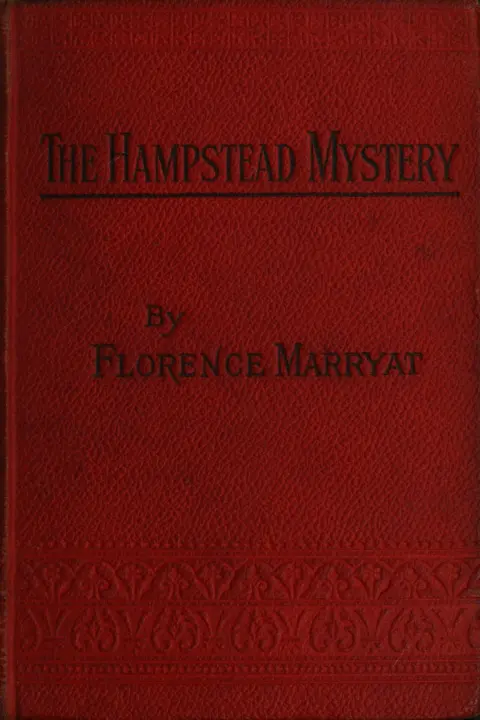
THE CLASSIC COLLECTION · 1894
"The Hampstead Mystery" by Florence Marryat is a novel written in the late 19th century. The book delves into the complex relationships and societal expectations surrounding Jenny Crampton, a spirited and beautiful young woman, as her father, Mr. Crampton, vehemently opposes her budding romance with Frederick Walcheren, a man of disreputable habits and Catholic faith. The narrative explores themes of love, parental control, and individual desire set against the backdrop of a rigid social structure. At the start of the novel, we are introduced to Mr. Crampton's authoritarian stance regarding his daughter Jenny's interactions with Mr. Walcheren. A heated discussion ensues between Mr. Crampton and his family regarding Jenny's alleged romantic interest in Walcheren. Despite her father's strict prohibitions, Jenny's affection for Walcheren remains steadfast, leading her to contemplate elopement. As tensions rise, the dynamics between love and duty become palpable, foreshadowing the conflicts that will challenge the characters throughout the unfolding drama.
Introduction adapted from the source catalogue; source summaries may be automatically generated.
Free to read · English · 40,331 words · No account needed
MAKE TIME FOR A GOOD BOOK
On by default. Untick to stop anonymous reading totals. Each page counts after 10 seconds in view. How this works.
Anonymous counting is on unless you have switched it off.
‘In that case,’ replied Mr Hindes, smiling, ‘I’m afraid Mr Frederick Walcheren must be one of the lost sheep, for, from all I hear, he does not trouble the church, nor the director of his conscience much. But I’ll do my level best to bring him to hear reason in this instance. Au revoir.’
And, with a nod and a smile, he was gone.
‘He’s a true friend,’ thought Mr Crampton to himself, as he took up the Times, and tried to possess his soul in patience until the appearance of his daughter.
Meanwhile, Mrs Crampton and Miss Bostock were making their way, timidly, towards the young lady’s bedroom. In the ante-chamber they encountered her maid, employed in sewing.
‘Is Miss Crampton awake yet, Ellen?’ demanded her mother.
‘Oh! no, ma’am, I haven’t heard a sound of her, and she begged me particularly not to call her till she rung. She was terrible tired, she said, and didn’t wish to be disturbed.’
‘I’m sorry, Ellen, but I’m afraid I must wake her now. It’s past eleven, and her papa particularly wishes to see her before he leaves for the city,’ replied Mrs Crampton.
‘Oh, dear! I’m sure I don’t know what she’ll say,’ remarked the maid, as she re-applied herself to her work, and looked as if she was glad the task had not fallen to her.
The two ladies entered the adjoining bedroom on tip-toe, and as if they feared the result of the least noise. It was one of the most perfectly-arranged chambers a young girl could desire, and it was pre-evident that its furnishings had been selected with the greatest care, and for someone who was much loved and treasured. The walls and chintzes were all of palest pink, the woodwork of white enamel, and the hangings of lace. On the walls were hung a selection of photographs, chiefly of dogs and horses, for Miss Crampton’s tastes ran in that line, and the low, walnut-wood bookcase was filled with the best authors. Everywhere were signs of profusion and luxury, for the Cramptons were rich and spared no expense for this one beloved child, who made all the joy of their lives. The toilet table was covered with silver and cut glass, and on the mantelpiece stood a handsome clock and candelabras of Sevres china; but the fairest sight in all the room was Jenny Crampton herself, as she lay, flushed, dishevelled and palpitating on her bed, one of the most beautiful specimens of work that ever proceeded from the Creator’s hand. It was difficult to believe that the two plain women who stood gazing at her from the foot of the bed, could be her nearest blood relations. The questions of hereditary resemblances and non-resemblances are amongst the most anomalous in Nature. Whence did Jenny Crampton inherit her perfect features and colouring? Her father was a type of the average middle-class Englishman. He had a broad-set, muscular figure, with legs too short for his size, a florid complexion, with thick bushy eyebrows, a heavy nose, and a long upper lip. His small grey eyes were shrewd, but honest and benevolent-looking, and his hands and feet were large and coarse. His wife and her sister might have stood, with a little caricaturing, for the Frenchman’s notion of an ‘English Mees.’
Your reading position is saved on this browser. Take it to another device with a library code. Reading pages adapt to text, rather than matching a printed edition.
Florence Marryat
Florence Marryat
Florence Marryat
Florence Marryat
BEHIND THE BOOK
This eBook is for the use of anyone anywhere in the United States and most other parts of the world at no cost and with almost no restrictions whatsoever. You may copy it, give it away or re-use it under the terms of the Project Gutenberg License included with this eBook or online at www.gutenberg.org. If you are not located in the United States, you will have to check the laws of the country where you are located before using this eBook. Read the source licence.
The original source file, including credits and licence, is retained by this library. Request an original-format copy at no charge. Please include the book title and Project Gutenberg identifier #69286.
KEEP YOUR CURIOSITY GOING
Coulson Kernahan

Maurice Baring
Frances Wright
Cécile Tormay

Frederic Jesup Stimson

W. H. P. (William Henry Pope) Jarvis