
The Writing of News A Handbook with Chapters on Newspaper Correspondence and Copy Reading
Charles G. (Charles Griffith) Ross
THE CLASSIC COLLECTION · 1905
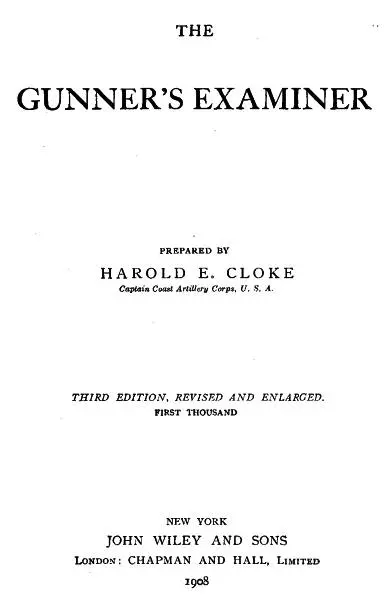
"The Gunner's Examiner" by Harold E. Cloke is a scientific publication written in the early 20th century. The book serves as a comprehensive guide for enlisted personnel in the Coast Artillery Corps, specifically focusing on preparing them for examinations as first- and second-class gunners. It compiles technical information and practical knowledge necessary for understanding gunnery operations and qualifying for artillery exams. The opening of "The Gunner's Examiner" provides a preface that explains the author's motivation for compiling the text, emphasizing the challenges faced by students of gunnery in accessing important information and comprehending the often technical language found in existing materials. In this section, Cloke outlines his intentions to simplify and clarify the examination requirements established by the War Department, including the subjects covered and the structure of the qualifications. The content suggests that the text will be continuously revised to keep pace with the evolving art of gunnery, underscoring its practical application for military education and training.
Introduction adapted from the source catalogue; source summaries may be automatically generated.
Free to read · English · 37,468 words · No account needed
MAKE TIME FOR A GOOD BOOK
On by default. Untick to stop anonymous reading totals. Each page counts after 10 seconds in view. How this works.
Anonymous counting is on unless you have switched it off.
A. The frame holds the field-magnets within which revolves an armature consisting of a winding of conductors and a commutator. Brushes made of carbon touch the commutator. The base rests on guides which permits of a motion of the generator to take up the slack of the belt.
Q. Point out the following parts of the generator: frame, base, field-coil, commutator, brushes, shaft, pulley, adjusting-screw, rocker-handle, magnet-frame bolt, brush-holder, brush stud-cable, rocker, bearing-cup, journal-box, pole-shoe, pole.
A. See Fig. 105.
Q. Point out the following parts of the oil-engine: cylinder-casing, vaporizer, vaporizer-cap, vaporizer-cover, vaporizer-cover lid, valve-box journal, valve-box sleeve, spray-nozzle, horizontal valve, horizontal-valve spring, vertical valve, vertical-valve spring, valve-box, valve-box screw-cap, valve-box coupling, overflow-glass, oil-pump can, oil-pump plug, oil-pump plunger, oil-pump plunger-spring, oil-pump plunger-head, oil-pump plunger-head guide, oil-pump gauge, oil-pump body, bed-plate, bearing-cup, splasher, oil-tank, oil-filter, filter-cock, worm-gear, gear-wheel, gear-guard, crank-shaft, crank-pin oiler, piston, connecting-rod, cam-shaft, governor-wheel, governor-pinion, governor-counterpoise, crank-shaft, governor-balls, governor-counterweight, air-valve cam, exhaust-valve cam, cam rollers, cam shifter, locking-handle, air-valve, exhaust-valve, cylinder-lubricator, cylinder-lubricator pulley, fly-wheel, fly-wheel key-guard, splasher.
A. See Fig. 106.
Q. Name some important points to be observed in caring for the
generator.
A. 1^o Keep it perfectly dry.
2^o Keep it perfectly clean.
3^o Do not let pieces of iron or steel come near it when running.
4^o Keep the belt adjusted.
5^o Keep the bearings well oiled.
6^o Keep commutator clean and smooth (use fine sandpaper only, then a soft cloth and some oil or vaseline, then dry thoroughly).
7^o Keep brushes in trim and making good contact.
8^o Do not allow armature to heat badly, or it will suddenly burn
out.
9^o Keep brushes on neutral point to prevent sparking. There is usually a mark on the dynamo to show this, if not, rock brushes until sparking ceases.
10^o Keep covered when not using.
11^o Keep connections clean and tight.
12^o Never overload it.
Q. Point out the following parts of the power panel:
Milli-ammeter and its protecting lamp.
Double pole circuit-breaker.
Single pole reverse current circuit breaker.
Direct current ammeter (two way).
Direct current voltmeter.
Alternating current voltmeter.
Double-pole double-throw lever switches.
Double-pole single-throw lever switches.
Receptacles.
Plugs.
Lamps.
D. C. busses.
A. C. "
Charging rheostat.
Field "
Resistance for reverse current circuit-breaker.
Terminal strips.
Fuses.
Fuse clips.
A. This must be learned at casemate.
Q. Point out the following parts of the operating panel:
Your reading position is saved on this browser. Take it to another device with a library code. Reading pages adapt to text, rather than matching a printed edition.
BEHIND THE BOOK
This eBook is for the use of anyone anywhere in the United States and most other parts of the world at no cost and with almost no restrictions whatsoever. You may copy it, give it away or re-use it under the terms of the Project Gutenberg License included with this eBook or online at www.gutenberg.org. If you are not located in the United States, you will have to check the laws of the country where you are located before using this eBook. Read the source licence.
The original source file, including credits and licence, is retained by this library. Request an original-format copy at no charge. Please include the book title and Project Gutenberg identifier #47895.
KEEP YOUR CURIOSITY GOING
Charles G. (Charles Griffith) Ross
Hannah Webster Foster

Emily Lawless
Edwin Hamlin Carr

Charles De Lano Hine
Andrew Ure