
The Writing of News A Handbook with Chapters on Newspaper Correspondence and Copy Reading
Charles G. (Charles Griffith) Ross
THE CLASSIC COLLECTION · 1905
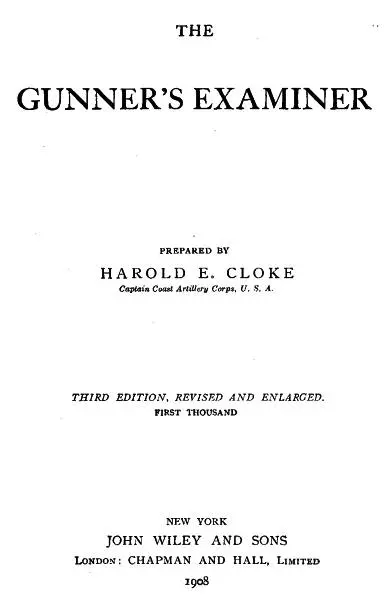
"The Gunner's Examiner" by Harold E. Cloke is a scientific publication written in the early 20th century. The book serves as a comprehensive guide for enlisted personnel in the Coast Artillery Corps, specifically focusing on preparing them for examinations as first- and second-class gunners. It compiles technical information and practical knowledge necessary for understanding gunnery operations and qualifying for artillery exams. The opening of "The Gunner's Examiner" provides a preface that explains the author's motivation for compiling the text, emphasizing the challenges faced by students of gunnery in accessing important information and comprehending the often technical language found in existing materials. In this section, Cloke outlines his intentions to simplify and clarify the examination requirements established by the War Department, including the subjects covered and the structure of the qualifications. The content suggests that the text will be continuously revised to keep pace with the evolving art of gunnery, underscoring its practical application for military education and training.
Introduction adapted from the source catalogue; source summaries may be automatically generated.
Free to read · English · 37,468 words · No account needed
MAKE TIME FOR A GOOD BOOK
On by default. Untick to stop anonymous reading totals. Each page counts after 10 seconds in view. How this works.
Anonymous counting is on unless you have switched it off.
Raw Linseed, Turpentine, Drier, and Lampblack, for making different kinds of paint. Turpentine is also used to clean brushes, etc.
Tallow: For mixing with white lead to form a preservative.
Pumice-stone: When powdered and mixed with oil is used to rub down surfaces, as the first coat of varnish on an engine.
Varnish: As a finishing coat for metal and wood surfaces not exposed to
heat or water.
Asphaltum Varnish: For painting anchors, distribution-boxes, mooring-sockets, shackles, sister hooks, junction boxes, iron work of operating boards and power panels, etc.
Shellac: For covering decks, spars, etc.
Graphite Paint: For painting hot parts of engines, etc.
Insulac: For preserving insulation on electrical instruments, etc.
Q. How is an engine painted?
A. All hot surfaces should be painted with black graphite paint. All other surfaces after being thoroughly scraped and sand-papered should be given a priming coat of red-lead paint. This should be lightly rubbed down with powdered pumice and oil, then two coats of preferably steel color metal paint applied and rubbed. Two coats of varnish are now applied and rubbed with pumice as above, after each coat becomes thoroughly dry.
Q. Name some high explosives used in submarine mining.
A. Wet gun-cotton principally, dynamite, and other high explosives that can be readily purchased in commercial life in case of emergency.
Q. Why is wet gun-cotton to be preferred as a high explosive?
A. Because it is perfectly safe to handle. It can only be detonated by first detonating a small piece of dry gun-cotton placed near it.
Q. What are some important precautions to be observed when loading
mines?
A. 1^o Always wear rubbers when entering the magazine to get the explosive. (The main supply is always kept in a cool magazine.)
2^o Never drop or slide along the floor boxes of high explosive.
3^o Do not expose high explosive to sun's rays or heat.
4^o Bring only one box to the loading-room at a time, then, when used, burn the box and sawdust in a safe place.
5^o Place canvas or burlap on floor of loading-room, then place
mine on skids upon this.
6^o Use rubber gloves when handling dynamite.
7^o Sweep floor frequently and throw sweepings in water.
8^o After mine is loaded by use of funnel, carefully clean threads with a soft brush, then smear plenty of ruberine on threads.
9^o Never saw or bore a dry guncotton cake.
10^o Never open a mine loaded with dynamite without first
consulting an officer.
11^o Never thaw out dynamite near a stove.
Q. How is dynamite that is frozen thawed out?
Your reading position is saved on this browser. Take it to another device with a library code. Reading pages adapt to text, rather than matching a printed edition.
BEHIND THE BOOK
This eBook is for the use of anyone anywhere in the United States and most other parts of the world at no cost and with almost no restrictions whatsoever. You may copy it, give it away or re-use it under the terms of the Project Gutenberg License included with this eBook or online at www.gutenberg.org. If you are not located in the United States, you will have to check the laws of the country where you are located before using this eBook. Read the source licence.
The original source file, including credits and licence, is retained by this library. Request an original-format copy at no charge. Please include the book title and Project Gutenberg identifier #47895.
KEEP YOUR CURIOSITY GOING
Charles G. (Charles Griffith) Ross
Hannah Webster Foster

Emily Lawless
Edwin Hamlin Carr

Charles De Lano Hine
Andrew Ure