
The Writing of News A Handbook with Chapters on Newspaper Correspondence and Copy Reading
Charles G. (Charles Griffith) Ross
THE CLASSIC COLLECTION · 1905
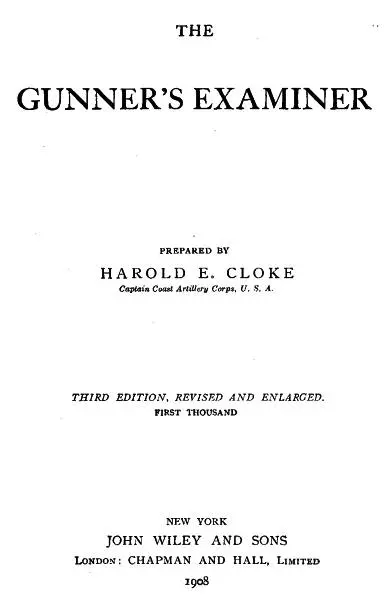
"The Gunner's Examiner" by Harold E. Cloke is a scientific publication written in the early 20th century. The book serves as a comprehensive guide for enlisted personnel in the Coast Artillery Corps, specifically focusing on preparing them for examinations as first- and second-class gunners. It compiles technical information and practical knowledge necessary for understanding gunnery operations and qualifying for artillery exams. The opening of "The Gunner's Examiner" provides a preface that explains the author's motivation for compiling the text, emphasizing the challenges faced by students of gunnery in accessing important information and comprehending the often technical language found in existing materials. In this section, Cloke outlines his intentions to simplify and clarify the examination requirements established by the War Department, including the subjects covered and the structure of the qualifications. The content suggests that the text will be continuously revised to keep pace with the evolving art of gunnery, underscoring its practical application for military education and training.
Introduction adapted from the source catalogue; source summaries may be automatically generated.
Free to read · English · 37,468 words · No account needed
MAKE TIME FOR A GOOD BOOK
On by default. Untick to stop anonymous reading totals. Each page counts after 10 seconds in view. How this works.
Anonymous counting is on unless you have switched it off.
Men operating tripping hooks keep their feet free from all cable. Men on after deck must keep entirely free of all cable while being spent when planter is passing from distribution-box boat to mine buoy.
If dynamite is used as explosive all mines should be covered with paulines or burlap to protect them from the direct rays of the sun.
Q. Name the apparatus on the boat used in planting mines.
A. Derricks, catheads, snatch-blocks, steam-winches, insulated cable, cable-drum frames, circuit detector, boat-hooks, sounding-lines graduated to feet, davits, differential blocks, mooring-ropes, raising-ropes, buoyant mines and anchors, shackles and extra split pins for same, lashing-rope, alcohol, 2 alcohol lamps, 1 cable cutter, cable tags, Turk's head, collars, cotton waste, 4 files, 4 hammers, 6 heaving-lines, knives, marline, 2 marline spikes, 1 megaphone, 2 monkey wrenches, 4 pliers, protective tape, rope, rubber cement, rubber tape, 2 scissors, 1 set of stencil numbers, tin-foil, and a measuring line which has marks every 100 feet, with double marks at 300 and 600 feet.
Q. Give a method for marking the positions at which mines are to be
planted.
A. The distribution-box is located first, a buoy and anchor being used as the mark. The center point of the group is located next, then the two ends of the group. The launch is directed over the spot selected from the map for the distribution-point by means of base-end instruments at the primary and secondary stations (these two instruments being set at the azimuth of the selected spot), and by signals from these stations the launch drops the anchor and buoy when it is at the intersection of the vertical cross-wires of each instrument. The launch marks the center of the group by moving approximately perpendicular to the line of mines to the desired distance. The line of mines is then determined by taking bearings and objects on shore (previously determined from the map) or by a similar method to that of locating the distribution-box buoy. Small planting-buoys are used for this purpose. The distribution-box buoy is usually a large keg or vinegar-barrel.
Q. How are soundings made?
A. By starting from either end of the "located group" and making a
sounding at every 100 feet.
Q. Explain how a small boat used for marking and locating is managed, and give the commands necessary.
A. Upon leaving wharf, "Shove off!" performed by designated man.
To raise oars preliminary to rowing: "Up oars!" all oars being held vertically, opposite rowlocks, blades athwart boat.
To lower oars into the water: "Let fall!"; all oars are dropped easily into the water, without splashing, and quickly adjusted into the rowlocks, and then held in position of "Oars!" (See below.)
Your reading position is saved on this browser. Take it to another device with a library code. Reading pages adapt to text, rather than matching a printed edition.
BEHIND THE BOOK
This eBook is for the use of anyone anywhere in the United States and most other parts of the world at no cost and with almost no restrictions whatsoever. You may copy it, give it away or re-use it under the terms of the Project Gutenberg License included with this eBook or online at www.gutenberg.org. If you are not located in the United States, you will have to check the laws of the country where you are located before using this eBook. Read the source licence.
The original source file, including credits and licence, is retained by this library. Request an original-format copy at no charge. Please include the book title and Project Gutenberg identifier #47895.
KEEP YOUR CURIOSITY GOING
Charles G. (Charles Griffith) Ross
Hannah Webster Foster

Emily Lawless
Edwin Hamlin Carr

Charles De Lano Hine
Andrew Ure