
The Writing of News A Handbook with Chapters on Newspaper Correspondence and Copy Reading
Charles G. (Charles Griffith) Ross
THE CLASSIC COLLECTION · 1905
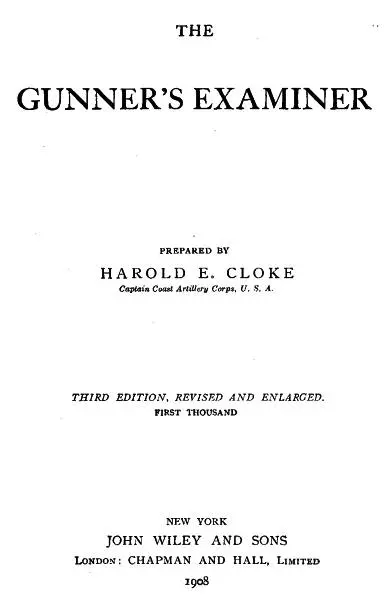
"The Gunner's Examiner" by Harold E. Cloke is a scientific publication written in the early 20th century. The book serves as a comprehensive guide for enlisted personnel in the Coast Artillery Corps, specifically focusing on preparing them for examinations as first- and second-class gunners. It compiles technical information and practical knowledge necessary for understanding gunnery operations and qualifying for artillery exams. The opening of "The Gunner's Examiner" provides a preface that explains the author's motivation for compiling the text, emphasizing the challenges faced by students of gunnery in accessing important information and comprehending the often technical language found in existing materials. In this section, Cloke outlines his intentions to simplify and clarify the examination requirements established by the War Department, including the subjects covered and the structure of the qualifications. The content suggests that the text will be continuously revised to keep pace with the evolving art of gunnery, underscoring its practical application for military education and training.
Introduction adapted from the source catalogue; source summaries may be automatically generated.
Free to read · English · 37,468 words · No account needed
MAKE TIME FOR A GOOD BOOK
On by default. Untick to stop anonymous reading totals. Each page counts after 10 seconds in view. How this works.
Anonymous counting is on unless you have switched it off.
Where ordinary anchors are used the mooring-ropes must be prepared for depths obtained by sounding. If sockets are used, the ropes for No. 32 cases are but 10 feet less than the ascertained depths at mean low water. This allows 5 feet for submergence and 5 feet for mine, mine bail, sockets, shackles, and anchor. For the larger mine cases an additional allowance must be made for the length of the cylindrical part of the case. Finally each mooring-rope is tagged at each end with the number of the corresponding mine.
Mine cables are cut to the following lengths, plus twice the
approximate depth of the water:
Feet.
No. 1 1425
No. 2 1225
No. 3 1025
No. 4 825
No. 5 725
No. 6 625
No. 7 525
No. 8 475
No. 9 425
No. 10 375
No. 11 425
No. 12 475
No. 13 525
No. 14 625
No. 15 725
No. 16 825
No. 17 1025
No. 18 1225
No. 19 1425
Each end of each cable is tagged with the number of the corresponding
mine.
Q. What apparatus is taken out on the distribution-box boat?
A. One distribution-box, 1 buoy for same, 1 mooring-rope for attaching buoy to distribution-box, 1 anchor sufficiently heavy to hold distribution-box boat, 1 anchor buoy (keg), and rope for same, 2 anchor shackles (1 for anchor and 1 for box), 1 pair field glasses, alcohol, 2 alcohol lamps, cable tags, Turk's head, collars, cotton waste, 2 files, 2 hammers, 2 heavy lines, knives, marline, 2 marline spikes, 1 megaphone, 2 monkey wrenches, 2 pliers, protective tape, rubber cement, rubber tape, 2 scissors, tin-foil, telephone, brass connectors, lashings.
The planter may locate the distribution-box boat anchor, and in that case it, together with its buoy, would not be taken out in the distribution-box boat.
Q. How and in what way are the cores of cable numbered?
A. They are numbered by the non-commissioned officer in charge of the boat, who establishes communication with the casemate, using the boat telephone, and working under the instructions of the casemate electrician.
Nos. 1, 13, and 19 are easily selected by means of their special marking; No. 19 is the center core; No. 13 is the marked core in the inner row of six; and No. 1 is the marked core in the outer row of twelve.
In the seven-cored cable there are no marked cores, the cores being numbered under the instructions of the casemate electrician.
Q. How is multiple cable laid?
A. It is transported to the planter by tramway, hoisted by steam-derrick to the forward jacks; it is then joined to the "shore ends" of the cable; the planter then steams to the distribution-box buoy and passes the end of the cable to the distribution launch, where a Turk's head is made and all is ready to receive the single-core cables for planting.
Q. How are single-core cables prepared?
Your reading position is saved on this browser. Take it to another device with a library code. Reading pages adapt to text, rather than matching a printed edition.
BEHIND THE BOOK
This eBook is for the use of anyone anywhere in the United States and most other parts of the world at no cost and with almost no restrictions whatsoever. You may copy it, give it away or re-use it under the terms of the Project Gutenberg License included with this eBook or online at www.gutenberg.org. If you are not located in the United States, you will have to check the laws of the country where you are located before using this eBook. Read the source licence.
The original source file, including credits and licence, is retained by this library. Request an original-format copy at no charge. Please include the book title and Project Gutenberg identifier #47895.
KEEP YOUR CURIOSITY GOING
Charles G. (Charles Griffith) Ross
Hannah Webster Foster

Emily Lawless
Edwin Hamlin Carr

Charles De Lano Hine
Andrew Ure