
The Writing of News A Handbook with Chapters on Newspaper Correspondence and Copy Reading
Charles G. (Charles Griffith) Ross
THE CLASSIC COLLECTION · 1905
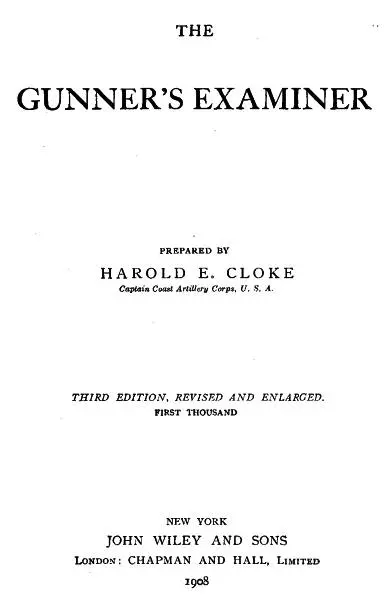
"The Gunner's Examiner" by Harold E. Cloke is a scientific publication written in the early 20th century. The book serves as a comprehensive guide for enlisted personnel in the Coast Artillery Corps, specifically focusing on preparing them for examinations as first- and second-class gunners. It compiles technical information and practical knowledge necessary for understanding gunnery operations and qualifying for artillery exams. The opening of "The Gunner's Examiner" provides a preface that explains the author's motivation for compiling the text, emphasizing the challenges faced by students of gunnery in accessing important information and comprehending the often technical language found in existing materials. In this section, Cloke outlines his intentions to simplify and clarify the examination requirements established by the War Department, including the subjects covered and the structure of the qualifications. The content suggests that the text will be continuously revised to keep pace with the evolving art of gunnery, underscoring its practical application for military education and training.
Introduction adapted from the source catalogue; source summaries may be automatically generated.
Free to read · English · 37,468 words · No account needed
MAKE TIME FOR A GOOD BOOK
On by default. Untick to stop anonymous reading totals. Each page counts after 10 seconds in view. How this works.
Anonymous counting is on unless you have switched it off.
For definite details in the drill for 6-inch Pedestal, 5-inch Balanced Pillar, 4·7-inch Quick-firing, 15-pounder and 6-pounder Rapid-fire Guns, see Coast Artillery Drill Regulations.
Q. What are projectiles?
A. They correspond to the bullets in small-arm cartridges.
Q. Why are projectiles made oblong and guns rifled?
A. To prevent the projectile from tumbling, thereby securing greater penetration, and better results in accuracy of fire.
Q. What is the difference between guns and mortars?
A. Guns are long in comparison with their calibers, mortars are short in comparison with their calibers.
Q. What is meant by a built-up gun?
A. One that is composed of several cylindrical forgings separately
shrunk one over the other.
Q. Why are these forgings shrunk on?
A. To give an initial compression to the steel toward the bore, such that the strength of the gun to resist the pressure of the powder-gas will be increased.
Q. Name the principal parts of a built-up gun.
A. The tube, jacket, hoops, and trunnion-band. (See Figs. 5, 6, and 23.)
Q. What is a wire-wound gun?
A. One in which wire takes the place of the jacket and hoops and is wound over the tube. The wire is really in the form of a ribbon.
Q. Define the breech-reinforce.
A. That portion of the gun between the rear of the trunnion-band and the front of the breech. (Fig. 5.)
Q. Define the chase.
A. That portion of the gun between the front of the trunnion-band and
the muzzle. (Fig. 5.)
Q. What is a barbette gun?
A. One that fires over a parapet.
Q. What two classes of barbette guns are there?
A. Barbette disappearing and barbette non-disappearing.
Q. What is the center of gravity?
A. That point where, if the gun were pivoted, it would balance. It is
always near the trunnions.
Q. What is the difference between front-pintle and center-pintle
carriages?
A. Front pintle is where the gun traverses about a point in the front part of the carriage; center pintle where it traverses about a point in the center of the carriage.
Q. What is a rack?
A. A bar or arc having teeth that engage in a gear-wheel or worm. (See
Fig. 7.)
Q. What is a gear-wheel?
A. A wheel with teeth on the circumference.
Q. What is a bevel-gear?
A. Two wheels whose axles are at an angle to each other and whose teeth
engage. (Fig. 8.)
Q. What is a miter-gear?
A. A bevel-gear with axles of equal-sized wheels at right angles. (Fig.
9.)
Q. What is a worm?
A. A gear-wheel in the form of a continuous screw. (Fig. 10.)
Q. What is a sprocket-wheel?
Your reading position is saved on this browser. Take it to another device with a library code. Reading pages adapt to text, rather than matching a printed edition.
BEHIND THE BOOK
This eBook is for the use of anyone anywhere in the United States and most other parts of the world at no cost and with almost no restrictions whatsoever. You may copy it, give it away or re-use it under the terms of the Project Gutenberg License included with this eBook or online at www.gutenberg.org. If you are not located in the United States, you will have to check the laws of the country where you are located before using this eBook. Read the source licence.
The original source file, including credits and licence, is retained by this library. Request an original-format copy at no charge. Please include the book title and Project Gutenberg identifier #47895.
KEEP YOUR CURIOSITY GOING
Charles G. (Charles Griffith) Ross
Hannah Webster Foster

Emily Lawless
Edwin Hamlin Carr

Charles De Lano Hine
Andrew Ure