
The Writing of News A Handbook with Chapters on Newspaper Correspondence and Copy Reading
Charles G. (Charles Griffith) Ross
THE CLASSIC COLLECTION · 1905
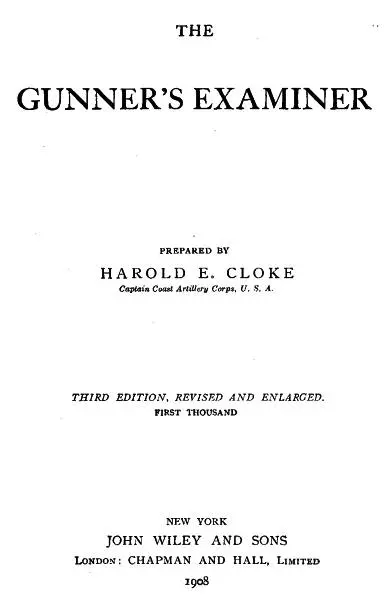
"The Gunner's Examiner" by Harold E. Cloke is a scientific publication written in the early 20th century. The book serves as a comprehensive guide for enlisted personnel in the Coast Artillery Corps, specifically focusing on preparing them for examinations as first- and second-class gunners. It compiles technical information and practical knowledge necessary for understanding gunnery operations and qualifying for artillery exams. The opening of "The Gunner's Examiner" provides a preface that explains the author's motivation for compiling the text, emphasizing the challenges faced by students of gunnery in accessing important information and comprehending the often technical language found in existing materials. In this section, Cloke outlines his intentions to simplify and clarify the examination requirements established by the War Department, including the subjects covered and the structure of the qualifications. The content suggests that the text will be continuously revised to keep pace with the evolving art of gunnery, underscoring its practical application for military education and training.
Introduction adapted from the source catalogue; source summaries may be automatically generated.
Free to read · English · 37,468 words · No account needed
MAKE TIME FOR A GOOD BOOK
On by default. Untick to stop anonymous reading totals. Each page counts after 10 seconds in view. How this works.
Anonymous counting is on unless you have switched it off.
Q. After examining gun, what changes in posts are made?
A. The chief of detachment and gunner go wherever their presence is necessary. No. 7 takes post at the door of the cartridge-room.
Q. Give the duties of each member of the detachment at the command
"Load!"
A. Gun commander operates switches and firing-plug. Observes all
detachments.
Chief generally supervises the proper loading of his piece, signals
"Ready" or "Misfire," etc.
Gunner gives the piece the proper azimuth, signals "Azimuth set" to the
chief.
No. 1 assists in opening and closing breech. Examines or oils, if necessary, the breech-block and gas-check. Assists in ramming.
No. 2 assists in opening and closing breech. Examines or oils, if necessary, the gas-check seat and breech-recess. Commands "Home!", "Ram!" Assists in ramming. Observes the scale on the rammer. Inserts loading-tray and withdraws same. Pushes cartridge properly into chamber. After firing, assisted by No. 5, sponges chamber and bore.
No. 3 assists in ramming. If firing by lanyard be used, he attaches the long lanyard to the short one and, after the piece is elevated, hooks the short lanyard to eye of firing-leaf and fires at the command. After firing, brings bore and chamber-sponge and assists No. 2 in sponging. Replaces sponge.
No. 4 brings up rammer, and places its head on the base of the projectile. Assists in ramming. Replaces rammer.
Nos. 5 and 6 give elevation at command of chief. (No. 5 operates the clamp and lock.) Assists in ramming.
After piece is fired, brings piece to 0° elevation.
No. 7 brings up cartridge and takes post at traverse-crank. On taking cover he returns to cartridge-room.
No. 8 inserts and removes primers.
Nos. 7 and 8 traverse the mortar at the signal of the gunner.
Nos. 9 and 10 bring up loaded trucks.
Q. What are the positions for ramming?
A. Nos. 1, 3, and 5 on right, Nos. 2, 4, and 6 on left, all facing rammer. The projectile is rammed home in one motion.
Q. In taking cover, what is the order of formation in rear of pits?
A. They take cover as shown in the following diagram:
Mortar No. 4 Mortar No. 2
" " 3 " " 1
{8, 6, 5, G.} {8, 6, 5, G.} 4th detachment { } 2d detachment { } {4, 3, 2, 1 } {4, 3, 2, 1 }
{8, 6, 5, G.} {8, 6, 5, G.} 3d detachment { } 1st detachment { } {4, 3, 2, 1 } {4, 3, 2, 1 }
Q. What comprises an ammunition detachment?
A. One chief, two corporals, and sixteen privates.
Q. Name the details.
A. Projectile: One corporal and Nos. 1 to 12.
Cartridge: One corporal and Nos. 13 to 16.
Q. Give their duties in brief.
A. The chief has general supervision and is responsible for the proper
supply of ammunition.
Nos. 1 and 2 operate a trolley and pulley, and load trucks with shell.
Nos. 3 and 4, 5 and 6, 7 and 8 operate other trolleys similarly.
Nos. 9, 10, 11, and 12 run up empty trucks, and when loaded return them
to gallery entrance.
Nos. 13, 14, 15, and 16 pass designated cartridge to No. 7.
Your reading position is saved on this browser. Take it to another device with a library code. Reading pages adapt to text, rather than matching a printed edition.
BEHIND THE BOOK
This eBook is for the use of anyone anywhere in the United States and most other parts of the world at no cost and with almost no restrictions whatsoever. You may copy it, give it away or re-use it under the terms of the Project Gutenberg License included with this eBook or online at www.gutenberg.org. If you are not located in the United States, you will have to check the laws of the country where you are located before using this eBook. Read the source licence.
The original source file, including credits and licence, is retained by this library. Request an original-format copy at no charge. Please include the book title and Project Gutenberg identifier #47895.
KEEP YOUR CURIOSITY GOING
Charles G. (Charles Griffith) Ross
Hannah Webster Foster

Emily Lawless
Edwin Hamlin Carr

Charles De Lano Hine
Andrew Ure