
The Writing of News A Handbook with Chapters on Newspaper Correspondence and Copy Reading
Charles G. (Charles Griffith) Ross
THE CLASSIC COLLECTION · 1905
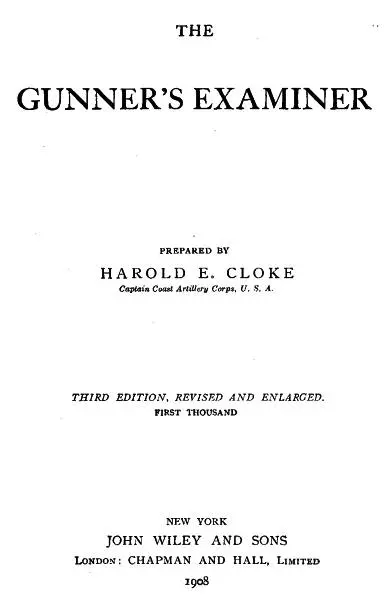
"The Gunner's Examiner" by Harold E. Cloke is a scientific publication written in the early 20th century. The book serves as a comprehensive guide for enlisted personnel in the Coast Artillery Corps, specifically focusing on preparing them for examinations as first- and second-class gunners. It compiles technical information and practical knowledge necessary for understanding gunnery operations and qualifying for artillery exams. The opening of "The Gunner's Examiner" provides a preface that explains the author's motivation for compiling the text, emphasizing the challenges faced by students of gunnery in accessing important information and comprehending the often technical language found in existing materials. In this section, Cloke outlines his intentions to simplify and clarify the examination requirements established by the War Department, including the subjects covered and the structure of the qualifications. The content suggests that the text will be continuously revised to keep pace with the evolving art of gunnery, underscoring its practical application for military education and training.
Introduction adapted from the source catalogue; source summaries may be automatically generated.
Free to read · English · 37,468 words · No account needed
MAKE TIME FOR A GOOD BOOK
On by default. Untick to stop anonymous reading totals. Each page counts after 10 seconds in view. How this works.
Anonymous counting is on unless you have switched it off.
At the first command Nos. 7 and 8 go to the retraction-cranks. No. 7 operates the retaining-pawl and speed-crank to permit the pulling out of the ropes. Nos. 9 and 10 mount on the gun-levers and place the ends of the ropes on the hooks, receiving them from Nos. 3 and 4, who mount on the chassis to assist. Nos. 1 and 2 pull out the ropes and pass the ends to Nos. 3 and 4. No. 7 takes in the slack. Nos. 7, 8, 9, and 10 take positions at the retraction-cranks, and at the second command turn the cranks.
Nos. 3, 4, 5, and 6 relieve Nos. 7, 8, 9, and 10 when directed by the chief of the detachment. Odd numbers work on the right side of the carriage, even numbers on the left side. When the gun has reached the loading position the command "Halt!" is given. As the command "Cast off!" is given No. 7 lets out enough slack to enable Nos. 1 and 2 to take the rope-ends off the hooks.
Q. Where electric motors are provided, who operates them?
A. The gunner the traversing-controllers, No. 5 the elevating and retracting controllers; No. 6 watches the circuit-breakers, and when broken by an overload he closes the breaker.
Q. When the shot-hoist is on the right, what changes in the service of
the piece are made?
A. No. 4 in ramming takes position between Nos. 2 and 10 on the left side. Nos. 10 and 14 assist No. 4 in bringing up and replacing the rammer, instead of Nos. 9 and 13. No. 9 brings up and replaces sponge and assists in sponging, instead of No. 10.
Q. How many men in the ammunition detail?
A. One chief and twelve privates.
Q. Name the details into which it is divided, and the numbers composing
each.
A. Hoist detail, Nos. 1 and 2.
Projectile detail, Nos. 3, 4, 5, and 6.
Cartridge detail, Nos. 7, 8, 9, 10, 11, and 12.
Q. Give the duties of each in brief.
A. No. 1 operates the controller and starts the hoist supplying the delivery-table with ammunition.
No. 2 repeats name of projectile announced, rolls same with cartridge
to hoist-carrier.
Nos. 3 and 4 operate a trolley and differential pulley.
Nos. 5 and 6 operate another trolley and pulley.
Nos. 7 and 8 uncase cartridges.
Nos. 9, 10, 11, and 12 place sections on receiving-table in proper
order. If electrical power fails, Nos. 1 and 2 operate hoist by
hand-cranks.
Your reading position is saved on this browser. Take it to another device with a library code. Reading pages adapt to text, rather than matching a printed edition.
BEHIND THE BOOK
This eBook is for the use of anyone anywhere in the United States and most other parts of the world at no cost and with almost no restrictions whatsoever. You may copy it, give it away or re-use it under the terms of the Project Gutenberg License included with this eBook or online at www.gutenberg.org. If you are not located in the United States, you will have to check the laws of the country where you are located before using this eBook. Read the source licence.
The original source file, including credits and licence, is retained by this library. Request an original-format copy at no charge. Please include the book title and Project Gutenberg identifier #47895.
KEEP YOUR CURIOSITY GOING
Charles G. (Charles Griffith) Ross
Hannah Webster Foster

Emily Lawless
Edwin Hamlin Carr

Charles De Lano Hine
Andrew Ure