
The Writing of News A Handbook with Chapters on Newspaper Correspondence and Copy Reading
Charles G. (Charles Griffith) Ross
THE CLASSIC COLLECTION · 1905
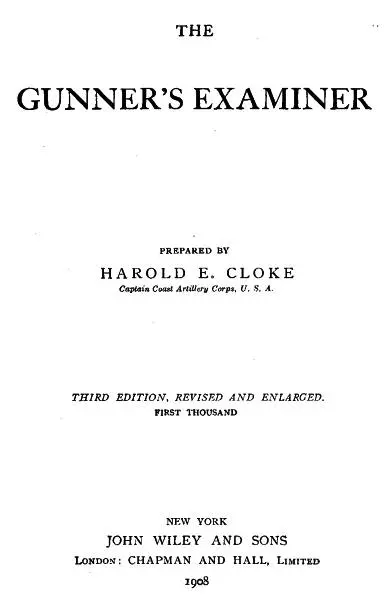
"The Gunner's Examiner" by Harold E. Cloke is a scientific publication written in the early 20th century. The book serves as a comprehensive guide for enlisted personnel in the Coast Artillery Corps, specifically focusing on preparing them for examinations as first- and second-class gunners. It compiles technical information and practical knowledge necessary for understanding gunnery operations and qualifying for artillery exams. The opening of "The Gunner's Examiner" provides a preface that explains the author's motivation for compiling the text, emphasizing the challenges faced by students of gunnery in accessing important information and comprehending the often technical language found in existing materials. In this section, Cloke outlines his intentions to simplify and clarify the examination requirements established by the War Department, including the subjects covered and the structure of the qualifications. The content suggests that the text will be continuously revised to keep pace with the evolving art of gunnery, underscoring its practical application for military education and training.
Introduction adapted from the source catalogue; source summaries may be automatically generated.
Free to read · English · 37,468 words · No account needed
MAKE TIME FOR A GOOD BOOK
On by default. Untick to stop anonymous reading totals. Each page counts after 10 seconds in view. How this works.
Anonymous counting is on unless you have switched it off.
Q. Give the signals for the following: Clamp or Halt; Ready.
A. Clamp or Halt: Raise either arm to a horizontal position, fingers closed. Ready: Raise either arm vertically to its full extent, fingers extended.
Q. How would you signal stand fast with the whistle at a rapid-fire
gun?
A. One blast signifies stand fast, the pause being of sufficient duration to enable orders to be correctly given and received; to resume operations the command "Go on!" will be given. Other signals may also be used.
Q. What composes a gun section?
A. A gun commander, a gun detachment, an ammunition detachment, and a
reserve.
Q. How many men in a gun detachment?
A. One chief, one gunner, one range-keeper, and eighteen privates.
Q. Name the details into which a detachment is divided, and give posts
of each.
Details. Posts.
Chief of detachment Two yards in rear of the breech, facing it (sergeant). or wherever presence is necessary.
Gunner (duly qualified Sighting-platform or wherever presence is
non-commissioned necessary.
officer or
private).
Range-keeper (non- Near the elevation-scale, on the right or
commissioned officer left of the carriage.
or private).
Breech detail (Nos. Nos. 1 and 2 in line immediately in rear of 1, 2, and 3). the breech, facing it, No. 1 on the right; No. 3 on the right of the piece, two feet from and facing it, opposite the elevating-band.
Rammer detail At the platform rail facing the carriage, No. (Nos. 4, 13, and 4 opposite the rammer, four feet from its 14). head, Nos. 13 and 14 four paces to his right and left respectively.
Elevating detail At the elevating hand-wheels, facing them, (Nos. 5 and 6). No. 5 on the right of the carriage, No. 6 on the left.
Traversing detail In front of the traversing-cranks, facing (Nos. 7 and 8). from the parapet, No. 7 on the right of the carriage, No. 8 on the left.
Tripping detail At the tripping-levers, facing the carriage, (Nos. 9 and 10). No. 9 on the right of the carriage, No. 10 on the left.
Truck detail Near the hoist, in rear of a loaded truck, (Nos. 11 and 12). No. 11 on the right, No. 12 on the left, both facing the truck.
Telautograph detail At the telautograph.
(No. 15).
Hoist detail (Nos. At the delivery-table and facing it.
16, 17, and 18).
Q. Name the equipments or implements which each member procures and places in proper position at the command "Posts!" on first arriving at the gun.
A. Gunner: Sight and difference-chart.
Range-keeper: Stop-watch and prediction-scale.
No. 1: Translating roller or crank, can with sponge and oil, and a silk
wiper.
No. 2: Loading-tray and a silk wiper.
No. 3: Primer-pouch, bag for empty primers, scabbard containing punch, gimlet, and reamer, and a lanyard.
No. 4, assisted by No. 13: Rammer.
Your reading position is saved on this browser. Take it to another device with a library code. Reading pages adapt to text, rather than matching a printed edition.
BEHIND THE BOOK
This eBook is for the use of anyone anywhere in the United States and most other parts of the world at no cost and with almost no restrictions whatsoever. You may copy it, give it away or re-use it under the terms of the Project Gutenberg License included with this eBook or online at www.gutenberg.org. If you are not located in the United States, you will have to check the laws of the country where you are located before using this eBook. Read the source licence.
The original source file, including credits and licence, is retained by this library. Request an original-format copy at no charge. Please include the book title and Project Gutenberg identifier #47895.
KEEP YOUR CURIOSITY GOING
Charles G. (Charles Griffith) Ross
Hannah Webster Foster

Emily Lawless
Edwin Hamlin Carr

Charles De Lano Hine
Andrew Ure