THE CLASSIC COLLECTION✦Angel Unawares: A Story of Christmas EveCLASSIC FREE BOOKS
Angel Unawares: A Story of Christmas Eve
C. N. (Charles Norris) Williamson & A. M. (Alice Muriel) Williamson
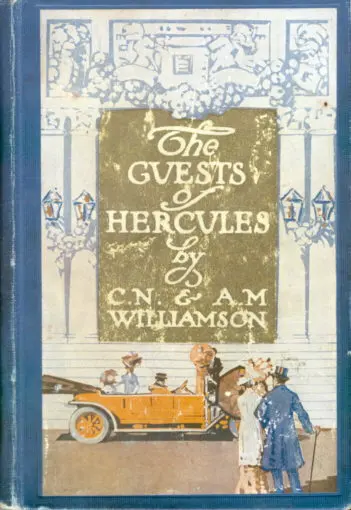
THE CLASSIC COLLECTION · 1912
"The Guests of Hercules" by C. N. Williamson and A. M. Williamson is a novel written in the early 20th century. The story begins with the character Mary Grant, a novice set to leave her convent home to embark on a new life outside its walls. The narrative explores themes of self-discovery, nostalgia, and the clash between sheltered innocence and the allure of the outside world, particularly the exciting yet daunting prospect of Monte Carlo. At the start of the novel, Mary is saying goodbye to the convent garden, reflecting on her years spent in the sheltered life of a novice. As she prepares for her departure, she grapples with feelings of nostalgia and homesickness, despite having chosen to leave the convent. Her friend, Peter Maxwell, encourages her to embrace her newfound freedom as Mary's mind swirls with thoughts of the vibrant world awaiting her, particularly her long-held dream of visiting Italy. The emotional weight of her decision to leave the convent is palpable and sets up a compelling exploration of her journey into adulthood, freedom, and the uncertainties that come with it.
Introduction adapted from the source catalogue; source summaries may be automatically generated.
Free to read · English · 159,020 words · No account needed
MAKE TIME FOR A GOOD BOOK
On by default. Untick to stop anonymous reading totals. Each page counts after 10 seconds in view. How this works.
Anonymous counting is on unless you have switched it off.
"But no, excuse me, Madame, you had money on black and the second dozen, on pair, and on the carre of twenty-four; but nothing on the number itself. Your maximum was on twenty-six," the croupier explained firmly.
"I tell you it was on twenty-four!" shrieked the actress.
"Madame is mistaken. You staked in so many different places, it is impossible for you to remember."
"It is still more impossible for you. Do you intend to pay me?"
"But certainly, for everything you won."
"And the maximum on twenty-four?"
"Not that, Madame."
"I will complain to the management!"
"As Madame pleases."
"I will stop the game till I am paid!"
One of the two inspectors left his high chair, came to the enraged lady and attempted to soothe her. She looked magnificent in her passion, ten years having fallen like a mask from the marble face.
The croupier, who had paid her for several bets won, attempted to go on with his duties. People, some delighting in the "row," others annoyed at the delay, placed their stakes, but she, a lioness at bay, stared furiously without putting a piece on the table. As the disc turned, however, she pounced. She threw a louis into the wheel. But the croupier, without changing countenance, took out the coin, pushed it back to her, and began spinning again. In went another louis and again the croupier stopped the wheel. Voices rose in complaint: Russian voices, German voices, English voices. "Is this going on all night?"
"Pay Madame," said one of the inspectors.
Quietly and with incredible quickness nine times thirty-five louis were counted out, payment for a maximum on a number. As the croupier pushed the notes and gold across the table, a beautiful white hand, blazing with rings, thrust it proudly back again. "That is all I wanted," the actress said, with the air of Lady Macbeth. "The acknowledgment that I was right. Keep the money."
The croupier shrugged his shoulders, and spun the wheel, with a bored
air.
"Faites vos jeux, Messieurs."
"Shall I put something for you on twenty-four?" hastily asked Madame
d'Ambre.
"But it has just come."
"It may come again. Often a number repeats. Shall I or not? An instant, and it will be too late."
With her heart in her throat, Mary handed the Frenchwoman a hundred-franc note crushed in a ball. Madame d'Ambre asked a croupier near where she stood to stake the money. He did so, just in time. The ball slipped into the pocket of number 21. "Too bad! But better luck next time. Will you try a simple chance, red or black, for instance? Or one of the dozens?"
Your reading position is saved on this browser. Take it to another device with a library code. Reading pages adapt to text, rather than matching a printed edition.
C. N. (Charles Norris) Williamson & A. M. (Alice Muriel) Williamson
C. N. (Charles Norris) Williamson & A. M. (Alice Muriel) Williamson
C. N. (Charles Norris) Williamson & A. M. (Alice Muriel) Williamson
C. N. (Charles Norris) Williamson & A. M. (Alice Muriel) Williamson
BEHIND THE BOOK
This eBook is for the use of anyone anywhere in the United States and most other parts of the world at no cost and with almost no restrictions whatsoever. You may copy it, give it away or re-use it under the terms of the Project Gutenberg License included with this eBook or online at www.gutenberg.org. If you are not located in the United States, you will have to check the laws of the country where you are located before using this eBook. Read the source licence.
The original source file, including credits and licence, is retained by this library. Request an original-format copy at no charge. Please include the book title and Project Gutenberg identifier #19569.
KEEP YOUR CURIOSITY GOING
Coulson Kernahan

Maurice Baring
Frances Wright
Cécile Tormay

Frederic Jesup Stimson

W. H. P. (William Henry Pope) Jarvis