THE CLASSIC COLLECTION✦Angel Unawares: A Story of Christmas EveCLASSIC FREE BOOKS
Angel Unawares: A Story of Christmas Eve
C. N. (Charles Norris) Williamson & A. M. (Alice Muriel) Williamson
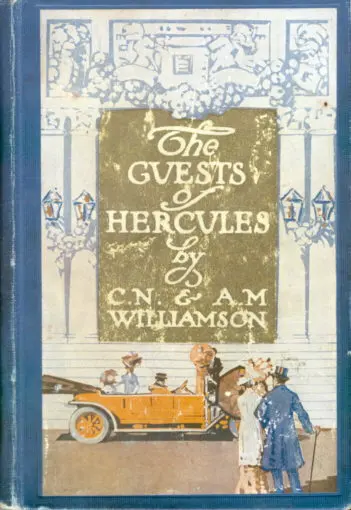
THE CLASSIC COLLECTION · 1912
"The Guests of Hercules" by C. N. Williamson and A. M. Williamson is a novel written in the early 20th century. The story begins with the character Mary Grant, a novice set to leave her convent home to embark on a new life outside its walls. The narrative explores themes of self-discovery, nostalgia, and the clash between sheltered innocence and the allure of the outside world, particularly the exciting yet daunting prospect of Monte Carlo. At the start of the novel, Mary is saying goodbye to the convent garden, reflecting on her years spent in the sheltered life of a novice. As she prepares for her departure, she grapples with feelings of nostalgia and homesickness, despite having chosen to leave the convent. Her friend, Peter Maxwell, encourages her to embrace her newfound freedom as Mary's mind swirls with thoughts of the vibrant world awaiting her, particularly her long-held dream of visiting Italy. The emotional weight of her decision to leave the convent is palpable and sets up a compelling exploration of her journey into adulthood, freedom, and the uncertainties that come with it.
Introduction adapted from the source catalogue; source summaries may be automatically generated.
Free to read · English · 159,020 words · No account needed
MAKE TIME FOR A GOOD BOOK
On by default. Untick to stop anonymous reading totals. Each page counts after 10 seconds in view. How this works.
Anonymous counting is on unless you have switched it off.
"That's the way I'm to help her--by calling? I thought perhaps I was to get her out of pawn, or something, by buying her jewellery. But I had to tell you, if that was what you wanted, I couldn't do much, for all my pocket money is exhausted, owing to so many people coming and crying tears as large as eggs all over the living-room--quite strange people I've never seen before. You can't conceive, Dick, the cataracts of tears that have poured over this rug you admire so much."
"I don't understand," said Carleton, looking blank. "Unless you want to switch me off the subject of----"
"The Poor Dear? No, indeed. But you couldn't be expected to understand, not being a chaplain's wife at Monte Carlo. You see, they hear we're kind, so they call, and then begin to cry and offer me pawn tickets as security."
"Who are 'they'?"
"Oh, poor creatures--seldom poor dears--who've lost, you know. As I
suppose your one has?"
"On the contrary," said Dick, almost sharply. "She's won tremendous sums. She simply can't lose--anything except her head."
"Not her heart? But without joking, if she isn't a 'case,' why do you
want me to----"
"Because I think she ought to have some one to look after her, some one who knows the ropes. Honestly, Rose, I'd be awfully obliged if you'd call."
"I will of course," Rose answered. "Have I got to be agreeable to any mothers or aunts she may have lurking in the background?"
"That's the trouble. She hasn't got a soul."
"Oh! And she is quite young?"
"Sometimes she looks a baby. Sometimes I think she's a little older."
"Then she probably is. Where's she staying?"
"At the Hotel de Paris."
"My gracious! Alone at a big Monte Carlo hotel! A young girl! No wonder you glare out of the window while you ask me to call on her, and stick your hands deep in your pockets. People won't allow me for an instant to forget I'm a clergyman's wife. Et tu Brute!"
"I told you she was a lady." Dick turned rather white. "She doesn't know what she's doing. I'm sure she doesn't. She--even Schuyler, who reads most people at sight like A B C, can't make her out. She's a mystery."
"Forgive me," said Rose. "I was half in fun. I wouldn't hurt your Flying-Fish feelings for anything on earth or in air. Is she pretty, and is she American--or what?"
"She's perfectly beautiful, and she's English, I think."
"Hasn't she told you?"
"No. She says nothing about herself--I mean about herself before she
came here."
"What's past is past. Dark or fair?--not her past, but her complexion?"
Your reading position is saved on this browser. Take it to another device with a library code. Reading pages adapt to text, rather than matching a printed edition.
C. N. (Charles Norris) Williamson & A. M. (Alice Muriel) Williamson
C. N. (Charles Norris) Williamson & A. M. (Alice Muriel) Williamson
C. N. (Charles Norris) Williamson & A. M. (Alice Muriel) Williamson
C. N. (Charles Norris) Williamson & A. M. (Alice Muriel) Williamson
BEHIND THE BOOK
This eBook is for the use of anyone anywhere in the United States and most other parts of the world at no cost and with almost no restrictions whatsoever. You may copy it, give it away or re-use it under the terms of the Project Gutenberg License included with this eBook or online at www.gutenberg.org. If you are not located in the United States, you will have to check the laws of the country where you are located before using this eBook. Read the source licence.
The original source file, including credits and licence, is retained by this library. Request an original-format copy at no charge. Please include the book title and Project Gutenberg identifier #19569.
KEEP YOUR CURIOSITY GOING
Coulson Kernahan

Maurice Baring
Frances Wright
Cécile Tormay

Frederic Jesup Stimson

W. H. P. (William Henry Pope) Jarvis