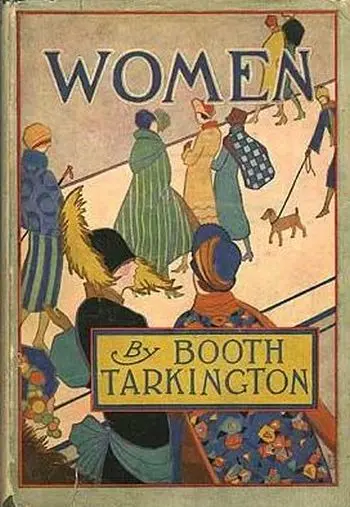
Women
Booth Tarkington
THE CLASSIC COLLECTION · 1908
"The Guest of Quesnay" by Booth Tarkington is a novel written during the early 20th century. The story is set in Paris and centers around George Ward, a portrait painter, as he navigates the vibrant and sometimes seedy life of the boulevards. The narrative begins with Ward observing the various characters that populate the Parisian streets, including the notable figure Larrabee Harman, whose scandalous life has led to a severe decline in his fortune and reputation. At the start of the book, the reader is introduced to the lively atmosphere of Paris, filled with diverse characters including wealthy patrons and struggling artists. Ward, who has become a successful painter, finds himself drawn into the narrative through his recognition of Harman, a former acquaintance who has succumbed to a life of debauchery. As the plot unfolds, Ward's world is intertwined with that of Harman and the enigmatic dancer Mariana, reflecting themes of fame, downfall, and the complexities of human relationships against the backdrop of Parisian life. The opening scenes establish a rich visual tapestry, drawing readers into a world full of color, intrigue, and the pulse of the city.
Introduction adapted from the source catalogue; source summaries may be automatically generated.
Free to read · English · 61,104 words · No account needed
MAKE TIME FOR A GOOD BOOK
On by default. Untick to stop anonymous reading totals. Each page counts after 10 seconds in view. How this works.
Anonymous counting is on unless you have switched it off.
"Monsieur, people say everything," he answered, frowning as if deploring what they said in some secret, particular instance. "The world is full of idle gossipers, tale-bearers, spreaders of scandal! And, though I speak with perfect respect, all the people at the chateau are not perfect in such ways."
"Do you mean the domestics?"
"The visitors!"
"What do they say?"
"Eh, well, then, they say--but no!" He contrived a masterly pretense of pained reluctance. "I cannot--"
"Speak out," I commanded, piqued by his shilly-shallying. "What do they
say?"
"Monsieur, it is about"--he shifted his weight from one leg to the other--"it is about--about that beautiful Mademoiselle Elliott who sometimes comes here."
This was so far from what I had expected that I was surprised into a slight change of attitude, which all too plainly gratified him, though he made an effort to conceal it. "Well," I said uneasily, "what do they find to say of Mademoiselle Elliott?"
"They say that her painting is only a ruse to see monsieur."
"To see Monsieur Saffren, yes."
"But, no!" he cried. "That is not--"
"Yes, it is," I assured him calmly. "As you know, Monsieur Saffren is very, very handsome, and Mademoiselle Elliott, being a painter, is naturally anxious to look at him from time to time."
"You are sure?" he said wistfully, even plaintively. "That is not the meaning Jean Ferret put upon it."
"He was mistaken."
"It may be, it may be," he returned, greatly crestfallen, picking up his tray and preparing to go. "But Jean Ferret was very positive."
"And I am even more so!"
"Then that malicious maid of Mademoiselle Ward's was mistaken also," he sighed, "when she said that now a marriage is to take place between Mademoiselle Ward and Monsieur Ingle--"
"Proceed," I bade him.
He moved a few feet nearer the kitchen. "The malicious woman said to Jean Ferret--" He paused and coughed. "It was in reference to those Italian jewels monsieur used to send--"
"What about them?" I asked ominously.
"The woman says that Mademoiselle Ward--" he increased the distance between us--"that now she should give them to Mademoiselle Elliott! GOOD night, monsieur!"
His entrance into the kitchen was precipitate. I sank down again into the wicker chair (from which I had hastily risen) and contemplated the stars. But the short reverie into which I then fell was interrupted by Mr. Percy, who, sauntering leisurely about the garden, paused to address me.
"You folks thinks you was all to the gud, gittin' them trunks off,
what?"
"You speak in mysterious numbers," I returned, having no comprehension
of his meaning.
Your reading position is saved on this browser. Take it to another device with a library code. Reading pages adapt to text, rather than matching a printed edition.
Booth Tarkington
Booth Tarkington
Booth Tarkington
Booth Tarkington
BEHIND THE BOOK
This eBook is for the use of anyone anywhere in the United States and most other parts of the world at no cost and with almost no restrictions whatsoever. You may copy it, give it away or re-use it under the terms of the Project Gutenberg License included with this eBook or online at www.gutenberg.org. If you are not located in the United States, you will have to check the laws of the country where you are located before using this eBook. Read the source licence.
The original source file, including credits and licence, is retained by this library. Request an original-format copy at no charge. Please include the book title and Project Gutenberg identifier #5756.
KEEP YOUR CURIOSITY GOING
Coulson Kernahan

Maurice Baring
Frances Wright
Cécile Tormay

Frederic Jesup Stimson

W. H. P. (William Henry Pope) Jarvis