The unhallowed harvest
Homer Greene
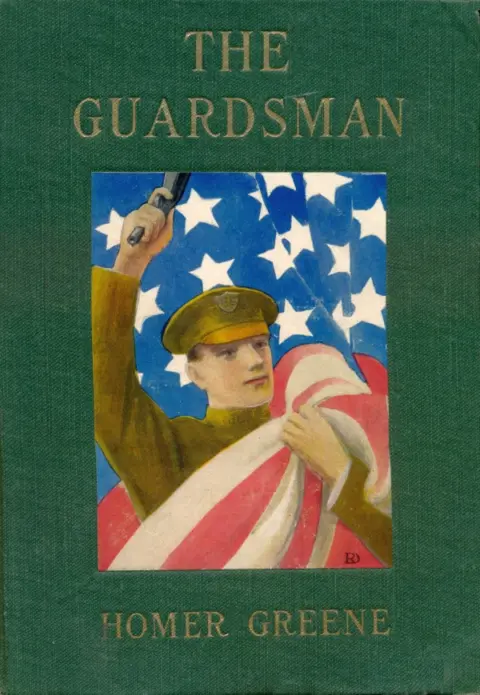
THE CLASSIC COLLECTION · 1919
"The Guardsman" by Homer Greene is a novel written in the early 20th century. The story revolves around the youthful characters in the town of Fairweather as they navigate the mischief of Hallowe'en and face the consequences of their actions. The main characters, Halpert McCormack and Benjamin Barriscale, both come from prominent families and engage in a series of antics that culminate in the theft of a statue from Barriscale's home, which leads to unintended afflictions and moral dilemmas. The opening of the novel introduces readers to the mischief and chaotic spirit of Hallowe'en in 1909, showcasing a group of boys, led by Hal McCormack, who embark on a nighttime escapade that involves removing a cobbler's sign and aiming to place it on the property of Benjamin Barriscale, the wealthy head of the Barriscale Manufacturing Company. However, their adventure escalates when they consider stealing an ornamental marble statue from Barriscale’s fountain, leading to the accidental breaking of the statue later in the story when a rival group encounters it. The narrative sets up a conflict rooted in youthful indiscretion, friendship, and the pursuit of social standing, paving the way for themes of accountability and personal growth as Hal must face the repercussions of their Hallowe'en antics.
Introduction adapted from the source catalogue; source summaries may be automatically generated.
Free to read · English · 71,044 words · No account needed
MAKE TIME FOR A GOOD BOOK
On by default. Untick to stop anonymous reading totals. Each page counts after 10 seconds in view. How this works.
Anonymous counting is on unless you have switched it off.
The colors were at the top of the staff, the halyards were fastened to the clamps, the company was brought to an “order arms,” and again to a rest at will, and the period of waiting was resumed. But Lieutenant McCormack’s eyes were still fixed on the flag. Somehow, suddenly, there was a fascination in the sight of it that he could not resist; his country’s flag, the flag of his ancestors, the symbol of the soul of America; America, his home. That strange grip on his heart grew tighter, firmer, deeper--was it pain, was it sweetness, was it one of that trio of highest and noblest sentiments that stir humanity, love of one’s own country as distinct from every other country in the world, that caused his eyes to fill with tears as he stood with raised head and gazed on the “Banner of the Stars”?
He was suddenly aware that some one was standing at his side, and when he looked down he saw that it was General Chick. The boy, too, was staring at the colors.
“Ain’t it beautiful?” he asked.
“Chick,” was the reply, “I feel this morning that that flag is the most beautiful thing in the world, and that every American citizen should love it.”
“And,” added Chick, “should ought to want to be a soldier an’ fight under it. That’s what I’ve been wanting to be; but lately I’m kind o’ discouraged.”
“Why discouraged, Chick?”
“Oh, I’m afraid I won’t never git into the Guard now. It feels as though somethin’s gone wrong inside o’ me.”
McCormack looked down at the boy, at his gray face, his hollow eyes, his sunken cheeks, at the evidences of physical pain with which his countenance was marked, and he felt a sudden pity for him.
“You’re not well, Chick,” he said; “you ought not to be here.”
“I know,” was the labored reply. “But I couldn’t help comin’. I heard about it, an’ I got up an’ come away while the old woman was asleep.”
A wan smile spread over his face at the memory of his diplomatic
escape.
“I thought, mebbe,” he continued, “I might never see the boys ag’in--in action; and I--wanted to see ’em.”
“Chick, you must go back home. You’re too ill to stay here.”
The boy ignored the command and asked a question.
“They ain’t through tryin’ you yet, air they?”
“No, the trial will be resumed next Tuesday. Chick, you----”
“Well, Mr. ’Cormack, if I should--should jest happen, you know--to die before then, they couldn’t git nothin’ on you, could they?”
Your reading position is saved on this browser. Take it to another device with a library code. Reading pages adapt to text, rather than matching a printed edition.
Homer Greene
Homer Greene
Homer Greene
Homer Greene
BEHIND THE BOOK
This eBook is for the use of anyone anywhere in the United States and most other parts of the world at no cost and with almost no restrictions whatsoever. You may copy it, give it away or re-use it under the terms of the Project Gutenberg License included with this eBook or online at www.gutenberg.org. If you are not located in the United States, you will have to check the laws of the country where you are located before using this eBook. Read the source licence.
The original source file, including credits and licence, is retained by this library. Request an original-format copy at no charge. Please include the book title and Project Gutenberg identifier #55768.
KEEP YOUR CURIOSITY GOING
Coulson Kernahan

Maurice Baring
Frances Wright
Cécile Tormay

Frederic Jesup Stimson

W. H. P. (William Henry Pope) Jarvis