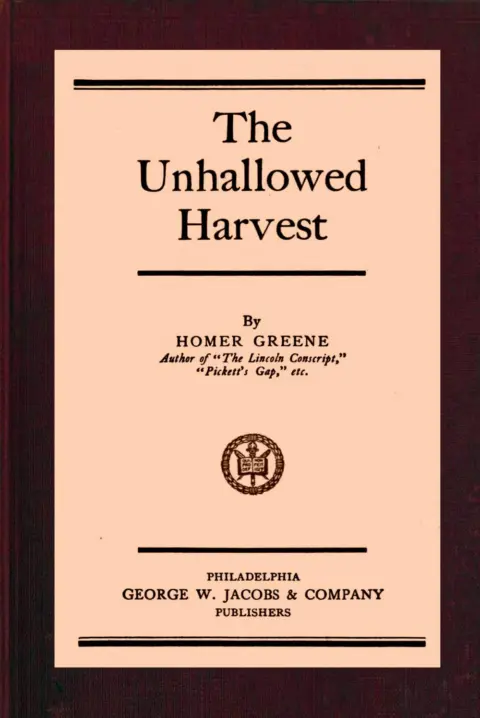
The unhallowed harvest
Homer Greene
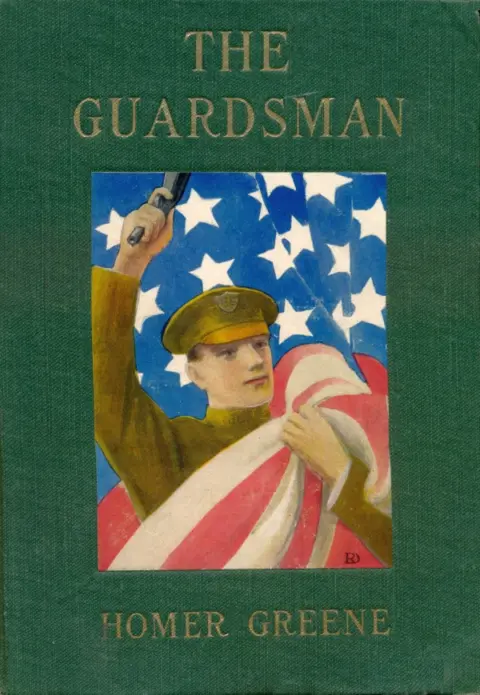
THE CLASSIC COLLECTION · 1919
"The Guardsman" by Homer Greene is a novel written in the early 20th century. The story revolves around the youthful characters in the town of Fairweather as they navigate the mischief of Hallowe'en and face the consequences of their actions. The main characters, Halpert McCormack and Benjamin Barriscale, both come from prominent families and engage in a series of antics that culminate in the theft of a statue from Barriscale's home, which leads to unintended afflictions and moral dilemmas. The opening of the novel introduces readers to the mischief and chaotic spirit of Hallowe'en in 1909, showcasing a group of boys, led by Hal McCormack, who embark on a nighttime escapade that involves removing a cobbler's sign and aiming to place it on the property of Benjamin Barriscale, the wealthy head of the Barriscale Manufacturing Company. However, their adventure escalates when they consider stealing an ornamental marble statue from Barriscale’s fountain, leading to the accidental breaking of the statue later in the story when a rival group encounters it. The narrative sets up a conflict rooted in youthful indiscretion, friendship, and the pursuit of social standing, paving the way for themes of accountability and personal growth as Hal must face the repercussions of their Hallowe'en antics.
Introduction adapted from the source catalogue; source summaries may be automatically generated.
Free to read · English · 71,044 words · No account needed
MAKE TIME FOR A GOOD BOOK
On by default. Untick to stop anonymous reading totals. Each page counts after 10 seconds in view. How this works.
Anonymous counting is on unless you have switched it off.
“That sign,” said Halpert McCormack, the apparent leader of the group, “ought to come down. In my opinion a cobbler has no business to be selling puppies. ‘Shoemaker, stick to your last!’ That’s a proverb we parsed in Miss Buskin’s class this morning. What do you say, fellows?”
“Sure it ought to come down,” was the immediate and unanimous response.
“Besides,” added Little Dusty, the youngest boy in the company, “his puppies is no good anyway. My cousin Joe bought one off of him last week, and he can’t even bark yet.”
One member of the group, inclined to be facetious, inquired:
“Who can’t bark? Joe or the dog?”
“Neither one of ’em,” was the quick reply. “But the puppy’s got fleas an’ Joe ain’t.”
“That settles it,” said Hal McCormack, gravely. “A man that will sell puppies with fleas on ’em deserves no consideration from us.”
“Right you are!” was the response. “Here goes!”
It took but a minute to cut the sign loose from its fastenings and to carry it around into a side street where darkness threw a protecting mantle over mischief.
One of the other boys turned to Hal. “Well,” he said, “you told us to take it down; now you got to say what we do with it.”
“Blessed if I know,” replied Hal.
“Stick it up somewheres,” suggested Little Dusty.
“Sure, stick it up somewheres,” exclaimed the first boy, “but where?”
“We might fasten it to the sign o’ Jim Nagel, the butcher,” responded
Little Dusty.
Then a boy known as Slicker spoke up. “Butchers don’t sell puppies,” he said, “they buy ’em. Folks’d think he was goin’ out o’ business if he put up a sign like that.”
“Oh,” commented Hal, “can that joke. It’s got whiskers.”
“Besides,” continued Slicker, “I know a better stunt than that. We’ll take it up to Barriscale’s, an’ fasten it on the gate-post.”
“Gee!” exclaimed Little Dusty. “My dad works at Barriscale’s, and if Mr. Barriscale found out I had a hand in it, Pop might get fired.”
“Well,” replied Slicker, “nobody’s goin’ to know who had a hand in it. We ain’t goin’ to hire no brass band an’ go around shoutin’ what we done. Are we, Hal?”
“No,” said Hal soberly. “This is secret business. No boy’s got a right to tell on anybody but himself, not even if they skin him alive. I won’t.”
“Nor I,” “Nor I.” The response was unanimous and whole-hearted.
Your reading position is saved on this browser. Take it to another device with a library code. Reading pages adapt to text, rather than matching a printed edition.
Homer Greene
Homer Greene
Homer Greene
Homer Greene
BEHIND THE BOOK
This eBook is for the use of anyone anywhere in the United States and most other parts of the world at no cost and with almost no restrictions whatsoever. You may copy it, give it away or re-use it under the terms of the Project Gutenberg License included with this eBook or online at www.gutenberg.org. If you are not located in the United States, you will have to check the laws of the country where you are located before using this eBook. Read the source licence.
The original source file, including credits and licence, is retained by this library. Request an original-format copy at no charge. Please include the book title and Project Gutenberg identifier #55768.
KEEP YOUR CURIOSITY GOING
Coulson Kernahan

Maurice Baring
Frances Wright
Cécile Tormay

Frederic Jesup Stimson

W. H. P. (William Henry Pope) Jarvis