THE CLASSIC COLLECTION✦The wonders of scienceCLASSIC FREE BOOKS
The wonders of science
Henry Mayhew
THE CLASSIC COLLECTION · 1847
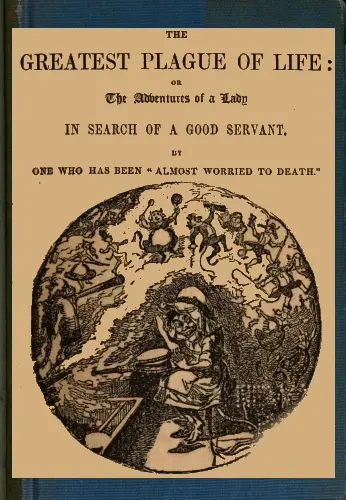
"The Greatest Plague of Life: or, The Adventures of a Lady in Search of a Good Servant" is a novel likely written in the mid-19th century. The narrative follows the life of a woman, referred to as Caroline, who is plagued by the difficulties of managing servants in her household. Her experiences serve as a commentary on domestic life and the challenges faced by women in that era. At the start of the book, the narrator introduces herself and her plight, detailing the stress and turmoil caused by ungrateful and incompetent servants during her marriage. After a series of unfortunate events that lead her family to seek solace in a boarding house, she decides to compile her experiences into a guide for young wives entering domestic life, hoping to prevent them from suffering as she has. The beginning vividly conveys her frustrations and aspirations, establishing a humorous yet poignant tone that sets the stage for her ensuing adventures.
Introduction adapted from the source catalogue; source summaries may be automatically generated.
Free to read · English · 126,448 words · No account needed
MAKE TIME FOR A GOOD BOOK
On by default. Untick to stop anonymous reading totals. Each page counts after 10 seconds in view. How this works.
Anonymous counting is on unless you have switched it off.
When I went down stairs, after the fourth day, I laid myself upon the sofa, and was too ill to eat a thing; though Mr. Edward would come to my side, and beg and pray of me just to take a mouthful for his sake. But no! I told him, with a sigh, I was too weak to take anything beyond a cup of tea and a little dry toast (for, of course, after the couple of good large mutton chops that I took good care to have in the middle of the day, I hadn’t much of an appetite left for dinner, especially as I wouldn’t let my gentleman have any thing particularly nice--saying to myself, “If we can’t afford a footman--I’m sure we can’t afford dainties!”)
And so I went on with my severe attack of Neuralgia, getting worse and worse, and making my grand Turk breakfast by himself, and dine by himself--and get out of bed at all hours of the night to give me my delicious tinctures, and never even condescending to speak to him, unless it was to tell him, with a sigh, how ill and weak I felt,--and that I knew it was all owing to my over-exertions about the great big house,--and continually reminding him too that he had only himself to blame for it, as I had given him fair warning of what would be the consequence of his unfeeling meanness,--and then asking him quietly whether it wasn’t better now to pay the money for a footman, instead of seeing his poor, dear, fond, foolish wife suffering so acutely as she was, and having to pay, at least, double or treble as much in those horrid doctor’s bills for her,--and so I went on, I say, until, upon my word, one Monday evening (for I remember Mr. Edward had the boiled knuckle of veal cold for dinner which I’d given him hot on the Sunday), I was lying on the sofa groaning away, and my gentleman was seated by me after dinner, looking quite repentant, and asking me whether I thought Mr. J--pp was doing me good, and a whole troup of other civil things, when I said--with a sigh that seemed to cut him to the quick, thank goodness!--“It’s too late now, Edward dear; I told you I was sinking fast, but you wouldn’t believe it then, and now I feel satisfied that I sha’n’t trouble you with my presence here much longer.” “For Heaven’s sake! Carry, my love, don’t go on in that way!” he exclaimed, pressing my hand between his two palms. “Is there anything I can get for you, dearest?” “That footman I spoke to you about,” I replied, “perhaps might have relieved me at one time; but now”--I added, as if in pain, “there is no hope. You will be kind to my little darling toodle-loodle-lumpty, when its poor dear mother’s no more, and take care when the little trot grows up that she’s not killed in this great big house for want of a footman.” Here that Edward gave two or three pathetic snivels, and commenced feeling for his pocket-handkerchief. So as I saw he was beginning to melt, I continued, in a low, solemn voice, “When I am gone, promise me, Edward--you wont marry again--and you will put upon my tombstone that I was a ‘TENDER AND AFFECTIONATE WIFE,’ and ‘UNIVERSALLY REGRETTED’--and now I come to think of it, Edward dear, it would look charming if you were to add those beautiful lines of ‘Affliction sore long time I bore,’ and wind up with ‘she fell a martyr to the want of a footman,’ brought in nicely somehow.” This, I’m proud to say, was a severe homethrust; and on looking at my fine gentleman, if I didn’t see a beautiful little tear in the corner of each of his eyes; and thank goodness, by staring as hard as ever I could at one of the roses in the carpet, and drawing the air in up my nose, I was lucky enough to squeeze out two or three tears myself--so that at last I worked upon the hard-hearted monster’s feelings in such a way, that he turned round and told me if I thought a footman would be any relief to me, for goodness sake to get one, only I was not to give way to low spirits as I did. But I merely answered, “No, thank you, dearest, dearest Edward; you must not go to any expense to please me in my last moments--you cannot afford it.” “Do not say so, dear Carry,” he answered, “you must and shall have one!” “No, no,” I replied, groaning as if in severe agony; “you cannot afford it, and I will not listen to it.” “What!--not to please your own Edward, my lamb,” he said, in a low voice, putting his lips close to my ear. “To please her own Edward,” I returned, with affection, “his lamb will do anything;” and then throwing my arms round his neck, I put an end to that awkward business.
Your reading position is saved on this browser. Take it to another device with a library code. Reading pages adapt to text, rather than matching a printed edition.
Henry Mayhew
Henry Mayhew
BEHIND THE BOOK
This eBook is for the use of anyone anywhere in the United States and most other parts of the world at no cost and with almost no restrictions whatsoever. You may copy it, give it away or re-use it under the terms of the Project Gutenberg License included with this eBook or online at www.gutenberg.org. If you are not located in the United States, you will have to check the laws of the country where you are located before using this eBook. Read the source licence.
The original source file, including credits and licence, is retained by this library. Request an original-format copy at no charge. Please include the book title and Project Gutenberg identifier #60562.
KEEP YOUR CURIOSITY GOING
Coulson Kernahan

Maurice Baring
Frances Wright
Cécile Tormay

Frederic Jesup Stimson

W. H. P. (William Henry Pope) Jarvis