THE CLASSIC COLLECTION✦The wonders of scienceCLASSIC FREE BOOKS
The wonders of science
Henry Mayhew
THE CLASSIC COLLECTION · 1847
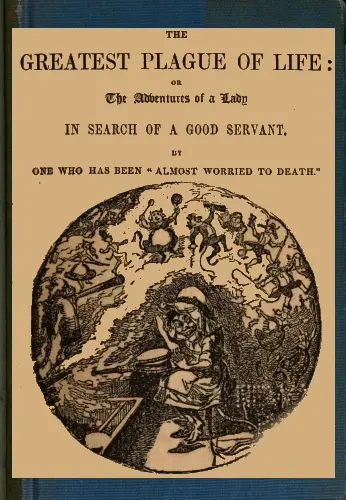
"The Greatest Plague of Life: or, The Adventures of a Lady in Search of a Good Servant" is a novel likely written in the mid-19th century. The narrative follows the life of a woman, referred to as Caroline, who is plagued by the difficulties of managing servants in her household. Her experiences serve as a commentary on domestic life and the challenges faced by women in that era. At the start of the book, the narrator introduces herself and her plight, detailing the stress and turmoil caused by ungrateful and incompetent servants during her marriage. After a series of unfortunate events that lead her family to seek solace in a boarding house, she decides to compile her experiences into a guide for young wives entering domestic life, hoping to prevent them from suffering as she has. The beginning vividly conveys her frustrations and aspirations, establishing a humorous yet poignant tone that sets the stage for her ensuing adventures.
Introduction adapted from the source catalogue; source summaries may be automatically generated.
Free to read · English · 126,448 words · No account needed
MAKE TIME FOR A GOOD BOOK
On by default. Untick to stop anonymous reading totals. Each page counts after 10 seconds in view. How this works.
Anonymous counting is on unless you have switched it off.
Besides, I said--just to put Edward in a good temper--a man of his naturally strong judgment must be well aware that a great big strapping boy, who hadn’t done growing, and kept running up so fast that he required to have at least two tucks let out of his trowsers every quarter, must eat more than a decent, well-behaved, abstemious young man who had got to his proper size, and who consequently wouldn’t be always getting a head taller per annum out of your mutton and beef. And moreover, I added, going to the sofa and kissing him, as I saw him smile, with what at the time I foolishly supposed to be good humour,--“It will, you know, my dear, look so highly genteel, and give one such a standing in the world, to have one’s door opened by a fine good-looking fellow, with powdered hair and a pair of handsome legs, and near upon six feet in his shoes.” But, oh dear bless me, no! Mr. Edward wouldn’t listen to such stuff, as he called it; and must needs go bursting into a contemptuous laugh, telling me to go along with me, for I was an old fool, and ought to have more sense in my head at my time of life, (my time of life, indeed! Well, that is good! Isn’t it, gentle reader?)
Of course it was the old story over and over again. He wasn’t going to bring himself to the workhouse, he wasn’t, for any of my fine fal-lal notions. As for his having a great, fat, lazy footman, sauntering about his house, and eating the very bed from under him, he wouldn’t think of it for a moment; for the long and short of it was, he couldn’t afford it, especially with the few suits that he had then down on his ‘Chancery Cause Book;’ and the world seemed to have come to such a pass now-a-days, that relations and partners would settle all their disputes amicably. So I merely told him, that, of course, I couldn’t say whether his trumpery Chancery Cause-Book would allow him to afford me a rubbishing footman or not; but this I could and I would say, that unless something was done, he’d have to afford, somehow or other, to pay for my funeral expenses before long--though, perhaps, I added, with my usual biting sarcasm, that would be far more agreeable to him. Then, bursting into tears, I went on saying, “If some change does not take place, I can only tell you, sir, I shall fall a martyr to your meanness and this great big house; for I feel myself sinking every day under the weight of it; and Doctor J--pp himself has, over and over again, said, when he has called and found me here nearly fainting with fatigue, ‘Why, my dear madam, will we over-exert ourselves in this way. Really, we are too attentive and good a housewife. We are not fit for it--positively, we are not. Now, we ought to be in bed in our present state--indeed, we ought--instead of being up here, ruining our naturally fine constitution in this way. Mr. Sk--n--st--n, I’m sure, cannot be aware of what we are doing, or he would never allow us, if he had one spark of feeling, to be killing ourselves by inches in this way. Really, my dear, good, lady, it comes to this--either we must get extra help, and eat little and good, and often, or depend upon it we shall be in our graves before many months are over our heads. Would you like us to speak to our good worthy husband on the subject, for I am sure he would gladly make any sacrifice, rather than let us endanger our precious life thus?” And what reply did I make to my medical attendant? I asked Edward, with an indignant look--why, I merely said, “No, Dr. J--pp, my own dear Edward will tell you that he cannot afford it; and if so, perhaps my funeral expenses will fall less heavily upon him than having an extra servant in the house.”
Your reading position is saved on this browser. Take it to another device with a library code. Reading pages adapt to text, rather than matching a printed edition.
Henry Mayhew
Henry Mayhew
BEHIND THE BOOK
This eBook is for the use of anyone anywhere in the United States and most other parts of the world at no cost and with almost no restrictions whatsoever. You may copy it, give it away or re-use it under the terms of the Project Gutenberg License included with this eBook or online at www.gutenberg.org. If you are not located in the United States, you will have to check the laws of the country where you are located before using this eBook. Read the source licence.
The original source file, including credits and licence, is retained by this library. Request an original-format copy at no charge. Please include the book title and Project Gutenberg identifier #60562.
KEEP YOUR CURIOSITY GOING
Coulson Kernahan

Maurice Baring
Frances Wright
Cécile Tormay

Frederic Jesup Stimson

W. H. P. (William Henry Pope) Jarvis