THE CLASSIC COLLECTION✦The wonders of scienceCLASSIC FREE BOOKS
The wonders of science
Henry Mayhew
THE CLASSIC COLLECTION · 1847
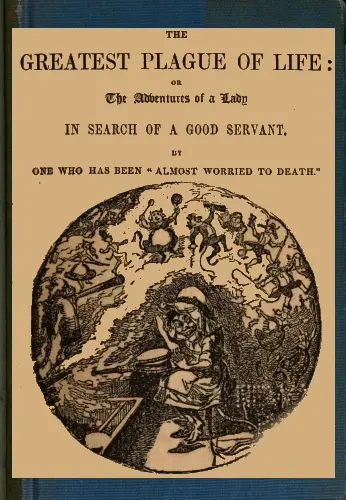
"The Greatest Plague of Life: or, The Adventures of a Lady in Search of a Good Servant" is a novel likely written in the mid-19th century. The narrative follows the life of a woman, referred to as Caroline, who is plagued by the difficulties of managing servants in her household. Her experiences serve as a commentary on domestic life and the challenges faced by women in that era. At the start of the book, the narrator introduces herself and her plight, detailing the stress and turmoil caused by ungrateful and incompetent servants during her marriage. After a series of unfortunate events that lead her family to seek solace in a boarding house, she decides to compile her experiences into a guide for young wives entering domestic life, hoping to prevent them from suffering as she has. The beginning vividly conveys her frustrations and aspirations, establishing a humorous yet poignant tone that sets the stage for her ensuing adventures.
Introduction adapted from the source catalogue; source summaries may be automatically generated.
Free to read · English · 126,448 words · No account needed
MAKE TIME FOR A GOOD BOOK
On by default. Untick to stop anonymous reading totals. Each page counts after 10 seconds in view. How this works.
Anonymous counting is on unless you have switched it off.
“You call it old woman’s rubbish, do you?--then I don’t,” I continued, with my customary satire. “I call it an excellent remedy--that’s what I call it.”
“But how can the tallow on your nose do you any good, I should like to
know!” he returned.
“You’d like to know?” I said, in my bitterest way--“I dare say you would, but I’m not going to tell you.”
“Yes; but why is it an excellent remedy?” he inquired, grinning in a way I didn’t half like.
“Because it is,” I replied, with my usual argument.
“Yes; but what on earth do you use it for?” he continued.
“Because I do,” I answered, determined to have the best of it.
As I wasn’t going to stop there wasting my argumentative powers upon a man who was deaf to reason, I put an end to his sneers by ringing the bell for that Betsy, and told her to get some boiling water ready as soon as she could, for I wanted to have my bed warmed, and to be sure and stand the warming-pan near the fire for a few minutes before putting the water in it, so that I might have it as hot as I could. We always used one of the new patent hot-water warming-pans, because with them one hasn’t that nasty coal-gassy smell that the old-fashioned things invariably leave behind them; and there’s no chance--even if the pan’s left to stand a moment in the bed--of having one’s best linen sheets scorched, and with large brown marks upon them as if they were stuck over with pancakes.
I thought my lady was taking her time nicely to boil a trumpery kettle full of water. So, even ill as I was, I couldn’t help just slipping quietly down stairs, and popping in upon her when she least expected me. Hoity-toity! was there ever such a sight!--I thought I should have dropped down when I saw it. My beautiful kitchen for all the world like a cheap Jack’s cart at a fair--saucepans here, kettles there, crockery everywhere, while my beauty was sitting with her toes cocked up on the fender, and that trumpery “GIPSY GIRL OF ROSEMARY DELL” in her hand, as I live, and crying water-spouts over that stupid, disgusting “OUTCAST” of an “ELA.” There was our cat, too, right in the frying-pan, and the house flannel and the scrubbing-brush in the fish-kettle, and that precious “EMILY FITZORMOND, or the Deserted One,” lying on the ground, with the “RANGER OF THE TOMB” by her side, and “FATHERLESS FANNY, or the Mysterious Orphan,” as the thing was called, all over grease, and without even so much as a wrapper to its back, pitched about anywhere. There were all the dirty plates and dishes besides, just as they had come down from dinner more than an hour ago, side by side with the breakfast things, which she had got to wash up before we could have even a mouthful of tea; and although it was nearly dark, I declare she hadn’t so much as cleaned a single candlestick all the day through, for they were standing on the hob with all the hot tallow running out of them, and dripping into one of my best new block-tin saucepans. As I’m a Christian, drat the woman, if she hadn’t stuck my beautiful bright copper warming-pan, too, (that hadn’t been used more than twice, and which I picked up, quite a bargain, at a broker’s only a year ago,) right on the top of the oven, and so close to the fire, that, upon my word, when I went to take hold of it, it was nearly red hot, while of course her head was so full of her romantic rubbish, that she hadn’t so much as thought about the hot water; for,
Your reading position is saved on this browser. Take it to another device with a library code. Reading pages adapt to text, rather than matching a printed edition.
Henry Mayhew
Henry Mayhew
BEHIND THE BOOK
This eBook is for the use of anyone anywhere in the United States and most other parts of the world at no cost and with almost no restrictions whatsoever. You may copy it, give it away or re-use it under the terms of the Project Gutenberg License included with this eBook or online at www.gutenberg.org. If you are not located in the United States, you will have to check the laws of the country where you are located before using this eBook. Read the source licence.
The original source file, including credits and licence, is retained by this library. Request an original-format copy at no charge. Please include the book title and Project Gutenberg identifier #60562.
KEEP YOUR CURIOSITY GOING
Coulson Kernahan

Maurice Baring
Frances Wright
Cécile Tormay

Frederic Jesup Stimson

W. H. P. (William Henry Pope) Jarvis