THE CLASSIC COLLECTION✦The wonders of scienceCLASSIC FREE BOOKS
The wonders of science
Henry Mayhew
THE CLASSIC COLLECTION · 1847
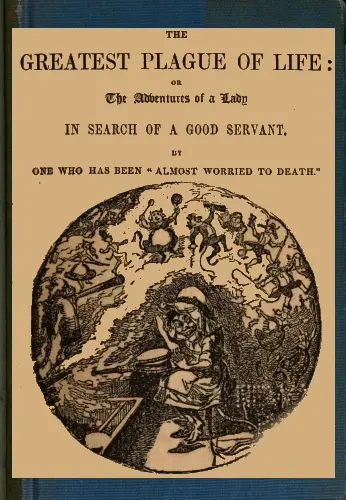
"The Greatest Plague of Life: or, The Adventures of a Lady in Search of a Good Servant" is a novel likely written in the mid-19th century. The narrative follows the life of a woman, referred to as Caroline, who is plagued by the difficulties of managing servants in her household. Her experiences serve as a commentary on domestic life and the challenges faced by women in that era. At the start of the book, the narrator introduces herself and her plight, detailing the stress and turmoil caused by ungrateful and incompetent servants during her marriage. After a series of unfortunate events that lead her family to seek solace in a boarding house, she decides to compile her experiences into a guide for young wives entering domestic life, hoping to prevent them from suffering as she has. The beginning vividly conveys her frustrations and aspirations, establishing a humorous yet poignant tone that sets the stage for her ensuing adventures.
Introduction adapted from the source catalogue; source summaries may be automatically generated.
Free to read · English · 126,448 words · No account needed
MAKE TIME FOR A GOOD BOOK
On by default. Untick to stop anonymous reading totals. Each page counts after 10 seconds in view. How this works.
Anonymous counting is on unless you have switched it off.
When the man had gone, I said to myself: “Well, my fine gentleman, I shall never trouble you again,” for I declare that of all the servants I ever heard of, his seemed to be the worst; for, of course, how was I ever to be able to tell that he was only talking of a set of trumpery plants that he had got for sale. I’m sure, if he had two grains of common sense, he ought to have seen that there was some mistake somewhere; though, for the matter of that, I don’t suppose I should ever have found it out myself, had it not been for the gentleman from the Servants’ Institution calling to see me, scarcely half-an-hour afterwards. And then, bless us and save us, if I didn’t go taking him for the nurseryman, though I certainly must do myself the justice to say that I couldn’t help thinking that he looked rather grand for a gardener, with his white cravat, and black coat buttoned up to his chin, and black kid gloves, with the fingers all out, and looking as crumpled and shrivelled as French plums.
No sooner had Mr. Dick Farden told me that the other gentleman that I had sent him for had come, than I had him into the parlour, and told him that if he would step with me into the garden, I would arrange with him what I wanted done to it, and he could let me have his opinion about it. The man opened his eyes, and looked at me as wise as an owl; as, indeed, he might; for what on earth could what my garden wanted doing to it, be to him? When we got there, I declare he must have thought me mad, for I took him right up to the middle of it, and told him, I had made up my mind to have a nice grass plot laid down in the centre, so that my dear little pet might play about on it, without coming to any harm. But he only stared the more, and said, “Very good;” though, of course, if he had spoken his real opinion, he would have said “very strange.” Then I told him I had settled upon having some nice flower-beds all round the sides, and said I thought it would look very pretty; on which he looked at me for a short time, with his mouth wide open, as much as to say, “Surely the woman must be out of her mind;” but he only answered, “Indeed.” After that, I asked him what plants he would advise me to have, and whether he thought the soil would be rich enough for dahlias? But, without looking at the ground, and keeping his eye fixed intently on me, he answered, “Certainly;” and then clutching the handle of his umbrella as tight as he could, he retreated several paces off, in a way that I couldn’t for the life of me understand at the time, but which--now that I come to think of it--clearly convinces me that the poor man must have fancied that I had broken loose from Bedlam, and that he expected every minute I should seize hold of the spade, which was within arm’s length of me, and race round the garden after him with it. When I told him that most likely he was not aware of how hard the ground was, and I stamped on it two or three times, and raised myself up on my toes, just to show him that I couldn’t make any impression upon it, the stupid ninny began jumping about and dancing away, and staring at me, till, I declare, his eyes looked for all the world like two farthings. Coupling this with the whole of the man’s previous strange behaviour, upon my word, I thought he had gone stark raving mad, though it’s quite plain to me now that he thought the same of me, and was only playing those antics just to humour me. I seized the spade and he opened his umbrella, and there we stood, face to face, thrusting away at one another as hard as ever we could, and all the time jumping and skipping about, like two dancing bears. I gave a loud scream, and he, poor man, retreated as quick as he could do so backwards to the door, where he met with that scoundrel of a Dick Farden, who had been the cause of it all, and whom I no sooner saw than I told him, for Heaven’s sake, to seize that mad friend of his. Then, lawk a daisy! out it all came; and I learnt, to my great horror, that I had been confounding the two men. Of course I apologized to the gentleman from the Servants’ Institution as a lady ought to, telling him that I was extremely sorry that I had mistaken him for a gardener and a madman; but the man went as red in the face as a tomata, with passion, declaring that he had never been so insulted before in all his life, and vowing that he would make me pay for having dragged him all that way, through a broiling sun, upon a fool’s errand; and then out of the house he bounced, like a human cracker.
Your reading position is saved on this browser. Take it to another device with a library code. Reading pages adapt to text, rather than matching a printed edition.
Henry Mayhew
Henry Mayhew
BEHIND THE BOOK
This eBook is for the use of anyone anywhere in the United States and most other parts of the world at no cost and with almost no restrictions whatsoever. You may copy it, give it away or re-use it under the terms of the Project Gutenberg License included with this eBook or online at www.gutenberg.org. If you are not located in the United States, you will have to check the laws of the country where you are located before using this eBook. Read the source licence.
The original source file, including credits and licence, is retained by this library. Request an original-format copy at no charge. Please include the book title and Project Gutenberg identifier #60562.
KEEP YOUR CURIOSITY GOING
Coulson Kernahan

Maurice Baring
Frances Wright
Cécile Tormay

Frederic Jesup Stimson

W. H. P. (William Henry Pope) Jarvis