THE CLASSIC COLLECTION✦The wonders of scienceCLASSIC FREE BOOKS
The wonders of science
Henry Mayhew
THE CLASSIC COLLECTION · 1847
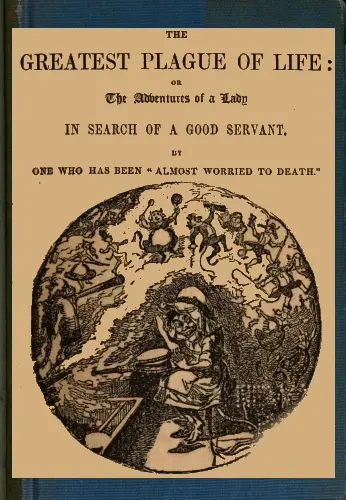
"The Greatest Plague of Life: or, The Adventures of a Lady in Search of a Good Servant" is a novel likely written in the mid-19th century. The narrative follows the life of a woman, referred to as Caroline, who is plagued by the difficulties of managing servants in her household. Her experiences serve as a commentary on domestic life and the challenges faced by women in that era. At the start of the book, the narrator introduces herself and her plight, detailing the stress and turmoil caused by ungrateful and incompetent servants during her marriage. After a series of unfortunate events that lead her family to seek solace in a boarding house, she decides to compile her experiences into a guide for young wives entering domestic life, hoping to prevent them from suffering as she has. The beginning vividly conveys her frustrations and aspirations, establishing a humorous yet poignant tone that sets the stage for her ensuing adventures.
Introduction adapted from the source catalogue; source summaries may be automatically generated.
Free to read · English · 126,448 words · No account needed
MAKE TIME FOR A GOOD BOOK
On by default. Untick to stop anonymous reading totals. Each page counts after 10 seconds in view. How this works.
Anonymous counting is on unless you have switched it off.
Next day, nurse came; and really she was such a nice, goodnatured, fat, motherly old soul, that it was quite pleasant to have a little quiet chat with her. Her name was Mrs. Toosypegs, and she was the widow--poor thing--of a highly respectable eating-house keeper, who, she assured me, used to do such a deal in the eating line, that he would sometimes have as many as five hundred dinners a day. Unfortunately, however, one evening, “the spirit of progress”--as they call it--got into his head, and he would go having an ordinary for the Million, every day, at every half-hour, at only fifteen-pence a head. But the Million--drat ’em!--had every one of them the appetites of a hundred; and the consequence was, that there was no satisfying them, although he gave them oceans of soup, and as much fish as they could eat, by way of what he called a damper to their raging appetites; though really it seemed quite thrown away upon them: for, Lord bless you, when the joint was brought up, they seemed to be as fresh and ravenous as ever, and would fall-to at the meat, as if the Million were a parcel of boa-constrictors, and only in the habit of being fed twice a year. And she declared that, often and often, the waiters had to shake many of the Million to wake them up and get them to pay; and that when they swept up the room of a night, she had, over and over again, collected several gross of waistcoat buttons, which the greedy young ogres had actually burst off with her husband’s food. So that at last the blessed Million positively eat Mr. Toosypegs through the Insolvent Court, and left him little or nothing to satisfy his poor creditors with; and this so preyed upon her dear man’s mind, that in an insane moment of despair, he raised his own boiled-beef knife against himself, and fell, like another Cook, a victim to the Cannibals who prowled about To-heat-he. After which, Mrs. Toosypegs informed me she had been put to it so hard, that she had been obliged to go out nursing; and, thank goodness! she had done as well as could be expected; for though she had no dear little Toosypegs of her own, still she had brought such numbers of children into the world, that she could not help looking upon herself in the light of a mother of a very large family--indeed, she was always speaking of the little pets she had nursed as if they were her own flesh and blood; for at one time she would talk to me of a very fine boy she had had in Torrington Square, and at another, of her beautiful twins at Ball’s Pond; and then, of a sweet little flaxen-haired beauty of a little girl of hers with eleven toes, that she had had at Captain Jones’s, at Puddle Dock. And really, last year, she said she had had as many as eight confinements in the course of the twelvemonth, and which had been almost more than she had strength to go through with. Her last lying-in had been in the suburbs, near Stockwell Park; and what made her month very agreeable was, that the family lived in a long terrace, and she knew all the neighbours’ little secrets; for all kinds of strange reports used to travel from house to house, over the garden walls, or else from door to door, when the maids were cleaning the steps of a morning. And she advised me, if ever I took a house in a terrace a little way out of town, to be very careful that it was the centre one--at least, if I had any regard for my reputation. For I must be well aware that a story never lost by telling; and consequently, if I lived in the middle of a row of houses, it was very clear that the tales which might be circulated against me would only have half the distance to travel on either side of me, and therefore could only be half as bad, by the time they got down to the bottom of the terrace, as the tales that might be circulated against the wretched individuals who had the misfortune to live at the two ends of it; so that I should be certain to have twice as good a character in the neighbourhood as they had. For instance, she informed me of a lamentable case that actually occurred while she was there. The servant at No. 1 told the servant at No. 2 that her master expected his old friends the Baileys to pay him a visit shortly; and No. 2 told No. 3 that No. 1 expected to have the Baileys in the house every day; and No. 3 told No. 4 that it was all up with No. 1, for they couldn’t keep the bailiffs out; whereupon 4 told 5 that the officers were after No. 1, and that it was as much as he could do to prevent himself being taken in execution, and that it was nearly killing his poor, dear wife; and so it went on, increasing and increasing, until it got to No. 32, who confidently assured the last house, No. 33, that the Bow-street officers had taken up the gentleman who lived at No. 1, for killing his poor dear wife with arsenic, and that it was confidently hoped and expected that he would be executed at Horsemonger-lane jail, as the facts of the case were very clear against him. All which, Mrs. Toosypegs said, proved, very clearly, that servants were a “bad lot,” and that there was no trusting ’em with anything, but what they must go wasting their time gossiping and putting it about all over the neighbourhood. Though, for her own part, she always made it a rule to shut her ears against all scandal.
Your reading position is saved on this browser. Take it to another device with a library code. Reading pages adapt to text, rather than matching a printed edition.
Henry Mayhew
Henry Mayhew
BEHIND THE BOOK
This eBook is for the use of anyone anywhere in the United States and most other parts of the world at no cost and with almost no restrictions whatsoever. You may copy it, give it away or re-use it under the terms of the Project Gutenberg License included with this eBook or online at www.gutenberg.org. If you are not located in the United States, you will have to check the laws of the country where you are located before using this eBook. Read the source licence.
The original source file, including credits and licence, is retained by this library. Request an original-format copy at no charge. Please include the book title and Project Gutenberg identifier #60562.
KEEP YOUR CURIOSITY GOING
Coulson Kernahan

Maurice Baring
Frances Wright
Cécile Tormay

Frederic Jesup Stimson

W. H. P. (William Henry Pope) Jarvis