THE CLASSIC COLLECTION✦The wonders of scienceCLASSIC FREE BOOKS
The wonders of science
Henry Mayhew
THE CLASSIC COLLECTION · 1847
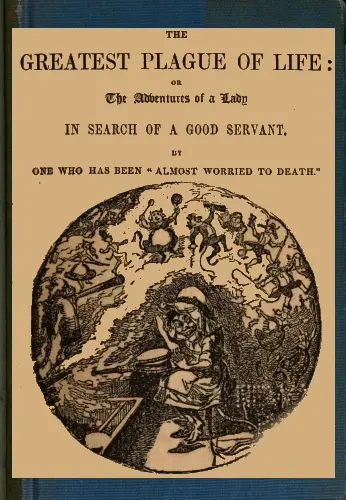
"The Greatest Plague of Life: or, The Adventures of a Lady in Search of a Good Servant" is a novel likely written in the mid-19th century. The narrative follows the life of a woman, referred to as Caroline, who is plagued by the difficulties of managing servants in her household. Her experiences serve as a commentary on domestic life and the challenges faced by women in that era. At the start of the book, the narrator introduces herself and her plight, detailing the stress and turmoil caused by ungrateful and incompetent servants during her marriage. After a series of unfortunate events that lead her family to seek solace in a boarding house, she decides to compile her experiences into a guide for young wives entering domestic life, hoping to prevent them from suffering as she has. The beginning vividly conveys her frustrations and aspirations, establishing a humorous yet poignant tone that sets the stage for her ensuing adventures.
Introduction adapted from the source catalogue; source summaries may be automatically generated.
Free to read · English · 126,448 words · No account needed
MAKE TIME FOR A GOOD BOOK
On by default. Untick to stop anonymous reading totals. Each page counts after 10 seconds in view. How this works.
Anonymous counting is on unless you have switched it off.
But let me see,--where was I? Oh, I remember: I had left off at our dinner. Well! as I was saying, our miserable, dried-up repast, could scarcely have gone down stairs, and Susan was just sweeping the crumbs off the tablecloth, when I heard a hackney coach draw up at our door, and, lo and behold! who should it contain but that bothering Mrs. Yapp, who had come with three hair trunks, a portmanteau, two bonnet-boxes, one band ditto, and a bundle, as if she was going to stop a whole twelvemonth with us.
When she came in, I declare upon my word and honour, if she was’nt the very woman, with a complexion like fullers-earth, that I had asked at the coach-office, whether her name was Yapp. And on reminding her of it, she said, she was very sorry for the mistake, but really and truly she had heard so much about the tricks of London people, that she could’nt be expected to go telling her name to the first stranger she met with. So she had thought that the safest plan, to prevent being imposed upon, was to jump with her boxes into a hackney coach, and tell the man to drive her to our house. The fellow, however, had been three hours at least galloping about with her, and had taken her over to Stockwell Park, and Highbury Park, and every other park he could think of, in search of Park Village. For of course the man saw that she was fresh from the country, and had determined to make the most of her; so she had to pay upwards of half a sovereign for her nasty suspicions of me, (your bilious people are always so suspicious,) and which I was heartily glad of.
Of course she was so happy to see her dear boy, “whose house she was going to make her home;” and declared she was delighted to make my acquaintance. Edward very imprudently would go inquiring after her health, when immediately off my lady went, and kept us for full half an hour, giving us a whole catalogue of all her illnesses and cures, and telling us how she had discovered a new pill which had really worked miracles with her. As I kept saying, “Indeed,” and “Bless me,” and “You don’t say so,” and appearing very interested--though all the time I could have wished her further--she had the impudence to tell me that, as a treat, she would let me have a couple to try on the morrow, for she could plainly see my liver was out of order--though, as I said to myself at the time, I should like to know what my liver was to her indeed. However, I slipped out of the room to look after Susan and the tray, and made her warm up one of the pork chops, and bring it up with the tea. But no sooner did my lady see it, than she said it would be death to her if she touched it, and before she let me make the tea, she would go and undo one of her boxes in the hall, just to get out a loaf of digestive bread, and a bottle of filthy soda; and if she didn’t force me to put half a teaspoonful at least into the pot, telling me that it would correct all the acidity, and make the tea go twice as far--which I can easily understand, as I’m sure neither Edward nor myself could touch it; for I declare it was more like soap-suds than full-flavoured wiry Pekoe. The worst of it was, too, I was obliged to say it “was very nice, I was sure;” and I could see that Edward, laughing away in his sleeve at every sip I took. Then she would sit all the evening with her shawl over her shoulders, declaring that the draughts came in at our door enough to cut her in two; and, bother take it, she made me go down stairs and see that the sheets for her bed were well aired--and give orders for a fire to be lighted in her room--and the feather-bed put down before it--and a pan of hot water to be taken up for her at ten precisely--and for a few spoonfuls of brown sugar to be put into the warming-pan with the coals, before warming her bed; adding that, with a good large basin of gruel, and a James’s powder in it, she thought she should do for that night. And really I should have thought so too. But what pleased me most was, that she said she was putting me to a great deal of trouble. And I should think she was too--though of course I was forced to assure her that she wasn’t, and that nothing gave me more pleasure than to be able to assist one with such a bad constitution as she appeared to have of her own. Whereupon she flew at me very spitefully, and told me I was never more mistaken in all my life, for every one that knew her allowed, that if it hadn’t been for her very fine constitution, and a score of Morison’s Number Two’s daily, she should have been in Abraham’s bosom long ago; and that I should be a lucky woman if my constitution was half as fine as hers. So as I saw it was useless arguing the point with her, I let her have her own way, and was’nt at all sorry when ten o’clock came, and I had seen her fairly up stairs to her bed-room, where she kept Susan a good three-quarters of an hour at least fiddle-faddleing and tying her flannel petticoat round her head, and tucking her up, and pinning her shawl before the window, and what not.
Your reading position is saved on this browser. Take it to another device with a library code. Reading pages adapt to text, rather than matching a printed edition.
Henry Mayhew
Henry Mayhew
BEHIND THE BOOK
This eBook is for the use of anyone anywhere in the United States and most other parts of the world at no cost and with almost no restrictions whatsoever. You may copy it, give it away or re-use it under the terms of the Project Gutenberg License included with this eBook or online at www.gutenberg.org. If you are not located in the United States, you will have to check the laws of the country where you are located before using this eBook. Read the source licence.
The original source file, including credits and licence, is retained by this library. Request an original-format copy at no charge. Please include the book title and Project Gutenberg identifier #60562.
KEEP YOUR CURIOSITY GOING
Coulson Kernahan

Maurice Baring
Frances Wright
Cécile Tormay

Frederic Jesup Stimson

W. H. P. (William Henry Pope) Jarvis