THE CLASSIC COLLECTION✦The wonders of scienceCLASSIC FREE BOOKS
The wonders of science
Henry Mayhew
THE CLASSIC COLLECTION · 1847
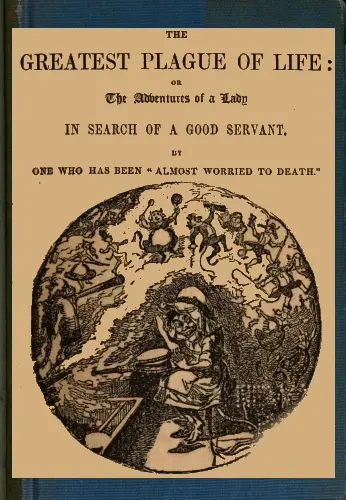
"The Greatest Plague of Life: or, The Adventures of a Lady in Search of a Good Servant" is a novel likely written in the mid-19th century. The narrative follows the life of a woman, referred to as Caroline, who is plagued by the difficulties of managing servants in her household. Her experiences serve as a commentary on domestic life and the challenges faced by women in that era. At the start of the book, the narrator introduces herself and her plight, detailing the stress and turmoil caused by ungrateful and incompetent servants during her marriage. After a series of unfortunate events that lead her family to seek solace in a boarding house, she decides to compile her experiences into a guide for young wives entering domestic life, hoping to prevent them from suffering as she has. The beginning vividly conveys her frustrations and aspirations, establishing a humorous yet poignant tone that sets the stage for her ensuing adventures.
Introduction adapted from the source catalogue; source summaries may be automatically generated.
Free to read · English · 126,448 words · No account needed
MAKE TIME FOR A GOOD BOOK
On by default. Untick to stop anonymous reading totals. Each page counts after 10 seconds in view. How this works.
Anonymous counting is on unless you have switched it off.
Well, on the Thursday home came Edward. Directly I heard his knock, I snatched up a duster and began rubbing down the hall chairs, so that he might not find a speck of dust in the house on his return; and I was quite glad to see that my exertions were not thrown away upon him, for he told me, that it was very wrong of me in my state to go fatiguing myself in that way, and that he wished I would make the servant do it. On which I said that if he expected Susan to take any pride about the look of the furniture he was mightily mistaken, and he would find himself eaten up alive in less than no time, if I wasn’t continually slaving myself to death for him as I was.
Edward was in quite a good humour, for he had won his cause like a clever lawyer, as he certainly is, though, as he said, all the facts, and the law, and justice of the case, were dead against him. So, when I broke to him the impending calamity of Mrs. Yapp’s visit, he took it much better than I had expected, for he laughed, and said he should like to see how old Mother Yapp and Mrs. B--ff--n would get on with one another; for he expected they would come together like two highly-charged thunder-clouds, and go off with a tremendous explosion, which would have the effect of clearing the air of his house, so that he would be left in a perfect heaven. And then the jocular monster tittered, and said that if he had been doomed to have only one mother-in-law, it was clear that he must have ended his days in a madhouse, but that as Providence had blessed him with two, he was as happy as a man who had married an orphan; for as mothers-in-law were the invariable negatives of domestic happiness, it was clear that two of them must make his home an affirmative paradise; adding that one was the poison and the other the antidote, so that, thank Heaven, now, if at any time he was suffering from an over-dose of mother-in-law B--ff--n, he had only to make up his mind to swallow a little of mother-in-law Yapp, and he would be all right again in no time; for the bitter alkali of the one would correct the acidity of the other, and drive off the dreadful effects of both in a twinkling. Then he went on giggling and railing at mothers-in-law in general, and at my dear mother, and the mother of his first wife, in particular, till I lost all patience with him; for he declared that a whole avalanche of treatises had been written on the origin of evil, and a mountain of rubbish shot into the British Museum about the cause of sorrow in this world; but it was very plain, and he had no doubt about it himself, that misery first came in with mothers-in-law, who he considered, to have been sent on earth to try the resignation of Man, and to prevent the over-population of the world, by setting them up as warnings to persons about to marry--in the same way as the horrors of dyspepsia and gout were designed, simply as a means of keeping persons from the excesses of the table. It was all very well to talk about Job’s extraordinary patience, but what he wanted to know was, had Job ever been scourged with a mother-in-law, because if not, it was very clear that his powers of endurance had not been taxed to the full. And he had the wickedness to say, that it was all a pack of rubbish and a cruel imposition for the law to declare that a man couldn’t marry his grandmother--or his mother--or his wife’s mother--or his wife’s sister--for the plain truth was, that when a man married a woman, he married her whole family. But I couldn’t put up with him any longer, when he protested, that if he had his way, he would have an act passed for the total abolition of all mothers-in-law, and insert a clause, that whenever a couple were joined together in holy matrimony, immediately after the wedding breakfast, the mother of the bride should offer herself up as a willing sacrifice, to perfect the happiness of the bridegroom, in the same way as the Hindoo widows immolated themselves out of regard to the husband. On which I very properly told him that he ought to be ashamed of himself to talk in that way of those poor benighted savages, and I begged that he would hold his tongue if he couldn’t find anything better to talk about, saying that his trip out of town seemed to have turned his head; and asking him how he himself would like what he had proposed, if, supposing I was to be blessed with a daughter, and had to be put out of the way when she got married, all for the sake of completing the happiness, as he called it, of some big-whiskered fellow, that I didn’t care twopence about. But it was useless speaking to him, for he only said that he should be delighted to see me setting so good an example.
Your reading position is saved on this browser. Take it to another device with a library code. Reading pages adapt to text, rather than matching a printed edition.
Henry Mayhew
Henry Mayhew
BEHIND THE BOOK
This eBook is for the use of anyone anywhere in the United States and most other parts of the world at no cost and with almost no restrictions whatsoever. You may copy it, give it away or re-use it under the terms of the Project Gutenberg License included with this eBook or online at www.gutenberg.org. If you are not located in the United States, you will have to check the laws of the country where you are located before using this eBook. Read the source licence.
The original source file, including credits and licence, is retained by this library. Request an original-format copy at no charge. Please include the book title and Project Gutenberg identifier #60562.
KEEP YOUR CURIOSITY GOING
Coulson Kernahan

Maurice Baring
Frances Wright
Cécile Tormay

Frederic Jesup Stimson

W. H. P. (William Henry Pope) Jarvis