THE CLASSIC COLLECTION✦The childrenCLASSIC FREE BOOKS
The children
Edith Wharton
THE CLASSIC COLLECTION · 1897
"The Greater Inclination" by Edith Wharton is a collection of short stories written during the late 19th century. The stories delve into the complexities of love, relationships, and the societal expectations faced by women and men in Wharton's era. The opening portion introduces readers to the character of Danyers, who is fascinated by the enigmatic Mrs. Anerton, a woman linked to the poetic legacy of the celebrated Vincent Rendle. At the start of the narrative, Danyers is introduced as a young man captivated by the poetic world of Rendle, who wrote sonnets inspired by a woman named Silvia, later revealed to be Mrs. Anerton. Danyers' thoughts reveal his long-standing admiration and his deep yearning to connect with Mrs. Anerton, who is portrayed as an elusive and solitary figure since the death of her husband, Rendle. The chapter captures the interplay of memory and admiration, as Danyers navigates his feelings towards Mrs. Anerton, driven by both reverence and an emerging desire for a more intimate understanding of her life and identity.
Introduction adapted from the source catalogue; source summaries may be automatically generated.
Free to read · English · 54,864 words · No account needed
MAKE TIME FOR A GOOD BOOK
On by default. Untick to stop anonymous reading totals. Each page counts after 10 seconds in view. How this works.
Anonymous counting is on unless you have switched it off.
The plumber came at length, in the shape of a clock striking ten; my companion, with a sigh of relief, drifted away in search of Charlie and the others; the audience scattered with the precipitation of people who had discharged a duty; and, without surprise, I found the brown-bearded stranger at my elbow.
We stood alone in the bare-floored room, under the flaring chandelier.
“I think you told me this afternoon that you were an old friend of Mrs. Amyot’s?” he began awkwardly.
I assented.
“Will you come in and see her?”
“Now? I shall be very glad to, if--”
“She’s ready; she’s expecting you,” he interposed.
He offered no further explanation, and I followed him in silence. He led me down the long corridor, and pushed open the door of a sitting-room.
“Mother,” he said, closing the door after we had entered, “here’s the gentleman who says he used to know you.”
Mrs. Amyot, who sat in an easy-chair stirring a cup of bouillon, looked up with a start. She had evidently not seen me in the audience, and her son’s description had failed to convey my identity. I saw a frightened look in her eyes; then, like a frost flower on a window-pane, the dimple expanded on her wrinkled cheek, and she held out her hand.
“I’m so glad,” she said, “so glad!”
She turned to her son, who stood watching us. “You must have told Lancelot all about me--you’ve known me so long!”
“I haven’t had time to talk to your son--since I knew he was your son,”
I explained.
Her brow cleared. “Then you haven’t had time to say anything very dreadful?” she said with a laugh.
“It is he who has been saying dreadful things,” I returned, trying to
fall in with her tone.
I saw my mistake. “What things?” she faltered.
“Making me feel how old I am by telling me about his children.”
“My grandchildren!” she exclaimed with a blush.
“Well, if you choose to put it so.”
She laughed again, vaguely, and was silent. I hesitated a moment and
then put out my hand.
“I see you are tired. I shouldn’t have ventured to come in at this hour
if your son--”
The son stepped between us. “Yes, I asked him to come,” he said to his mother, in his clear self-assertive voice. “I haven’t told him anything yet; but you’ve got to--now. That’s what I brought him for.”
His mother straightened herself, but I saw her eye waver.
“Lancelot--” she began.
Your reading position is saved on this browser. Take it to another device with a library code. Reading pages adapt to text, rather than matching a printed edition.
Edith Wharton
Edith Wharton
Annie Eliot Trumbull & George A. (George Abiah) Hibbard & Bliss Perry & Edith Wharton & John Seymour Wood
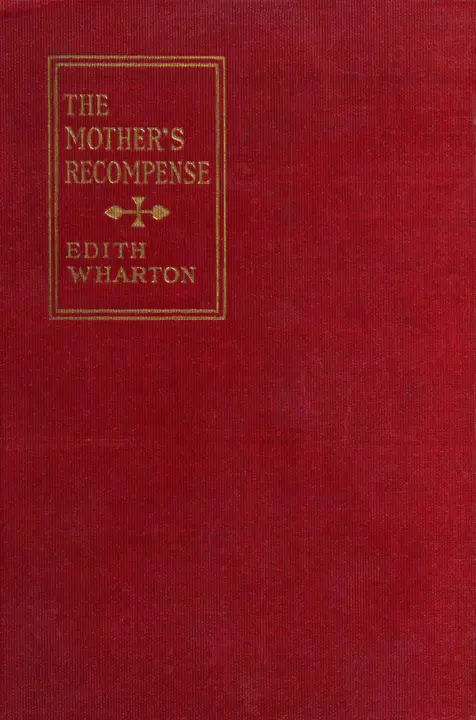
Edith Wharton
BEHIND THE BOOK
This eBook is for the use of anyone anywhere in the United States and most other parts of the world at no cost and with almost no restrictions whatsoever. You may copy it, give it away or re-use it under the terms of the Project Gutenberg License included with this eBook or online at www.gutenberg.org. If you are not located in the United States, you will have to check the laws of the country where you are located before using this eBook. Read the source licence.
The original source file, including credits and licence, is retained by this library. Request an original-format copy at no charge. Please include the book title and Project Gutenberg identifier #9190.
KEEP YOUR CURIOSITY GOING
Coulson Kernahan

Maurice Baring
Frances Wright
Cécile Tormay

Frederic Jesup Stimson

W. H. P. (William Henry Pope) Jarvis