THE CLASSIC COLLECTION✦An outlaw’s diary: the CommuneCLASSIC FREE BOOKS
An outlaw’s diary: the Commune
Cécile Tormay
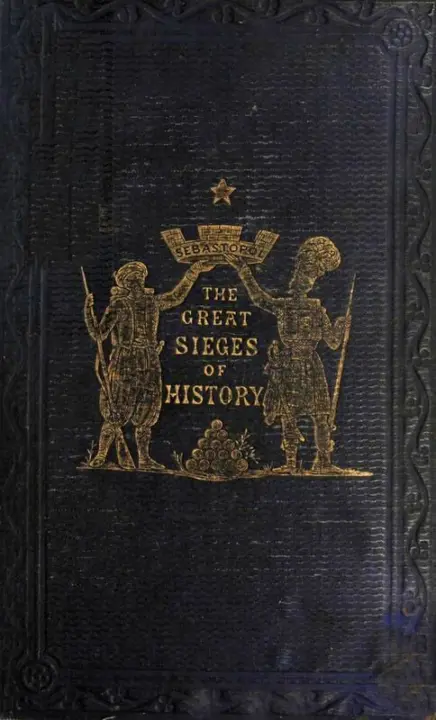
THE CLASSIC COLLECTION · 1856
"The Great Sieges of History" by William Robson is a historical account written in the mid-19th century. This work explores significant sieges throughout history, delving into the circumstances, strategies, and human experiences associated with these protracted conflicts. The author appears to aim at illustrating the lessons of military conduct and the human spirit in times of siege and hardship. The opening portion introduces the book's thesis, stating that sieges present a unique context wherein human virtues such as courage, endurance, and fidelity are tested to their limits. Robson reflects on historical conflicts, emphasizing the drama of desperation experienced by both the besieged and the attackers. His discussion highlights that while technology and strategy have evolved, the core essence of human struggle during sieges remains constant. The early examples presented set the stage for a journey through notable sieges, demonstrating how these events serve as key moments in the broader narrative of human history.
Introduction adapted from the source catalogue; source summaries may be automatically generated.
Free to read · English · 241,016 words · No account needed
MAKE TIME FOR A GOOD BOOK
On by default. Untick to stop anonymous reading totals. Each page counts after 10 seconds in view. How this works.
Anonymous counting is on unless you have switched it off.
The palpable lessons in these two sieges are--in the first, the imprudence of the governor in granting opportunities for treachery in prisoners; and in the second, the consummate prudence of the king of Prussia in not allowing the garrison to march out free, for the sake of quickly terminating the siege.
This siege is particularly interesting at the present moment, from the same parties being engaged in a war arising from the same motives as those which led to this sanguinary and memorable contest.
The position of Ismaïl, situated upon the Danube, in Bessarabia, tempted the court of St. Petersburg, then at war with the Turks, to endeavour to make the conquest of it. This was one of the most important cities of the Turkish empire in its European provinces. It had a numerous population, and a garrison of forty-three thousand men, commanded by Auduslu Pacha, one of the best of the Ottoman generals. Provisions and munitions were abundant, and its artillery powerful. Its walls, having a circuit of a mile from one bank of the Danube to the other, were from three to four toises high; at their feet was a fosse from seven to eight toises deep; they were crowned by pieces of large calibre. Between the polygons of Bender and Brock, there was a fausse-braie, near a cavalier, capable of containing many thousand soldiers. The water side was strongly defended by batteries making a horizontal fire. At the beginning of November, 1790, General Sudowitsch, with several bodies of troops, made the approaches upon Ismaïl, whilst Admiral Ribas blockaded it with a flotilla of a hundred row-boats. They obtained some advantages at sea, but the rigours of the winter obliged Sudowitsch to raise the siege. When informed of this, the court of St. Petersburg, accustomed to find no difficulty insurmountable, ordered Field-marshal Potemkin to return immediately before Ismaïl and take possession of it. The marshal felt all the difficulties of the undertaking, but he obeyed. Arrived upon the Pruth, he detached Lieutenant-General Potemkin with orders to bury himself under the ruins of Ismaïl; but his efforts were not more successful than those of Sudowitsch. Suwarrow then came up with a regiment of infantry, a thousand Arnauts, and two hundred Cossacks. The land army consisted of twenty-eight thousand men, of whom near one-half were Cossacks. The first care was to exercise these irregular troops in the manœuvres of an assault. Many days were employed in reconnaissances, in order that the general officers might be well acquainted with the posts they were to attack. When all the observations necessary had been made, batteries were raised, to lead the Turks to believe that they were preparing to make a regular siege, and not to carry Ismaïl by assault. On the 9th of December, Suwarrow sent the seraskier a letter from Prince Potemkin, to persuade him to surrender. The seraskier replied that he advised the Russians to retire, if they were unwilling to experience absolute want in an advanced season, and perish with famine and misery before a place amply provided with everything. Suwarrow, the next day, sent another note to the seraskier, in which he announced to him, that if he did not hoist the white flag that very day, the place should be taken by assault and the whole garrison be put to the sword. Many Turks were inclined to surrender; but the seraskier was resolved to risk everything, and made no reply. Suwarrow immediately assembled a council of war, and spoke as follows to his troops: “Brave warriors, remember to-day all your victories, and continue to prove that nothing can resist the arms of Russians. The affair in hand is not one that can be deferred, but it concerns an important place, the possession of which will decide the glory of the campaign, and which the proud Ottomans consider impregnable. Twice already has the Russian army laid siege to Ismaïl, and twice has it retreated from it. There only remains for us, as the third attempt, to conquer or to die with glory.” This speech inflamed the ardour of his soldiers, and an assault was decided upon. Suwarrow received a courier from Prince Potemkin, recommending him not to risk an assault if he was not sure of succeeding. Suwarrow replied in these few lines: “My plan is settled. The Russian army has already been twice at the gates of Ismaïl; it would be disgraceful for it to retire a third time.” Some Cossacks deserted in the evening, and informed the Ottomans of the approaching attack. The principal part of the garrison remained all night upon the ramparts. To make the Turks believe they were short of powder, the Russians fired but little during the night which preceded the assault. All measures being taken, by four o’clock in the morning the columns were formed: there were six on the land side and three upon the Danube. The Cossacks destined to mount to the assault were all on foot, and their lances had almost all been reduced to five feet in length, to render them more useful in the mêlée. The first column by water, commanded by General Islenief, consisted of two battalions of grenadiers, one battalion of chasseurs, and two thousand five hundred Cossacks. They had on board their shallops a hundred and thirty pieces of cannon. The second column had the same number of boats and cannon. In the third, and in the reserve, were two hundred and thirty-seven pieces of cannon, divided among a great number of barks, flat-bottomed boats, and floating batteries. Among the troops embarked were the prince de Ligni, the colonel duke de Richelieu, and the count de Langeron. A circumstance is remembered in which the count de Langeron, an emigrant, exhibited to the haughty Potemkin, the czarina’s favourite, a pride worthy of a Frenchman. Langeron, as an emigrant, was talking with him about the troubles which agitated France. “Colonel,” said he, “your compatriots are mad; I should require nothing but my grooms to bring them to reason.” Langeron could not suffer his nation to thus spoken of, and replied haughtily,--“Prince, I do not think that you and all your army could do it.”
Your reading position is saved on this browser. Take it to another device with a library code. Reading pages adapt to text, rather than matching a printed edition.
BEHIND THE BOOK
This eBook is for the use of anyone anywhere in the United States and most other parts of the world at no cost and with almost no restrictions whatsoever. You may copy it, give it away or re-use it under the terms of the Project Gutenberg License included with this eBook or online at www.gutenberg.org. If you are not located in the United States, you will have to check the laws of the country where you are located before using this eBook. Read the source licence.
The original source file, including credits and licence, is retained by this library. Request an original-format copy at no charge. Please include the book title and Project Gutenberg identifier #59093.
KEEP YOUR CURIOSITY GOING
Cécile Tormay

Moritz Busch
John L. Ransom
Frances Wright
Cécile Tormay

Mabel Potter Daggett