READ · DISCOVER · ENJOYClassic literature · Always free
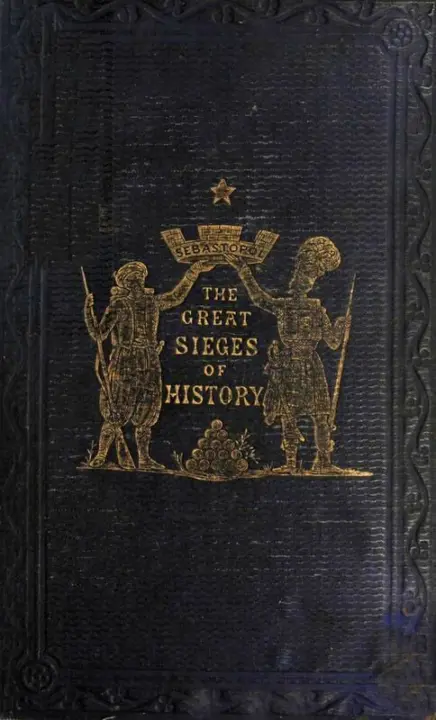
The Great Sieges of History — digital edition cover

THE CLASSIC COLLECTION · 1856

The Great Sieges of History

"The Great Sieges of History" by William Robson is a historical account written in the mid-19th century. This work explores significant sieges throughout history, delving into the circumstances, strategies, and human experiences associated with these protracted conflicts. The author appears to aim at illustrating the lessons of military conduct and the human spirit in times of siege and hardship. The opening portion introduces the book's thesis, stating that sieges present a unique context wherein human virtues such as courage, endurance, and fidelity are tested to their limits. Robson reflects on historical conflicts, emphasizing the drama of desperation experienced by both the besieged and the attackers. His discussion highlights that while technology and strategy have evolved, the core essence of human struggle during sieges remains constant. The early examples presented set the stage for a journey through notable sieges, demonstrating how these events serve as key moments in the broader narrative of human history.

Introduction adapted from the source catalogue; source summaries may be automatically generated.

Start reading ↓

Free to read · English · 241,016 words · No account needed

MAKE TIME FOR A GOOD BOOK

The Great Sieges of History

On by default. Untick to stop anonymous reading totals. Each page counts after 10 seconds in view. How this works.

Anonymous counting is on unless you have switched it off.

The Great Sieges of History

Thus we see as much courage and presence of mind may be displayed in a siege in which there is only one defender, as if numerous hosts were engaged.

STRALSUND.

A.D. 1713.

Charles XII. of Sweden, when he had taken refuge in Turkey, after being beaten by Peter of Russia, at length exhausted the obstinacy which had detained him so long at Demirtocka, meditating on means to excite the Ottoman Porte against his great rival, passed all at once, with characteristic energy, from excessive inactivity to equally excessive exertion. He set out from Demirtocka with prodigious speed, crossed the hereditary states of the emperor, Franconia and Mecklenburg, on horseback, and arrived at Stralsund when least expected. His first proceeding was to protest against the sequestration of the city of Stettin. He hastened to declare that, not having made any convention, he was not obliged to recognise that which his generals had done in his absence to place Pomerania and Stettin in a state of sequestration. With a character so obstinate as that of this prince, no other argument could be employed but force. Frederick William, king of Prussia, declared that he would not allow the Swedes to enter Saxony, and immediately joined the league of the Russians, Saxons, and Hanoverians. In order to force, with the strong hand, the king of Sweden to hold his engagements, he ordered a body of Prussian troops to advance close to Stettin. Charles XII. took possession of Anclam, Wolgaste, and Gripswalde, in which were Prussian garrisons; nevertheless, with a slight show of prudence, he dismissed the Prussian troops without violence. At the commencement of the following campaign, the Swedes dislodged the Prussians from the isle of Usedom, and made prisoners of a detachment of five hundred men. By this act of hostility they broke the neutrality of the Prussians, and became the aggressors. Frederick William, jealous of Charles’s glory, and irritated at this proceeding, declared war against Sweden. Twenty thousand Prussians joined the Saxons and the Danes in Pomerania. Europe then beheld two kings, in person, besieging another shut up in Stralsund; but this king was Charles XII., fighting at the head of fifteen thousand warlike Swedes, loving to idolatry the heroism of their prince. Besides, his great reputation and the prejudices of the universe fought in his favour. In the army of the allies, the king of Prussia examined the plans, decided upon the operations, and persuaded the Danes to adopt his views. The king of Denmark, a bad soldier, and not at all military in his tastes, had only come to Stralsund in the hope of seeing Charles XII. humiliated. Under these two kings the prince of Anhalt was the soul of all the military enterprises. “He was,” says the king of Prussia, in his Memoirs, “a man of a violent and obstinate character, who, with the valour of a hero, had the experience of the finest campaigns of Prince Eugene. His manners were ferocious, his ambition boundless; deeply versed in the art of sieges, a fortunate soldier, a bad citizen, he was capable of all the enterprises of both Marius and Sylla, if fortune had seconded his ambition.” This army laid siege to Stralsund, a city on the shores of the Baltic, the Swedish fleet being able to supply it constantly with provisions, munitions, and troops. Its situation is strong; an impracticable marsh defends two-thirds of its circumference; the only side by which it is accessible is furnished by a good intrenchment, which from the north extends to the sea-shore, and touches on the marsh towards the east. In this intrenchment were encamped twelve thousand Swedes, with Charles XII. at their head. The besiegers removed successively all the obstacles opposed to them. The first point was to drive away the Swedish fleet from the coasts of Pomerania, in order to deprive the Swedes of the succours they might receive by sea. Nevertheless the king of Denmark was unwilling to risk an action with a squadron he had on those coasts. All the influence of the king of Prussia was required to persuade him of the necessity for such a contest. The two kings were spectators of the action, which took place at a short distance from the shore, and threw the sea open to the allies. The Prussians afterwards drove the Swedes from the isle of Usedom, and took the fort of Pennamende at the point of the sword. They shortly afterwards prepared to attack the intrenchments. A Prussian officer singularly facilitated this undertaking, the most difficult and most dangerous of the whole siege. Being perfectly acquainted with the ground, he knew that the arm of the sea which washes the intrenchments was neither deep nor muddy; he sounded it by night, and found that it was possible to ford it, to turn this post by its left, and thus take the Swedes in flank and rear. This project was successfully executed. They attacked them by night; whilst one Prussian corps marched straight to the intrenchments, another passed along the sea-shore, and were in the Swedish camp before they were perceived. The surprise of an unexpected attack, the confusion natural to a night affair, and, above all, the numbers of the body which fell upon their flanks, threw them quickly into a state of rout: they abandoned their intrenchments, and sought refuge in the city. Enraged at being deserted by his own troops, Charles would have continued to fight alone. His generals dragged him from the scene of action, and had much difficulty in saving him from the hands of the allies; all who did not promptly gain Stralsund were either killed or made prisoners. The numbers taken in this attack amounted to more than four hundred men. The more closely to press the city, it became necessary for the allies to render themselves masters of the isle of Rugen, whence the besieged could likewise obtain succours. The prince of Anhalt, at the head of twenty thousand men, crossed in transports the space which divides Pomerania. This fleet kept the same order of battle the troops observed on the land. They pretended to land on the eastern coast, but turning suddenly to the left, the prince of Anhalt disembarked his troops at the port of Strezow, where the enemy did not expect him. He posted himself in a quarter of a circle, so that his two wings leant upon the sea, and during the whole day caused intrenchments to be dug, fortified by chevaux de frise. His disposition was such, that two lines of infantry supported his intrenchment. His cavalry formed the third, with the exception of six squadrons which he had posted without the lines, in order to be able to fall upon the left flank of those who might attack him on that side. Charles XII., deceived by the prince of Anhalt’s feint, could not arrive in time to oppose the disembarkation. Aware of the importance of this isle, he advanced by night upon the Prussians, although he had but four thousand men. He marched at the head of his infantry, which he led to the very edge of the ditch, assisting to pull up the chevaux de frise which bordered it with his own hands; he was slightly wounded in this attack, and General Dureng was killed at his side. The inequality of numbers, the darkness of the night, the six Prussian squadrons, but still more than all the king’s wound, made the Swedes lose the fruits of their valour. Fortune had turned her back upon that nation; everything seemed to tend to its decline. The king retired to have his wound dressed; his discomfited troops fled. The next day twelve hundred Swedes were made prisoners at Lafich-Schanz, and the isle of Rugen was entirely occupied by the allies. After this misfortune Charles XII. returned to Stralsund. That city was almost reduced to extremity. The besiegers having gained the counterscarp, had already begun to construct their gallery upon the principal fosse. It was the character of the king of Sweden to bear up firmly against reverses; he endeavoured to withstand his ill-fortune, and was able to preserve an inexpressible sang-froid under all circumstances. The citizens, far from murmuring, filled with admiration for their master, whose exertions, sobriety, and courage astonished them, had all become soldiers under him. One day, when the king was dictating letters for Sweden to a secretary, a bomb fell upon the house, penetrated the roof, and burst close to the king’s apartment. At the noise of the bomb and the crash of the house, which seemed falling about their ears, the pen fell from the hand of the secretary. “What’s the matter?” said the king, with a tranquil air; “why don’t you write on?” “Oh, sire, the bomb!” “Well,” rejoined the king, “what has the bomb to do with the letter I am dictating to you? Go on!” When he saw the breach open, he wanted to defend it in person, the besiegers threatening to give a general assault. His generals threw themselves at his feet to conjure him not to risk his life so uselessly. Seeing their prayers had no effect, they pointed out to him the danger to which he exposed himself of falling into the hands of his enemies. This apprehension at length made him determine to abandon the city. He embarked in a light boat, in which he passed, favoured by the darkness, through the Danish fleet which blockaded Stralsund, and gained with much trouble one of his own vessels, which conveyed him to Sweden. Fourteen years before, he had left this city as a conqueror about to subdue the world; he returned thither a fugitive, pursued by his enemies, despoiled of his finest provinces, and abandoned by his army. As soon as the king was gone, the garrison of Stralsund capitulated, and surrendered themselves prisoners of war.

Your reading position is saved on this browser. Take it to another device with a library code. Reading pages adapt to text, rather than matching a printed edition.

BEHIND THE WORDS

About William Robson

William Robson (1785–1863). Explore The Great Sieges of History in this collection. These books span history.

Explore this author’s books →

THE READERS’ VERDICT

How did this story stay with you?

Not rated yet
Your rating for The Great Sieges of History

Be the first to share your verdict.

One rating per browser, which you can change or remove. A necessary browser identifier remembers your vote. How ratings work

A GOOD STORY DESERVES COMPANY

Pass this book along.

A great read is even better when it’s shared.

SEND A LITTLE INSPIRATION

Share this book

BEHIND THE BOOK

Edition & source details.

Title
The Great Sieges of History
Author
William Robson
First publication (Open Library catalogue match)
1856
Digital edition publisher
Project Gutenberg
Gutenberg release date
2019-03-19
Language
English
Source edition imprint
Not stated in source catalogue
Source identifier
Project Gutenberg #59093
Contributors
John Gilbert (ill)

Public-domain source & licence

This eBook is for the use of anyone anywhere in the United States and most other parts of the world at no cost and with almost no restrictions whatsoever. You may copy it, give it away or re-use it under the terms of the Project Gutenberg License included with this eBook or online at www.gutenberg.org. If you are not located in the United States, you will have to check the laws of the country where you are located before using this eBook. Read the source licence.

Full source licence and obtaining an original copy

The original source file, including credits and licence, is retained by this library. Request an original-format copy at no charge. Please include the book title and Project Gutenberg identifier #59093.

the full Project Gutenberg License must appear
prominently whenever any copy of a Project Gutenberg work (any work
on which the phrase “Project Gutenberg” appears, or with which the
phrase “Project Gutenberg” is associated) is accessed, displayed,
performed, viewed, copied or distributed:

This eBook is for the use of anyone anywhere in the United States and most
other parts of the world at no cost and with almost no restrictions
whatsoever. You may copy it, give it away or re-use it under the terms
of the Project Gutenberg™ License included with this eBook or online
at www.gutenberg.org. If you
are not located in the United States, you will have to check the laws
of the country where you are located before using this eBook.

1.E.2. If an individual Project Gutenberg electronic work is
derived from texts not protected by U.S. copyright law (does not
contain a notice indicating that it is posted with permission of the
copyright holder), the work can be copied and distributed to anyone in
the United States without paying any fees or charges. If you are
redistributing or providing access to a work with the phrase “Project
Gutenberg” associated with or appearing on the work, you must comply
either with the requirements of paragraphs 1.E.1 through 1.E.7 or
obtain permission for the use of the work and the Project Gutenberg
trademark as set forth in paragraphs 1.E.8 or 1.E.9.

1.E.3. If an individual Project Gutenberg electronic work is posted
with the permission of the copyright holder, your use and distribution
must comply with both paragraphs 1.E.1 through 1.E.7 and any
additional terms imposed by the copyright holder. Additional terms
will be linked to the Project Gutenberg License for all works
posted with the permission of the copyright holder found at the
beginning of this work.

1.E.4. Do not unlink or detach or remove the full Project Gutenberg
License terms from this work, or any files containing a part of this
work or any other work associated with Project Gutenberg.

1.E.5. Do not copy, display, perform, distribute or redistribute this
electronic work, or any part of this electronic work, without
prominently displaying the sentence set forth in paragraph 1.E.1 with
active links or immediate access to the full terms of the Project
Gutenberg License.

1.E.6. You may convert to and distribute this work in any binary,
compressed, marked up, nonproprietary or proprietary form, including
any word processing or hypertext form. However, if you provide access
to or distribute copies of a Project Gutenberg work in a format
other than “Plain Vanilla ASCII” or other format used in the official
version posted on the official Project Gutenberg website
(www.gutenberg.org), you must, at no additional cost, fee or expense
to the user, provide a copy, a means of exporting a copy, or a means
of obtaining a copy upon request, of the work in its original “Plain
Vanilla ASCII” or other form. Any alternate format must include the
full Project Gutenberg License as specified in paragraph 1.E.1.

1.E.7. Do not charge a fee for access to, viewing, displaying,
performing, copying or distributing any Project Gutenberg works
unless you comply with paragraph 1.E.8 or 1.E.9.

1.E.8. You may charge a reasonable fee for copies of or providing
access to or distributing Project Gutenberg electronic works
provided that:

• You pay a royalty fee of 20% of the gross profits you derive from
the use of Project Gutenberg works calculated using the method
you already use to calculate your applicable taxes. The fee is owed
to the owner of the Project Gutenberg trademark, but he has
agreed to donate royalties under this paragraph to the Project
Gutenberg Literary Archive Foundation. Royalty payments must be paid
within 60 days following each date on which you prepare (or are
legally required to prepare) your periodic tax returns. Royalty
payments should be clearly marked as such and sent to the Project
Gutenberg Literary Archive Foundation at the address specified in
Section 4, “Information about donations to the Project Gutenberg
Literary Archive Foundation.”

• You provide a full refund of any money paid by a user who notifies
you in writing (or by e-mail) within 30 days of receipt that s/he
does not agree to the terms of the full Project Gutenberg™
License. You must require such a user to return or destroy all
copies of the works possessed in a physical medium and discontinue
all use of and all access to other copies of Project Gutenberg™
works.

• You provide, in accordance with paragraph 1.F.3, a full refund of
any money paid for a work or a replacement copy, if a defect in the
electronic work is discovered and reported to you within 90 days of
receipt of the work.

• You comply with all other terms of this agreement for free
distribution of Project Gutenberg™ works.


1.E.9. If you wish to charge a fee or distribute a Project
Gutenberg™ electronic work or group of works on different terms than
are set forth in this agreement, you must obtain permission in writing
from the Project Gutenberg Literary Archive Foundation, the manager of
the Project Gutenberg™ trademark. Contact the Foundation as set
forth in Section 3 below.

1.F.

1.F.1. Project Gutenberg volunteers and employees expend considerable
effort to identify, do copyright research on, transcribe and proofread
works not protected by U.S. copyright law in creating the Project
Gutenberg™ collection. Despite these efforts, Project Gutenberg™
electronic works, and the medium on which they may be stored, may
contain “Defects,” such as, but not limited to, incomplete, inaccurate
or corrupt data, transcription errors, a copyright or other
intellectual property infringement, a defective or damaged disk or
other medium, a computer virus, or computer codes that damage or
cannot be read by your equipment.

1.F.2. LIMITED WARRANTY, DISCLAIMER OF DAMAGES - Except for the “Right
of Replacement or Refund” described in paragraph 1.F.3, the Project
Gutenberg Literary Archive Foundation, the owner of the Project
Gutenberg™ trademark, and any other party distributing a Project
Gutenberg™ electronic work under this agreement, disclaim all
liability to you for damages, costs and expenses, including legal
fees. YOU AGREE THAT YOU HAVE NO REMEDIES FOR NEGLIGENCE, STRICT
LIABILITY, BREACH OF WARRANTY OR BREACH OF CONTRACT EXCEPT THOSE
PROVIDED IN PARAGRAPH 1.F.3. YOU AGREE THAT THE FOUNDATION, THE
TRADEMARK OWNER, AND ANY DISTRIBUTOR UNDER THIS AGREEMENT WILL NOT BE
LIABLE TO YOU FOR ACTUAL, DIRECT, INDIRECT, CONSEQUENTIAL, PUNITIVE OR
INCIDENTAL DAMAGES EVEN IF YOU GIVE NOTICE OF THE POSSIBILITY OF SUCH
DAMAGE.

1.F.3. LIMITED RIGHT OF REPLACEMENT OR REFUND - If you discover a
defect in this electronic work within 90 days of receiving it, you can
receive a refund of the money (if any) you paid for it by sending a
written explanation to the person you received the work from. If you
received the work on a physical medium, you must return the medium
with your written explanation. The person or entity that provided you
with the defective work may elect to provide a replacement copy in
lieu of a refund. If you received the work electronically, the person
or entity providing it to you may choose to give you a second
opportunity to receive the work electronically in lieu of a refund. If
the second copy is also defective, you may demand a refund in writing
without further opportunities to fix the problem.

1.F.4. Except for the limited right of replacement or refund set forth
in paragraph 1.F.3, this work is provided to you ‘AS-IS’, WITH NO
OTHER WARRANTIES OF ANY KIND, EXPRESS OR IMPLIED, INCLUDING BUT NOT
LIMITED TO WARRANTIES OF MERCHANTABILITY OR FITNESS FOR ANY PURPOSE.

1.F.5. Some states do not allow disclaimers of certain implied
warranties or the exclusion or limitation of certain types of
damages. If any disclaimer or limitation set forth in this agreement
violates the law of the state applicable to this agreement, the
agreement shall be interpreted to make the maximum disclaimer or
limitation permitted by the applicable state law. The invalidity or
unenforceability of any provision of this agreement shall not void the
remaining provisions.

1.F.6. INDEMNITY - You agree to indemnify and hold the Foundation, the
trademark owner, any agent or employee of the Foundation, anyone
providing copies of Project Gutenberg™ electronic works in
accordance with this agreement, and any volunteers associated with the
production, promotion and distribution of Project Gutenberg™
electronic works, harmless from all liability, costs and expenses,
including legal fees, that arise directly or indirectly from any of
the following which you do or cause to occur: (a) distribution of this
or any Project Gutenberg work, (b) alteration, modification, or
additions or deletions to any Project Gutenberg work, and (c) any
Defect you cause.

Section 2. Information about the Mission of Project Gutenberg

Project Gutenberg is synonymous with the free distribution of
electronic works in formats readable by the widest variety of
computers including obsolete, old, middle-aged and new computers. It
exists because of the efforts of hundreds of volunteers and donations
from people in all walks of life.

Volunteers and financial support to provide volunteers with the
assistance they need are critical to reaching Project Gutenberg’s
goals and ensuring that the Project Gutenberg collection will
remain freely available for generations to come. In 2001, the Project
Gutenberg Literary Archive Foundation was created to provide a secure
and permanent future for Project Gutenberg and future
generations. To learn more about the Project Gutenberg Literary
Archive Foundation and how your efforts and donations can help, see
Sections 3 and 4 and the Foundation information page at www.gutenberg.org.

Section 3. Information about the Project Gutenberg Literary Archive Foundation

The Project Gutenberg Literary Archive Foundation is a non-profit
501(c)(3) educational corporation organized under the laws of the
state of Mississippi and granted tax exempt status by the Internal
Revenue Service. The Foundation’s EIN or federal tax identification
number is 64-6221541. Contributions to the Project Gutenberg Literary
Archive Foundation are tax deductible to the full extent permitted by
U.S. federal laws and your state’s laws.

The Foundation’s business office is located at 41 Watchung Plaza #516,
Montclair NJ 07042, USA, +1 (862) 621-9288. Email contact links and up
to date contact information can be found at the Foundation’s website
and official page at www.gutenberg.org/contact

Section 4. Information about Donations to the Project Gutenberg
Literary Archive Foundation

Project Gutenberg™ depends upon and cannot survive without widespread
public support and donations to carry out its mission of
increasing the number of public domain and licensed works that can be
freely distributed in machine-readable form accessible by the widest
array of equipment including outdated equipment. Many small donations
($1 to $5,000) are particularly important to maintaining tax exempt
status with the IRS.

The Foundation is committed to complying with the laws regulating
charities and charitable donations in all 50 states of the United
States. Compliance requirements are not uniform and it takes a
considerable effort, much paperwork and many fees to meet and keep up
with these requirements. We do not solicit donations in locations
where we have not received written confirmation of compliance. To SEND
DONATIONS or determine the status of compliance for any particular state
visit www.gutenberg.org/donate.

While we cannot and do not solicit contributions from states where we
have not met the solicitation requirements, we know of no prohibition
against accepting unsolicited donations from donors in such states who
approach us with offers to donate.

International donations are gratefully accepted, but we cannot make
any statements concerning tax treatment of donations received from
outside the United States. U.S. laws alone swamp our small staff.

Please check the Project Gutenberg web pages for current donation
methods and addresses. Donations are accepted in a number of other
ways including checks, online payments and credit card donations. To
donate, please visit: www.gutenberg.org/donate.

Section 5. General Information About Project Gutenberg electronic works

Professor Michael S. Hart was the originator of the Project
Gutenberg concept of a library of electronic works that could be
freely shared with anyone. For forty years, he produced and
distributed Project Gutenberg eBooks with only a loose network of
volunteer support.

Project Gutenberg eBooks are often created from several printed
editions, all of which are confirmed as not protected by copyright in
the U.S. unless a copyright notice is included. Thus, we do not
necessarily keep eBooks in compliance with any particular paper
edition.

Most people start at our website which has the main PG search
facility: www.gutenberg.org.

This website includes information about Project Gutenberg,
including how to make donations to the Project Gutenberg Literary
Archive Foundation, how to help produce our new eBooks, and how to
subscribe to our email newsletter to hear about new eBooks.


KEEP YOUR CURIOSITY GOING

Your next chapter awaits.

Your privacy choices

Reading is always free. You can change these settings at any time.

Book banners link to our books on simonward.net. They do not use advertising cookies or tracking.

Privacy & cookie policy · Reading data and privacy controls