READ · DISCOVER · ENJOYClassic literature · Always free
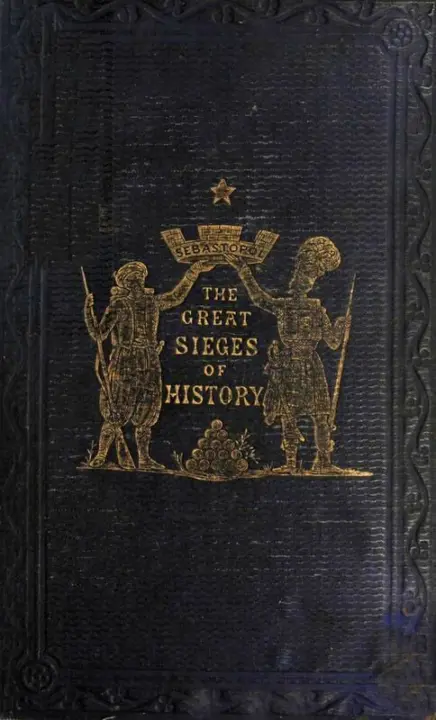
The Great Sieges of History — digital edition cover

THE CLASSIC COLLECTION · 1856

The Great Sieges of History

"The Great Sieges of History" by William Robson is a historical account written in the mid-19th century. This work explores significant sieges throughout history, delving into the circumstances, strategies, and human experiences associated with these protracted conflicts. The author appears to aim at illustrating the lessons of military conduct and the human spirit in times of siege and hardship. The opening portion introduces the book's thesis, stating that sieges present a unique context wherein human virtues such as courage, endurance, and fidelity are tested to their limits. Robson reflects on historical conflicts, emphasizing the drama of desperation experienced by both the besieged and the attackers. His discussion highlights that while technology and strategy have evolved, the core essence of human struggle during sieges remains constant. The early examples presented set the stage for a journey through notable sieges, demonstrating how these events serve as key moments in the broader narrative of human history.

Introduction adapted from the source catalogue; source summaries may be automatically generated.

Start reading ↓

Free to read · English · 241,016 words · No account needed

MAKE TIME FOR A GOOD BOOK

The Great Sieges of History

On by default. Untick to stop anonymous reading totals. Each page counts after 10 seconds in view. How this works.

Anonymous counting is on unless you have switched it off.

The Great Sieges of History

LIVRON.

A.D. 1574.

We present this little siege as a monument of the feeling entertained towards the infamous Catherine de Medici and her darling son, Henry III., by many communities in France.

When Henry III. left Poland as a fugitive, to occupy the throne made vacant by the death of Charles IX., he created Roger de St. Lary-Bellegarde, one of his minions, a marshal of France. A short time after his promotion, the new general was repulsed in three assaults which he made upon Livron, a small Huguenot fortified place in Dauphiny, although he attacked it with a good army, and it was defended but by a few inhabitants. The women of the city thought him so contemptible, that, to insult him, they plied their distaffs on the breach. Henry, who passed near the city, stopped for a few hours, to display his valour. The besieged, on learning his arrival, made a general discharge of their artillery, which they followed by continual hissings and hootings, accompanied by cutting railleries against the monarch and the queen his mother. “Ha! ha! you massacrers! you shall not poniard us in our beds, as you did the admiral! Bring us a few of your laced, ruffled, and perfumed minions; let them come and look at our women; they will see if they look like a prey to be easily taken!” Henry ordered a fresh assault to be made, but it was repulsed by the women only, and the siege was raised shortly after this disgraceful defeat.

CAHORS.

A.D. 1580.

Of the numerous sieges on both sides which marked the struggle of Henry IV. of France for his crown, we have selected that of Cahors as best displaying the character of that hero and the men and times he lived in.

Henry IV., whilst king of Navarre, resolved to gain possession of Cahors. That city is surrounded on all sides by the river Lot, which serves it as a fosse. It had a garrison of two thousand men, and Vesins, its governor, was a soldier of acknowledged valour and great experience. Its citizens, always armed, were never off their guard. Henry assembled his council of war, composed of valiant and tried captains, and all pronounced the enterprise hazardous. Their representations were useless. “Everything is possible to me,” said he, “with men as brave as those I consult.” On the 5th of May, he set out from Montauban, in excessively hot weather, and arrived in the middle of the night within a quarter of a league of Cahors. His troops there quenched their thirst at a fountain which flowed under a nursery of young walnut-trees. Twelve soldiers marched forward for the purpose of fastening a petard to the gates of the city. Fifty men, commanded by Captain Saint Martin, followed them closely; Roquilaure came next, with forty gentlemen and sixty soldiers; and after them, Henry of Navarre, with nine hundred men. Twelve hundred arquebusiers, in six platoons, closed the march. There were three gates to be forced. The petard attached to the first made so small an opening, that it was necessary to enlarge it with axes. The first passed through with difficulty; but the soldiers who followed them had time to file through in sufficiently great numbers. A furious storm which raged at the time did not permit the inhabitants to distinguish between the noise of the thunder and the report of the petards, which had broken down their gates. Henry’s soldiers, on first entering the city, met with forty men and two hundred arquebusiers, almost naked. The baron de Salignac cut them to pieces, and advanced into Cahors; but he was stopped in his march by the inhabitants, who, from the tops of the houses, hurled stones, tiles, pieces of wood, and other missiles upon the heads of his soldiers. In the mean time, the king of Navarre entered Cahors by another gate, with which the petard had succeeded better. At length day appeared, persons and objects were distinguishable, and all either rushed to the attack or stood firm in defence of the place. In all the streets it became necessary to force barricades and repulse a garrison much more numerous than the besiegers. Henry commanded and fought everywhere at the same time; his valour shrunk from no danger, though the blows of all the enemies seemed to be directed against him. He broke two partisans, and his armour was pierced in twenty places. This terrible combat lasted five days and five nights. The besieged, in full expectation of assistance, said not a word about surrendering. The assailants, fatigued with the weight of their armour and the excessive heat, maintained their posts with the intrepid courage their leader knew how to inspire. On the fourth day they learnt that the succours promised to the city were drawing near. At this news, his captains assembled round Henry, and conjured him to secure a retreat before the enemy could reach Cahors. Henry, too courageous to know what fear meant, and heedless of the pain caused by his wounds, replied, with that coolness which inspires confidence: “It is decreed above what is to become of me on this occasion. Remember that my retreat from this city without having taken it, will be the retreat of my life from my body. My honour is too deeply pledged to allow me to act otherwise; therefore, only speak to me of fighting, conquering, or dying.” Reanimated by these words, his soldiers made fresh efforts; and fortune seconded the efforts of the brave Béarnais. He received a reinforcement of a hundred horse and five hundred arquebusiers; he secured his posts in the interior, and marched out to meet the approaching enemy. He repulsed them; and on his return to the city, the inhabitants having lost all hope, laid down their arms. There were but few killed in Henry’s army, but many wounded. The brave and virtuous Vesins had perished early in the contest; he had a short time before done himself great honour, by an act of rare generosity. His bravery, degenerating sometimes into ferocity, had made him numerous enemies; among these was a gentleman named Régnier, of a mild and polished character. Their neighbours and friends had exerted themselves in vain to reconcile them. Régnier was a Huguenot, and Vesins a Catholic. Whilst the cities of France were being stained with the blood of Huguenots, Régnier retired to Cahors for safety. But the king had made Vesins governor of that city, and Régnier was living in daily expectation of being sacrificed to the vengeance of his enemy, when his door was broken open, and he saw Vesins, with a drawn sword in his hand, and with the appearance of furious rage, enter, followed by two armed soldiers. Régnier, believing his death certain, fell upon his knees and implored the mercy of Heaven. Vesins in a menacing voice ordered him to get up, follow him, and mount a horse that was standing at the door. Régnier left the city with his enemy, who conducted him as far as Guienne without stopping and without speaking a single word to him. They arrived together at the château of Régnier, where Vesins, without alighting from his horse, said to him: “I had it in my power, as thou mayst see, to profit by the opportunity I have been so long in search of; but I should have been ashamed to avenge myself thus on a man so brave as thou art; the peril must be equal when our quarrel is settled; and it is on that account I have spared thy life. Thou shalt always find me as disposed to terminate our differences in a manner suitable to gentlemen, as thou hast found me prompt to deliver thee from an inevitable death.” “I have no longer, my dear Vesins,” replied Régnier, “either resolution, strength, or courage against you. Your kindness has extinguished the heat of my enmity: it is destroyed by your generosity, which I can never forget. I will henceforward follow you whithersoever you go; I will be always ready to employ in your service the life you have given me, and the little bravery you attribute to me.” Régnier wished to embrace his benefactor; but Vesins, preserving all the asperity of his character, said: “It is thy business to see whether thou art my friend or my enemy; I only saved thy life to put thee in a condition to make a choice.” Without waiting for a reply, he put spurs to his horse, leaving Régnier, stupified with this strange adventure, to wonder at the greatness of soul and generosity of him whom he had considered as his most cruel enemy.

Your reading position is saved on this browser. Take it to another device with a library code. Reading pages adapt to text, rather than matching a printed edition.

BEHIND THE WORDS

About William Robson

William Robson (1785–1863). Explore The Great Sieges of History in this collection. These books span history.

Explore this author’s books →

THE READERS’ VERDICT

How did this story stay with you?

Not rated yet
Your rating for The Great Sieges of History

Be the first to share your verdict.

One rating per browser, which you can change or remove. A necessary browser identifier remembers your vote. How ratings work

A GOOD STORY DESERVES COMPANY

Pass this book along.

A great read is even better when it’s shared.

SEND A LITTLE INSPIRATION

Share this book

BEHIND THE BOOK

Edition & source details.

Title
The Great Sieges of History
Author
William Robson
First publication (Open Library catalogue match)
1856
Digital edition publisher
Project Gutenberg
Gutenberg release date
2019-03-19
Language
English
Source edition imprint
Not stated in source catalogue
Source identifier
Project Gutenberg #59093
Contributors
John Gilbert (ill)

Public-domain source & licence

This eBook is for the use of anyone anywhere in the United States and most other parts of the world at no cost and with almost no restrictions whatsoever. You may copy it, give it away or re-use it under the terms of the Project Gutenberg License included with this eBook or online at www.gutenberg.org. If you are not located in the United States, you will have to check the laws of the country where you are located before using this eBook. Read the source licence.

Full source licence and obtaining an original copy

The original source file, including credits and licence, is retained by this library. Request an original-format copy at no charge. Please include the book title and Project Gutenberg identifier #59093.

the full Project Gutenberg License must appear
prominently whenever any copy of a Project Gutenberg work (any work
on which the phrase “Project Gutenberg” appears, or with which the
phrase “Project Gutenberg” is associated) is accessed, displayed,
performed, viewed, copied or distributed:

This eBook is for the use of anyone anywhere in the United States and most
other parts of the world at no cost and with almost no restrictions
whatsoever. You may copy it, give it away or re-use it under the terms
of the Project Gutenberg™ License included with this eBook or online
at www.gutenberg.org. If you
are not located in the United States, you will have to check the laws
of the country where you are located before using this eBook.

1.E.2. If an individual Project Gutenberg electronic work is
derived from texts not protected by U.S. copyright law (does not
contain a notice indicating that it is posted with permission of the
copyright holder), the work can be copied and distributed to anyone in
the United States without paying any fees or charges. If you are
redistributing or providing access to a work with the phrase “Project
Gutenberg” associated with or appearing on the work, you must comply
either with the requirements of paragraphs 1.E.1 through 1.E.7 or
obtain permission for the use of the work and the Project Gutenberg
trademark as set forth in paragraphs 1.E.8 or 1.E.9.

1.E.3. If an individual Project Gutenberg electronic work is posted
with the permission of the copyright holder, your use and distribution
must comply with both paragraphs 1.E.1 through 1.E.7 and any
additional terms imposed by the copyright holder. Additional terms
will be linked to the Project Gutenberg License for all works
posted with the permission of the copyright holder found at the
beginning of this work.

1.E.4. Do not unlink or detach or remove the full Project Gutenberg
License terms from this work, or any files containing a part of this
work or any other work associated with Project Gutenberg.

1.E.5. Do not copy, display, perform, distribute or redistribute this
electronic work, or any part of this electronic work, without
prominently displaying the sentence set forth in paragraph 1.E.1 with
active links or immediate access to the full terms of the Project
Gutenberg License.

1.E.6. You may convert to and distribute this work in any binary,
compressed, marked up, nonproprietary or proprietary form, including
any word processing or hypertext form. However, if you provide access
to or distribute copies of a Project Gutenberg work in a format
other than “Plain Vanilla ASCII” or other format used in the official
version posted on the official Project Gutenberg website
(www.gutenberg.org), you must, at no additional cost, fee or expense
to the user, provide a copy, a means of exporting a copy, or a means
of obtaining a copy upon request, of the work in its original “Plain
Vanilla ASCII” or other form. Any alternate format must include the
full Project Gutenberg License as specified in paragraph 1.E.1.

1.E.7. Do not charge a fee for access to, viewing, displaying,
performing, copying or distributing any Project Gutenberg works
unless you comply with paragraph 1.E.8 or 1.E.9.

1.E.8. You may charge a reasonable fee for copies of or providing
access to or distributing Project Gutenberg electronic works
provided that:

• You pay a royalty fee of 20% of the gross profits you derive from
the use of Project Gutenberg works calculated using the method
you already use to calculate your applicable taxes. The fee is owed
to the owner of the Project Gutenberg trademark, but he has
agreed to donate royalties under this paragraph to the Project
Gutenberg Literary Archive Foundation. Royalty payments must be paid
within 60 days following each date on which you prepare (or are
legally required to prepare) your periodic tax returns. Royalty
payments should be clearly marked as such and sent to the Project
Gutenberg Literary Archive Foundation at the address specified in
Section 4, “Information about donations to the Project Gutenberg
Literary Archive Foundation.”

• You provide a full refund of any money paid by a user who notifies
you in writing (or by e-mail) within 30 days of receipt that s/he
does not agree to the terms of the full Project Gutenberg™
License. You must require such a user to return or destroy all
copies of the works possessed in a physical medium and discontinue
all use of and all access to other copies of Project Gutenberg™
works.

• You provide, in accordance with paragraph 1.F.3, a full refund of
any money paid for a work or a replacement copy, if a defect in the
electronic work is discovered and reported to you within 90 days of
receipt of the work.

• You comply with all other terms of this agreement for free
distribution of Project Gutenberg™ works.


1.E.9. If you wish to charge a fee or distribute a Project
Gutenberg™ electronic work or group of works on different terms than
are set forth in this agreement, you must obtain permission in writing
from the Project Gutenberg Literary Archive Foundation, the manager of
the Project Gutenberg™ trademark. Contact the Foundation as set
forth in Section 3 below.

1.F.

1.F.1. Project Gutenberg volunteers and employees expend considerable
effort to identify, do copyright research on, transcribe and proofread
works not protected by U.S. copyright law in creating the Project
Gutenberg™ collection. Despite these efforts, Project Gutenberg™
electronic works, and the medium on which they may be stored, may
contain “Defects,” such as, but not limited to, incomplete, inaccurate
or corrupt data, transcription errors, a copyright or other
intellectual property infringement, a defective or damaged disk or
other medium, a computer virus, or computer codes that damage or
cannot be read by your equipment.

1.F.2. LIMITED WARRANTY, DISCLAIMER OF DAMAGES - Except for the “Right
of Replacement or Refund” described in paragraph 1.F.3, the Project
Gutenberg Literary Archive Foundation, the owner of the Project
Gutenberg™ trademark, and any other party distributing a Project
Gutenberg™ electronic work under this agreement, disclaim all
liability to you for damages, costs and expenses, including legal
fees. YOU AGREE THAT YOU HAVE NO REMEDIES FOR NEGLIGENCE, STRICT
LIABILITY, BREACH OF WARRANTY OR BREACH OF CONTRACT EXCEPT THOSE
PROVIDED IN PARAGRAPH 1.F.3. YOU AGREE THAT THE FOUNDATION, THE
TRADEMARK OWNER, AND ANY DISTRIBUTOR UNDER THIS AGREEMENT WILL NOT BE
LIABLE TO YOU FOR ACTUAL, DIRECT, INDIRECT, CONSEQUENTIAL, PUNITIVE OR
INCIDENTAL DAMAGES EVEN IF YOU GIVE NOTICE OF THE POSSIBILITY OF SUCH
DAMAGE.

1.F.3. LIMITED RIGHT OF REPLACEMENT OR REFUND - If you discover a
defect in this electronic work within 90 days of receiving it, you can
receive a refund of the money (if any) you paid for it by sending a
written explanation to the person you received the work from. If you
received the work on a physical medium, you must return the medium
with your written explanation. The person or entity that provided you
with the defective work may elect to provide a replacement copy in
lieu of a refund. If you received the work electronically, the person
or entity providing it to you may choose to give you a second
opportunity to receive the work electronically in lieu of a refund. If
the second copy is also defective, you may demand a refund in writing
without further opportunities to fix the problem.

1.F.4. Except for the limited right of replacement or refund set forth
in paragraph 1.F.3, this work is provided to you ‘AS-IS’, WITH NO
OTHER WARRANTIES OF ANY KIND, EXPRESS OR IMPLIED, INCLUDING BUT NOT
LIMITED TO WARRANTIES OF MERCHANTABILITY OR FITNESS FOR ANY PURPOSE.

1.F.5. Some states do not allow disclaimers of certain implied
warranties or the exclusion or limitation of certain types of
damages. If any disclaimer or limitation set forth in this agreement
violates the law of the state applicable to this agreement, the
agreement shall be interpreted to make the maximum disclaimer or
limitation permitted by the applicable state law. The invalidity or
unenforceability of any provision of this agreement shall not void the
remaining provisions.

1.F.6. INDEMNITY - You agree to indemnify and hold the Foundation, the
trademark owner, any agent or employee of the Foundation, anyone
providing copies of Project Gutenberg™ electronic works in
accordance with this agreement, and any volunteers associated with the
production, promotion and distribution of Project Gutenberg™
electronic works, harmless from all liability, costs and expenses,
including legal fees, that arise directly or indirectly from any of
the following which you do or cause to occur: (a) distribution of this
or any Project Gutenberg work, (b) alteration, modification, or
additions or deletions to any Project Gutenberg work, and (c) any
Defect you cause.

Section 2. Information about the Mission of Project Gutenberg

Project Gutenberg is synonymous with the free distribution of
electronic works in formats readable by the widest variety of
computers including obsolete, old, middle-aged and new computers. It
exists because of the efforts of hundreds of volunteers and donations
from people in all walks of life.

Volunteers and financial support to provide volunteers with the
assistance they need are critical to reaching Project Gutenberg’s
goals and ensuring that the Project Gutenberg collection will
remain freely available for generations to come. In 2001, the Project
Gutenberg Literary Archive Foundation was created to provide a secure
and permanent future for Project Gutenberg and future
generations. To learn more about the Project Gutenberg Literary
Archive Foundation and how your efforts and donations can help, see
Sections 3 and 4 and the Foundation information page at www.gutenberg.org.

Section 3. Information about the Project Gutenberg Literary Archive Foundation

The Project Gutenberg Literary Archive Foundation is a non-profit
501(c)(3) educational corporation organized under the laws of the
state of Mississippi and granted tax exempt status by the Internal
Revenue Service. The Foundation’s EIN or federal tax identification
number is 64-6221541. Contributions to the Project Gutenberg Literary
Archive Foundation are tax deductible to the full extent permitted by
U.S. federal laws and your state’s laws.

The Foundation’s business office is located at 41 Watchung Plaza #516,
Montclair NJ 07042, USA, +1 (862) 621-9288. Email contact links and up
to date contact information can be found at the Foundation’s website
and official page at www.gutenberg.org/contact

Section 4. Information about Donations to the Project Gutenberg
Literary Archive Foundation

Project Gutenberg™ depends upon and cannot survive without widespread
public support and donations to carry out its mission of
increasing the number of public domain and licensed works that can be
freely distributed in machine-readable form accessible by the widest
array of equipment including outdated equipment. Many small donations
($1 to $5,000) are particularly important to maintaining tax exempt
status with the IRS.

The Foundation is committed to complying with the laws regulating
charities and charitable donations in all 50 states of the United
States. Compliance requirements are not uniform and it takes a
considerable effort, much paperwork and many fees to meet and keep up
with these requirements. We do not solicit donations in locations
where we have not received written confirmation of compliance. To SEND
DONATIONS or determine the status of compliance for any particular state
visit www.gutenberg.org/donate.

While we cannot and do not solicit contributions from states where we
have not met the solicitation requirements, we know of no prohibition
against accepting unsolicited donations from donors in such states who
approach us with offers to donate.

International donations are gratefully accepted, but we cannot make
any statements concerning tax treatment of donations received from
outside the United States. U.S. laws alone swamp our small staff.

Please check the Project Gutenberg web pages for current donation
methods and addresses. Donations are accepted in a number of other
ways including checks, online payments and credit card donations. To
donate, please visit: www.gutenberg.org/donate.

Section 5. General Information About Project Gutenberg electronic works

Professor Michael S. Hart was the originator of the Project
Gutenberg concept of a library of electronic works that could be
freely shared with anyone. For forty years, he produced and
distributed Project Gutenberg eBooks with only a loose network of
volunteer support.

Project Gutenberg eBooks are often created from several printed
editions, all of which are confirmed as not protected by copyright in
the U.S. unless a copyright notice is included. Thus, we do not
necessarily keep eBooks in compliance with any particular paper
edition.

Most people start at our website which has the main PG search
facility: www.gutenberg.org.

This website includes information about Project Gutenberg,
including how to make donations to the Project Gutenberg Literary
Archive Foundation, how to help produce our new eBooks, and how to
subscribe to our email newsletter to hear about new eBooks.


KEEP YOUR CURIOSITY GOING

Your next chapter awaits.

Your privacy choices

Reading is always free. You can change these settings at any time.

Book banners link to our books on simonward.net. They do not use advertising cookies or tracking.

Privacy & cookie policy · Reading data and privacy controls