THE CLASSIC COLLECTION✦An outlaw’s diary: the CommuneCLASSIC FREE BOOKS
An outlaw’s diary: the Commune
Cécile Tormay
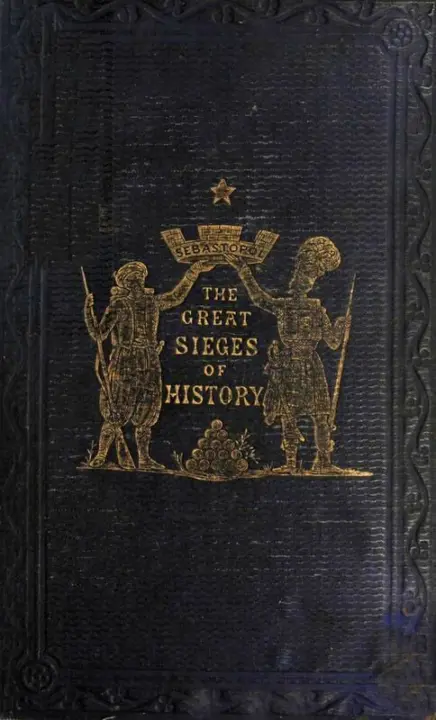
THE CLASSIC COLLECTION · 1856
"The Great Sieges of History" by William Robson is a historical account written in the mid-19th century. This work explores significant sieges throughout history, delving into the circumstances, strategies, and human experiences associated with these protracted conflicts. The author appears to aim at illustrating the lessons of military conduct and the human spirit in times of siege and hardship. The opening portion introduces the book's thesis, stating that sieges present a unique context wherein human virtues such as courage, endurance, and fidelity are tested to their limits. Robson reflects on historical conflicts, emphasizing the drama of desperation experienced by both the besieged and the attackers. His discussion highlights that while technology and strategy have evolved, the core essence of human struggle during sieges remains constant. The early examples presented set the stage for a journey through notable sieges, demonstrating how these events serve as key moments in the broader narrative of human history.
Introduction adapted from the source catalogue; source summaries may be automatically generated.
Free to read · English · 241,016 words · No account needed
MAKE TIME FOR A GOOD BOOK
On by default. Untick to stop anonymous reading totals. Each page counts after 10 seconds in view. How this works.
Anonymous counting is on unless you have switched it off.
Buonaparte, imitating Alexander, with a view of clearing a passage from Egypt to the possession of India, embarked with a large force, and after having treacherously obtained Malta, appeared off Alexandria. It is rather a singular circumstance, that more than a century before this expedition took place, Leibnitz, a German philosopher, addressed a long and interesting document to Louis XIV., pointing out to him the great advantages that would result to France from the conquest of Egypt. This document was still in existence, and it is believed that it assisted in inducing Buonaparte to leave his European conquests and achieve something extraordinary in the East. His career in Egypt was successful, and, among other places, he took Alexandria, our present subject; but there was nothing in the details of the short siege of it interesting enough to stop us. Nelson’s defeat of his fleet, and his check by Sir Sidney Smith, at Acre, sent the great conqueror of the age back again to his country, with a far smaller crop of laurels than he had anticipated.
Albinus, a Roman general, revolted against the emperor Severus, and encamped his rebel troops near Lyons. The emperor marched against him, and the battle commenced the instant the armies came in sight of each other. The conflict was terrible, but Albinus was conquered, and forced to take refuge in Lyons. The conquerors followed him thither, and plundered and ravaged the city. Albinus, finding all was lost, plunged his sword into his own body; but as he was not dead when the adverse party took Lyons, they enjoyed the savage satisfaction of cutting off the head of a man who could not have lived an hour.
The majority of the Lyonnais had witnessed the revolution of the 10th of August with great regret. Devoted to commerce and the arts, Lyons must necessarily have preferred a stable and tranquil government to the storms of a revolution. Political agitations, the emigration of the nobles, the proscriptions of the rich, were at every instant drying up the springs of its commerce, paralyzing its industry, and deteriorating the products of its manufactures. When private interests were thus injured, it could not be expected that the Lyonnais should feel much revolutionary ardour; they were certain to follow the ideas of the most moderate party. The Convention was recognised, the Republic proclaimed; but the rich trembled at the opening of the clubs; they were terrified at seeing municipal powers pass into the hands of proletaires; their minds revolted at hearing propositions for murder and carnage, the reward of their generosity in paying a loan of many millions. Their horror for the men who oppressed them was soon displaced by a desire for vengeance. Two parties declared themselves in Lyons: that of the Municipals, supported by the Montagne; and that of the Sections, composed of pure republicans and disguised royalists. Both sides assembled, and both spoke of preparations for defence and of measures for attack. Each party designated its enemies, watched its partisans, exaggerated its injuries and causes of alarm; minds were heated, and hearts divided. People became accustomed to consider as irreconcilable enemies all who did not embrace the opinions of the party they had espoused. The storm, which had been growling for a length of time, burst forth on the 29th of May, 1793. Two commissioners from the Convention were sitting with Châlier at the municipality; they had made a place of arms of it. On their side, the Sectionaries had gathered together all their columns. There were three attempts at accommodation, but they all failed through the perfidy of Châlier. A battalion of the Lyonnais approached the municipality, sent for under the pretence of conciliation. The signal for carnage was given; Châlier ordered a discharge of artillery and musketry. The unfortunate Lyonnais were obliged to abandon the bodies of their friends; the whole city was in arms. Two columns left the Place de Bellecourt, and besieged the Hôtel de Ville, defended by eighteen hundred men and two pieces of cannon; the besiegers did not amount to two thousand. The combat lasted two hours; the Hôtel de Ville was carried. The Lyonnais had in their power the men who appeared to have meditated their ruin. There was still more carnage after the victory; the soldiers were obliged to defend their prisoners against the fury of the people. Among them were the two commissioners from the Convention; but liberty was soon restored to them, on condition of their giving an honest account of the provocations which had brought on the combat. These representatives, four days after, notwithstanding a favourable account had been given, described the Lyonnais to the Convention as rebels, and demanded vengeance for the national representation having been unacknowledged, degraded, and insulted in their persons. In the mean time, the Lyonnais had chosen fresh magistrates, and these had created a commission to try the prisoners made in the contest on the 29th of May. Châlier was condemned to death; the rest were spared, and kept as hostages. The Lyonnais endeavoured at this moment to prove their love for their country, by concurring with all their power for the defence of the frontiers. Kellermann, the general of the army of the Alps, demanded of this city some pieces of artillery and articles of provisions. Although threatened with a siege, the Lyonnais were moved by the wants of the very soldiers who were soon to be employed against them. Kellermann was so affected by such kindness, that he became their constant intercessor, but one that was never listened to. Two untoward events then happened which accelerated the misfortunes of the Lyonnais. The moderate party had been crushed in the Convention by the 31st of May. Marseilles sent an army to the succour of Lyons, on the very day when treachery, conducted with great art, had given Toulon up to the English. It was feared, for a moment, that the whole south of France would detach itself from the north, and that Lyons would make common cause with Marseilles and Toulon, and all give themselves up to foreigners. Kellermann despatched Carteau against the Marseillais, with a body of troops very inferior in numbers to theirs, but which was to be recruited en route, with the national guards and the volunteers of the country. Carteau followed the left bank of the Rhône, secured the bridge of St. Esprit and Avignon, met the Marseillais army at Salon, and afterwards at Septêmes, where he entirely defeated them. The succours expected from the south by the Lyonnais were thus annihilated. Lyons made some efforts at conciliation; a deputy replied to them in these words: “Rebels, confess your crime, open your gates, show yourselves obedient, be disarmed, and prove yourselves, by your repentance, worthy of the clemency of the Convention.” The Lyonnais had no faith in this clemency, and could not avert the storm: the siege was resolved upon. Kellermann, then called from the army of the Alps, brought, with much regret, the greater part of it to act against the second city of France. The rivalry and jealousy of the neighbouring cities, with the obedience of the country to the orders of the Convention, soon augmented this army; sixty thousand men surrounded Lyons, of which fifteen thousand were disciplined troops. The besiegers received a hundred pieces of cannon, which were served by skilful gunners. Kellermann, according to the system of the time, had with him two commissioners from the Convention, Dubois-Crancé and Gauthier. During civil troubles, party animosities are more ardent in councils than in camps; the rigour of political principles there yields more easily to the generous sentiments which a military life establishes reciprocally between soldier and soldier. Kellermann endeavoured for a long time to bend the inflexibility of the commissioners; he could not succeed. In the mean time, the Lyonnais never ceased to express their devotion to the National Convention; they accepted the constitution of 1793 in primary assemblies, they celebrated the anniversary of the 10th of August, burnt all feudal titles, and invited Kellermann to be present at that fête. They kept up with him a regular correspondence, although they refused to hold any with the Conventional commissioners; they sought to reunite themselves with the neighbouring departments; but terror had combined all the inhabitants against them. At length, on receiving the last propositions of the Conventional deputies, which were equivalent to surrendering themselves at discretion, they replied: “Citizens, representatives of the people, your propositions are still more atrocious than your conduct; we await you; you will not reach us but over heaps of slain, or the cause of liberty and the republic will triumph.” From that time all hope of accommodation vanished; the parties prepared for attack and defence. Warlike enthusiasm fired every heart in Lyons; the young man who would not have devoted himself to all the dangers of the good cause, would have been expelled from his family as well as from the city. Women appeared upon the breach; a public military chest was formed. The insufficiency of the current coin was covered by the notes of the principal merchants; a considerable quantity of provisions of all kinds was brought in, at great expense, but by no means abundant enough for so immense a population. Lyons, situated at the confluence of the Saône and the Rhône, is dominated on the north by the heights which cover a part of its faubourgs; an engineer named Chennelette traced a plan for redoubts over all this front: they were erected with astonishing celerity. The houses were embattlemented, batteries were built, artillery was cast, powder was manufactured; everything denoted a determination for a vigorous resistance. All who held in Lyons either administrative or military posts, knew that there existed no capitulation for them; and they prepared for defence to the death.
Your reading position is saved on this browser. Take it to another device with a library code. Reading pages adapt to text, rather than matching a printed edition.
BEHIND THE BOOK
This eBook is for the use of anyone anywhere in the United States and most other parts of the world at no cost and with almost no restrictions whatsoever. You may copy it, give it away or re-use it under the terms of the Project Gutenberg License included with this eBook or online at www.gutenberg.org. If you are not located in the United States, you will have to check the laws of the country where you are located before using this eBook. Read the source licence.
The original source file, including credits and licence, is retained by this library. Request an original-format copy at no charge. Please include the book title and Project Gutenberg identifier #59093.
KEEP YOUR CURIOSITY GOING
Cécile Tormay

Moritz Busch
John L. Ransom
Frances Wright
Cécile Tormay

Mabel Potter Daggett