THE CLASSIC COLLECTION✦An outlaw’s diary: the CommuneCLASSIC FREE BOOKS
An outlaw’s diary: the Commune
Cécile Tormay
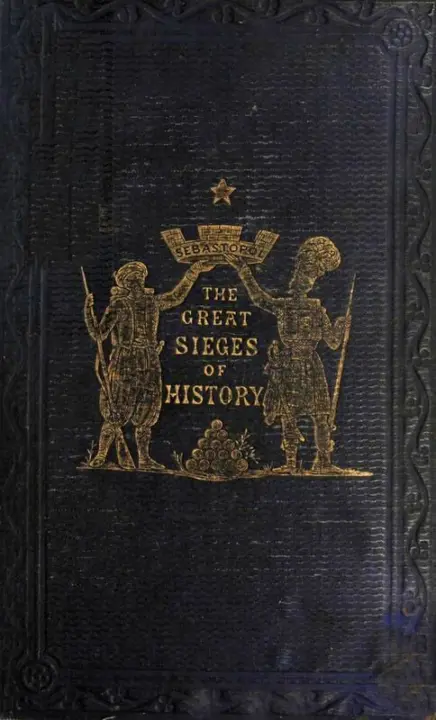
THE CLASSIC COLLECTION · 1856
"The Great Sieges of History" by William Robson is a historical account written in the mid-19th century. This work explores significant sieges throughout history, delving into the circumstances, strategies, and human experiences associated with these protracted conflicts. The author appears to aim at illustrating the lessons of military conduct and the human spirit in times of siege and hardship. The opening portion introduces the book's thesis, stating that sieges present a unique context wherein human virtues such as courage, endurance, and fidelity are tested to their limits. Robson reflects on historical conflicts, emphasizing the drama of desperation experienced by both the besieged and the attackers. His discussion highlights that while technology and strategy have evolved, the core essence of human struggle during sieges remains constant. The early examples presented set the stage for a journey through notable sieges, demonstrating how these events serve as key moments in the broader narrative of human history.
Introduction adapted from the source catalogue; source summaries may be automatically generated.
Free to read · English · 241,016 words · No account needed
MAKE TIME FOR A GOOD BOOK
On by default. Untick to stop anonymous reading totals. Each page counts after 10 seconds in view. How this works.
Anonymous counting is on unless you have switched it off.
There are other wonders connected with this event, about which we can only say that great historians have related them. For our own parts, we are not so sceptical regarding the remote events of history as some readers and authors are. We see, constantly, matters that must some day belong to history, put in as false a light by the passions and interests of contemporaries, as if they were viewed through the mist of past ages. Again, that which is wonderful is not necessarily untrue. When Marco Paolo returned from his long pilgrimage, his accounts were all received as fables; now, almost all of them prove to be bare truth. We shall never reject a story told by a respectable historian, on account of its being a little miraculous, provided it be amusing, instructive, and elevating, and at the same time a thing with which well-educated youth ought to be acquainted.
The only son Crœsus had living was dumb. This young prince, seeing a soldier about to cut down the king, whom he did not know, with his scimitar, made such a violent effort to save his father’s life, that he broke the string which had confined his tongue, and cried out,--“Soldier! spare the life of Crœsus!”
The account of Cyrus’s conversation, given above, is from Xenophon’s Cyropædia; the following, which greatly differs from the circumstances attending it, is from Herodotus.--How are we to choose? The Cyropædia is by some writers looked upon as little more than a romance; and Herodotus abounds in apocryphal stories.
Crœsus being a prisoner, was condemned by the conqueror to be burnt alive. Accordingly, the funeral pile was prepared, and the unhappy prince, having been laid thereon, and on the point of execution, recollecting the conversation he had formerly had with Solon, was wofully convinced of the truth of that philosopher’s admonition, and in remembrance thereof, cried out three times,--“Solon! Solon! Solon!” Cyrus, who with his court was present, was curious to know why Crœsus pronounced the name of that philosopher with so much vehemence in his extremity. “Mighty king,” replied Crœsus, “when Solon in search of wisdom visited my court, I tried every means to dazzle him, and impress upon him the immense extent of my wealth. When I had displayed it all before him, I asked which man in all his travels he had found the most truly happy, expecting, after what he had seen, he would name me. But he replied, ‘One Tellus, a citizen of Athens, a very honest and good man, who, after having lived all his days without indigence, having always seen his country in a flourishing condition, has left children who are universally esteemed, has had the satisfaction of seeing those children’s children, and at last died gloriously in fighting for his country.’ I was surprised to find that my gold and silver had so little weight; but, supposing I at least might claim the next rank, I asked him, ‘Who of all he had seen was most happy after Tellus?’ Solon replied,--‘Cleobis and Biton, two brothers, of Argos, who had left behind them a perfect pattern of fraternal affection, and of the respect due from children to parents. Upon a solemn festival, when their mother, a priestess of Juno, was to go to the temple, the oxen that were to have drawn her not being ready, the two sons put themselves into the yoke and drew their mother’s chariot thither, a distance of five miles. The mothers of the place, ravished with admiration, congratulated the priestess upon having such sons. She, in the transports of her joy and thankfulness, earnestly entreated the goddess to reward her children with the best thing Heaven can bestow. Her prayers were heard. When the sacrifice was over, her two sons fell asleep in the temple, and there died in a soft and sweet slumber. In honour of their piety, the people of Argos consecrated statues to them in the temple of Delphi.’ ‘What then,’ said I, in a tone of discontent, ‘you do not reckon me amongst the happy at all?’ Solon replied, calmly: ‘King of Lydia, the gods have given us Grecians a spirit of moderation and reserve, which has produced amongst us a plain, popular kind of philosophy, accompanied with a certain generous freedom, void of pride or ostentation, and therefore not well suited to the courts of kings. This philosophy, considering what an infinite number of vicissitudes and accidents the life of man is liable to, does not allow us to glory either in any prosperity we enjoy ourselves, or to admire happiness in others, which perhaps may prove only transient or superficial. The life of man seldom exceeds seventy years, which make up in all six thousand two hundred and fifty days, of which no two are exactly alike; so that the time to come is nothing but a series of various accidents which cannot be foreseen. Therefore, in our opinion, no man can be esteemed happy but he whose happiness the gods continue to the end of his life; as for others, who are perpetually exposed to a thousand dangers, we account their happiness as uncertain as the crown is to a person engaged in battle who has not yet won the victory.’”
Your reading position is saved on this browser. Take it to another device with a library code. Reading pages adapt to text, rather than matching a printed edition.
BEHIND THE BOOK
This eBook is for the use of anyone anywhere in the United States and most other parts of the world at no cost and with almost no restrictions whatsoever. You may copy it, give it away or re-use it under the terms of the Project Gutenberg License included with this eBook or online at www.gutenberg.org. If you are not located in the United States, you will have to check the laws of the country where you are located before using this eBook. Read the source licence.
The original source file, including credits and licence, is retained by this library. Request an original-format copy at no charge. Please include the book title and Project Gutenberg identifier #59093.
KEEP YOUR CURIOSITY GOING
Cécile Tormay

Moritz Busch
John L. Ransom
Frances Wright
Cécile Tormay

Mabel Potter Daggett